
International SEO: how to position your website in other countries and languages
Summary (TL;DR)
In this post we will talk about the strategies of International SEO and how they go far beyond the simple translation of content. We will explore how to adapt a website to different languages, searchers and cultural realities is essential to reach new audiences.
We will also address topics such as: target audience definition, ideal technical structure (subdomains, subdirectories or separate domains), correct use of the tag hreflang, location of the content and care with translation.
We will also show good technical SEO practices, the importance of international link building, region monitoring tools and common errors that should be avoided, such as relying only on automatic translators or ignoring cultural particularities.
And to conclude, we will show that international SEO is an excellent opportunity to extend the reach of your brand, as long as planned with depth, technical precision and local sensitivity.

Quick answer: International SEO is preparing the site to appear in searches of other countries and languages. Steps: choose countries by real demand, define the structure (subdirectory as site.com/fr/, subdomain or local domain), mark each version with hreflang, locate content and keywords instead of just translating, consider local searchers (such as Baidu and Navir) and track performance by country.
The digital presence of companies has crossed borders, and with it the challenges of being found in different languages and cultures. Although many entrepreneurs think it is enough to translate the content, the International SEO requires deeper strategies.
Organic search continues as one of the main sources of traffic on sites, also outside Brazil.
If you want to expand your business globally, you need more than an English or Spanish version of your website. It is necessary to adapt language, search terms, technical structure and even the server of Accommodation to ensure that your brand appears in the research of the target countries.
In this content, we will show how to do this strategically and efficiently.
What is international SEO?
International SEO is the set of practices that helps a website to be found by users in other countries or languages. Different from Local SEO, which focuses on optimizing pages for a specific region (such as a city or state), international SEO deals with multiple locations, cultural habits and different ways to search for products or services.
Although the Google it remains the dominant search engine globally, it is important to understand that in some regions it divides space with local seekers. For example, the Yandex It is widely used in Russia, the Baidu leads in China and the Browse is popular in South Korea. Each of them has different technical particularities and ranking criteria, which makes planning even more crucial.
In addition to language, theocalization of content makes all the difference. . This includes using regional language variations (such as British vs. American), adjusting cultural references, adapting calls to action and ensuring that dates, coins and units are in line with the target country.
More than translating, you need to locate the content to actually connect with the audience. So, shall we get started?
1. Choice of the target audience and countries that you want to reach
Before any practical action, the first step of international SEO is to understand where your brand wants to go. . International market research helps to identify which countries have a greater affinity for their product or service.
It is important to evaluate trends in consumption, digital behavior and cultural preferences. Tools like Google Trends, Semrush and reports from Statist are great allies in this process.
After the initial analysis, it's time to investigate real demand in target countries. Ask these questions:
- Is there a volume of searches for your key terms?
- Are there any local competitors already well positioned?
- What's the competitive advantage of your brand in this new territory?
This evaluation prevents you from investing in unreturned regions and helps to plan a more strategic entry.
Another essential point is: consider both the language and geographical location. . It is not enough to translate into “Spanish”, for example, Spanish spoken in Mexico is different from that of Argentina or Spain. The correct segmentation allows you to customize the content more accurately, increasing the relevance in search and connection with the local audience.
2. Ideal structure for multilingual and multi-country websites
For international SEO to work well, site architecture needs to be prepared to handle multiple languages and regions. There are three main formats for this: subdomains, subdirectories and separate domains. . The choice between them depends on the objective of the project, the technical capacity of the team and the investment available.
The subdomain format creates a separate version of the site, such as fr.site.com, which can be useful for teams and well segmented content. The subdirectories, as site.com/fr/, are simpler to maintain and usually take better advantage of the authority of the main domain. Finally, separate domains such as site.fr, are ideal for strategies of strong local presence, but require greater technical and budgetary effort.
Each model has its advantages and challenges. Subdomains offer flexibility, but may not inherit all SEO strength from the main domain. Subdirectories are efficient in terms of authority and maintenance, but limit customisation by country. Local domains, on the other hand, give more confidence to users, but demand more management and link building specific to each of you.
In short, the pros and cons are:
| Structure | Pros | Cons |
| Subdomain | Clear separation by country/language; technical flexibility | You may not inherit authority from the main domain |
| Subdirectory | Take advantage of domain authority; easy to maintain | Less local customisation |
| Separate domain | Local user confidence; greater autonomy | Higher cost and SEO effort separated by country |

3. Implementation of the hreflang tag (essential)
The tag hreflang is one of the most important elements in international SEO. It informs search engines which version of the content should be displayed for each language or country, helping to drive traffic correctly.
With this tag, Google understands, for example, that site.com/en It's for the US public, while site.com/en-gb It's back to the UK.
The correct application is made on the <head> of each page or via sitemap, pointing the alternative versions of the same URL. An example of use would be:
<link rel=”alternate” hreflang=”en” href=”https://www.site.com/en/” />
<link rel=“alternate” hreflang=”en-br” href=”https://www.site.com/en-br/” />
This care prevents pages from being seen as duplicates, and ensures that the right content is displayed to the right user.
Ignoring this implementation can cause serious indexing problems. . Without hreflang, Google can show the content in Portuguese to a user in Germany or confuse variations of English.
This directly impacts on user experience and site rejection rate. . Therefore, correctly applying the hreflang tag is a mandatory step in any international SEO strategy.
4. Translation and localization of content (it's not just translating!)
When we talk about international SEO, translate content literally It's not enough.. . It is essential to adapt cultural terms, expressions and references according to the target country.
An example: the term “apartment” in Portuguese vira “apartment” in the United States, but it's “flat” in the UK, and that changes all search intentions. This location ensures that the content sounds natural and relevant to the local user.
Also, it is essential to use keywords that really make sense for the language and region. . Tools like the Ubersuggest allow checking if the terms have actual search volume in each country. This avoids waste of effort in words that seem right, but are not popular locally.
Another critical point: avoid using automatic translations as much as possible. . They may even break the branch, but they don't transmit naturality or trust. Invest in native translators or writers fluent in the language and culture of destination.
The content needs to look like it was created for that audience, and not just translated in haste.
5. Technical SEO for international projects
So that yours e-commerce International performs well, it is necessary attention to technical details. . A loading speed in different regions it is fundamental for the user experience and also impacts ranking. A website that carries well in Brazil can take a long time in Europe, if the structure is not optimised.
In this sense, a good practice is to use CDN (Content Delivery Network), which distributes the content of the site to servers around the world, reducing response time in any country. It's also worth considering separate sitemaps by language or country, which facilitates the indexation Right by the searchers.
The redirection IP should be used with caution. Although it seems useful to direct the visitor to a local version automatically, this can cause indexing problems and frustration to the user who wants to access another language. The ideal is to offer the language exchange option on the site itself, in a clear and accessible way.
6. International Link Building and Domain Authority
Conquer backlinks relevant websites in the destination country is one of the biggest differentials for international SEO. Google values local signs of authority, then, being in portals, blogs or regional directories greatly strengthens its presence in that market.
For example: a link coming from a blog Reliable French has more weight for Google.fr than a generic link in English.
On the other hand, it is important to avoid backlinks from sites in different languages or outside the context of the target region. They do not contribute to the desired international authority and, in excess, may even harm ranking. Quality and relevance matter more than quantity in this scenario.
A good strategy is to invest in guest posts in international websites, participate in digital PR actions with local influencers and seek partnerships with specialised content portals. These actions help not only generate backlinks, but also build reputation in new audiences.
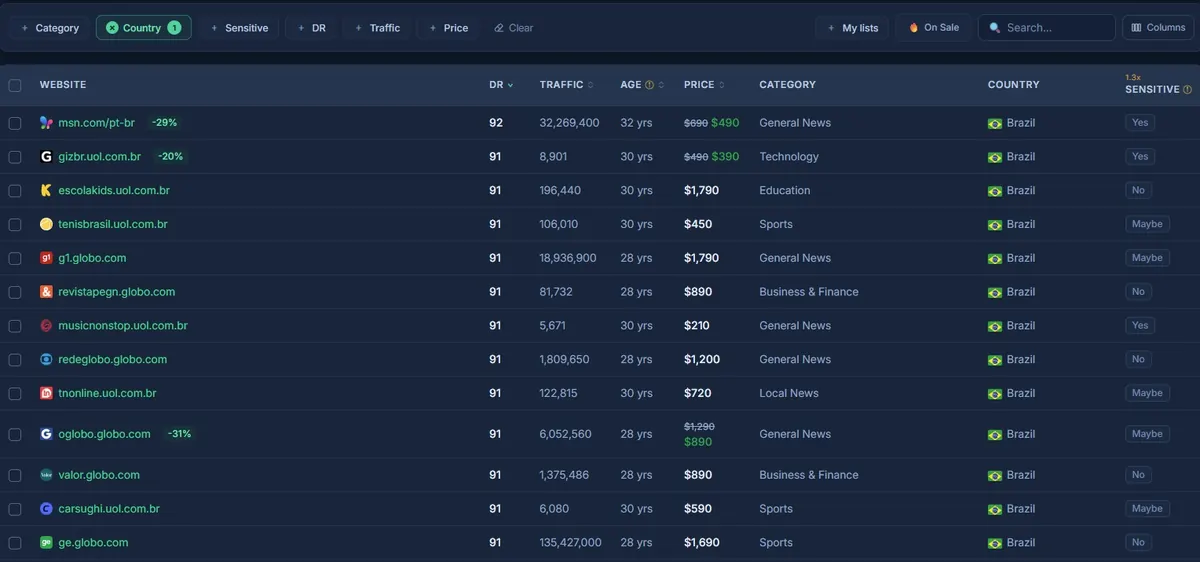
For this market survey, the BlaaS allows filtering publishers by country, category, DR, traffic and price, which makes it easy to assemble specific lists for each region before the outreach.
7. Monitoring and metrics specific to international SEO
Doing international SEO without following the right data is walking in the dark. One of the first actions should be correctly configure segments by country and language in Google Analytics, to understand the behavior of users in each region and customize improvements according to each audience.
Tools like AhrefsSEMrush and Google Search Console allow to configure regional segmentations, following the performance in local domains, subdomains and even language variations. So, you can do it. know exactly where you are ranking well and where you need to improve.
To follow the results in local SERPs more accurately, the ideal is use VPN or tools with location simulation (such as the SERPWatcher). This avoids distortion caused by searches made from Brazil, for example, to know ranking in another country. The location of the analysis needs to reflect the reality of the end user.
Common errors in international SEO
Expanding digital presence to other countries is a great opportunity, but many businesses stumble on basic failures while trying to execute international SEO. . Technical or cultural errors can compromise the entire strategy, impacting ranking and even brand reputation in foreign markets.
Next, we list the most common slippages that should be avoided. See what they are and how to avoid them:
Use automatic translators only
That's one of the most frequent mistakes. Automatic translators do not capture cultural nuances, contexts or search intentions. The result is texts with strange, unnatural phrases that drive away the user. . In addition, grammatical errors compromise the credibility of the site. Always prefer human translators or fluent writers in the local language.
Ignore hreflang tag
The tag hreflang informs the searchers which version of the content should be displayed for each language and region. Ignore this tag can cause cannibalization of keywords, displaying wrong pages in the results and falling rank. Implementing this tag correctly is essential to directing the right content to the right audience.
Do not adapt content to local culture
What works well in Brazil It may not make sense in another country. . Simple example: commemorative dates, greeting forms and even consumption habits vary. Relevant content needs to respect these cultural differences. Adapting messages to local reality shows empathy and improves connection with the public.
Try ranking for all countries with the same generic content
Another common error is to create a single text in English and try to use it for several countries. . This dilutes the relevance of content and reduces the impact on searchers. The ideal is to produce specific versions, with keywords, references and language adapted to each target country. The more segmented, the greater the chance to rank well.
Is it worth investing in international SEO?
International SEO is one of the most effective ways to expand your brand globallyBut it's not just a matter of translation. It is a strategy that requires technical attention, cultural adaptation and detailed planning to actually work.
If your company wants to reach new markets with intelligence and structure, talk to WebSyd team. . Our team specializing in SEO consulting can set up a tailor-made strategy for the countries you want to achieve. Ask for an estimate from the button below.
FREQUENTLY ASKED QUESTIONS
What is international SEO and why is it important?
International SEO is a set of strategies aimed at optimizing a website and making it visible in search engines from different countries or languages. It is essential for companies wishing to expand their digital presence globally, attract qualified traffic from other markets and increase the chances of conversion into specific regions.
Is translating my website into another language enough to rank in other countries?
Nope. Translation is just a step. To rank well in other countries, it is necessary locate the content, i.e. adapting keywords, language, action calls, date formats, currency and cultural references. In addition, it is necessary to properly configure the technical structure and use tags such as the hreflang.
How to choose between subdomain, subdirectory or separate domain for international SEO?
The choice depends on the objective and structure of the company. Subdirectories are easy to maintain and leverage the authority of the main domain. Subdomains allow for more segmentation, but may have lower transfer of authority. Separate domains pass more local trust, but require more regional management and link building.
What is the tag hreflang and why is it essential?
The tag hreflang informs search engines which version of the content should be displayed for each language or country. It prevents Google from showing the user a wrong page, improves the experience and reduces the risk of duplicate content. It's a critical step towards correctly directing international traffic.
How do I know if there is demand in the country where I want to expand my website?
Tools like Google Trends, SEMrush, Ahrefs and Ubersuggest help identify the volume of search for specific keywords in different countries. It is also important to analyze local competition, digital behavior and cultural trends to validate market potential before investing.
What are the most common errors in international SEO?
Among the most frequent errors are: use only automatic translators, do not configure the tag hreflang, ignore cultural differences, try to rank with the same content for all countries and neglect local backlinks. These errors impair the ranking and relevance of the site in international markets.

Caio Nogueira is a SEO, GEO, link building and Digital PR expert and co-founder of WebSyd, website creation agency and SEO consulting founded in 2016. It acts with organic search strategies, digital authority construction and brand optimisation for search engines and artificial intelligence platforms. Throughout his trajectory, he participated in more than 1000 projects involving SEO, website development, content marketing and authority acquisition through backlinks and Digital PR. At WebSyd, it participates in the planning of strategies to increase organic visibility, lead generation and presence of companies on Google and AI-based search engines. As an author, it publishes content on SEO, GEO, website creation, link building and digital authority, sharing analyses, strategies and practical experiences related to organic growth of companies. Its contents and contributions have also been published in companies and vehicles of technology and marketing such as Wix, HostGator, Duda, Neil Patel, Locaweb and E-Commerce Brasil.
View all posts


 Estimate the cost

