
Local SEO: How to position site in regional search in 2026?
Summary (TL;DR)
Local SEO is a site optimisation strategy that focuses on improving the ranking of a business in geolocalized searches. In addition to the optimisation tools for traditional search engines, it is based on specific factors that influence the site's positioning.
In this content, you understand what local SEO is, how it works, and what strategies you can adopt to optimise your site in Google's local search.

Imagine this scene: you travel to a new city and want to find a good place to eat pizza. Or, on the road, your car breaks down and you need a mechanic. In both cases, the first thing you do is search the internet for the nearest place.
Google uses a specific tool to help with this: Local SEO. It allows users to find close business with ease.
Local SEO is the job to appear in searches with regional intent, as “dentist near me”, on Google’s map and results. According to Google, local results depend on three factors: relevance, distance and prominence.
What is local SEO?
Local SEO is an optimisation for search engines that improves the visibility of a business for searches carried out in a specific geographical area.
In general, Google understands how localized search searches use terms such as “near me” or name of a specific place (e.g. “Art therapy in the Viana Granja”). Thus, for regional searches, the mechanism immediately interprets that this is a geolocalized search and presents options within that region.
However, the localized results may also appear according to the search intention of certain keywords. Note:
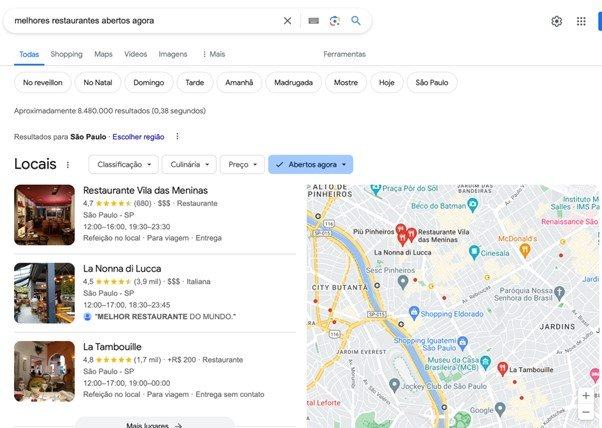
In the research above, it was not necessary to specify the region: by the way the question was asked, Google's search engine already understands that it can present the best results near where I am, using my location in real time. . And to define which results are these, it is based on local SEO.
What's the difference between local SEO and SEO?
The main difference between site optimisation (SEO general) for local SEO is in use by Google of specific tools that affect ranking.
Although, in general, the main SEO strategies also important when we talk about localized searches, there are particularities in this second type of research. Here are some:
- The presence of a map for the location, which guides the user to understand how close she is to a particular establishment;
- The use of user reviews, who help the user to understand what other people's experience was like in a certain place;
- The presence of details about the establishment, as average price, average service time, besides the possibility of finding images made by other people and information such as menu, services available etc.
Why is local SEO important?
The main function of local SEO is to get your business found by different people, who may never have heard of it before. In this sense, this is an important tool for those who want to attract new customers and stand out in the face of competition.
Although e-commerce and online sales are gaining more and more space in consumers' lives, “Presential” business has not lost its importance. . Also, depending on your type of company, a good optimisation for local SEO may be the difference between a customer choosing your business or a competitor. So it's worth starting with a site thought for your segment, with well-organized local information.
Think, for example, of a person who needs a mechanic because he faces an unexpected problem on the road. If your site is optimised for local SEO, it can find you; if it isn't, you will definitely find someone else.
Do you need to improve SEO on your site, and receive more qualified accesses?
Click on the button below and ask for a quick quote for our SEO consulting.
How does local SEO work?
Other than site optimisation strategies traditional, local SEO has three main factors that help your ranking. They are:
- The relevance of your business for that search, i.e. how related to the user's research is your business. If you have one site for restaurant Italian, for example, is more likely to appear for those who search for “pizza” or “mass” than for those looking for “sushi”.
- The distance from your business to the user. In general, closer business usually ranks better, as it requires less effort from the user.
- The highlight that your business receives, i.e. how different it is from its competitors, whether from a good number of positive evaluations, or because its digital presence is consolidated.
This means that for those who wish to rank using local SEO, extra care is needed when optimizing the site.
How to optimise my site for local SEO?
Stop optimise a site for local SEO, it is not enough to follow the “traditional” optimisation rules for search engines. Below, you give the main care you should take to ensure a better ranking for your website. Check it out!
1. Find the right keywords
Local keywords are the terms that the customer uses to find his/her business type in your region, such as the service plus the neighborhood or the city. If they're well used on the site and profile, it finds you.
But remember to also focus on related and secondary words, long tails.
After choosing the terms, use them where Google and the user look first: in the title tag and meta description (e.g. “Italian Restaurant in São Paulo” or “Divorce Lawyer in Porto Alegre”), in the headers (H1, H2 and H3) and, when it makes sense, in the page URL. Include the name of the city, neighborhood or region next to the terms of your business, always naturally.
2. Have a contact page
For Google (and the user, of course) to understand where you are and who you are, it is essential to have a clear and well-built contact page. In it, you should include the address of your store and all relevant information to be “found”.
If you have more than one store, it’s worth thinking about strategies like the pages “find the [shop] closest to you!”.
3. Optimize your mobile site
In Brazil, mobile phone is the means of access to the internet of 98.8% of those who use the network, according to the Continuous PNAD ICT 2024 of IBGE (Agency Brazil). In addition, Google indexes the pages by mobile version. Therefore, the site needs to work well on the mobile phone, with a clickable telephone and address.
4. Use structured location data
The use of structured location data (SCHEMA) are indispensable for those who want to rank with local SEO. After all, through them Google can have more information about your business and make it available to future customers.
For the format, follow Google's documentation on structured data from local enterprise. . This information also helps AI understand your business. See if your company shows up at ChatGPT and Gemini.
5. Have an optimised profile on Google Business
The Optimized profile on Google Business It is also important for those who wish to have a good ranking. Through it, Google has all the information you need to present your site in a localized search. . But be careful: make sure that all the data is filled in the right way!
In addition to the basic data (name, address, telephone, working hours and category), some care helps the profile stand out:
- Business description: describe what the company does using local keywords that customers would use to find their products or services;
- Quality photos: publish photos of the property, products and services. They increase engagement with the profile and help show what makes the business unique;
- Posts and updates: use the profile publications to disseminate news, special offers or events. This keeps the profile active and shows customers what's going on in the business.
6. Focus on reviews
The evaluations are part of the highlighted factor. Ask for an evaluation of real customers immediately after the service and respond to all, including negative ones. Do not offer discount or toast in return: Google policies prohibit encouraged assessments, which can be removed.
7. Produce relevant content
Finally, for those who really want to rank with local SEO, it is worth building a digital presence of greater authority. . To do so, investing in the production of relevant content is essential. So consider having a blog about the relevant topics of your business and ranking organically for other keywords associated with your service or product.
Do you need to improve SEO on your site, and receive more qualified accesses?
Click the button below and ask for a quick quote for our SEO consulting.
Advanced Local SEO Strategies
Stop improve the optimisation of your website and stand out even more in local search results, it is essential to implement advanced local SEO strategies.
Here are some of the best practices, examples and tips based on effective techniques:
Google Map Pack:
- How It Works: Map Pack displays the three best local results along with a map of Google Maps. To appear in Map Pack, you need to optimise your profile in Google Company Profile.
- Tracking Rankings: Use tools like Location Falcon to follow your Map Pack rankings in different areas of the city. This helps to understand where you are stronger and where you need to improve.
NAP Consistent Quotes:
- What They Are: Nap (Name, Address and Phone) should be consistent at all sites online, including your website, Google Company Profile and local directories. Tools like Whitespark help audit and correct inconsistencies.
- Importance: Nap Quotes help Google confirm the authenticity and location of your business by improving ranking.
Online Reviews:
- Review Collection: Encourage your customers to leave positive reviews on Google and other relevant websites. Respond to all assessments, whether positive or negative, showing that you value feedback.
- ImpactReviews are one of the most important factors for local SEO, influencing consumer confidence and visibility in your business.
Local Backlinks:
- Local Partnerships: Build relationships with other local companies to get links from relevant websites. This includes distributors, suppliers and business partners.
- Examples: Participating in local events and getting links from local sponsors or chambers of commerce sites can be highly beneficial.
Regional Content:
- Location Pages: Create specific pages for each location where your company operates, using local keywords and relevant information.
- Example: A service company can have pages for “canker in [city]” and “electrician in [city]”, each with exclusive content.
Schema Markup:
- Implementation of Schema: Use structured data to mark your address, phone number and other important details on your website. Although Google already uses this information from the Google Business Profile, schema marketup can provide additional data that helps optimise.
- Benefits: Rich snippets with rating stars or operating times can increase the rate of clicks in search results.
Competition analysis:
- & Tools: Use tools like Semrush Backlink Gap to identify where your competitors are getting quotes and backlinks. This may reveal new opportunities to strengthen your local presence.
Local SEO Actions and Examples
A local restaurant can benefit enormously from these strategies. Here is an example of implementation:
- Optimization of the Company Profile on Google: Make sure that all information is up-to-date and accurate, including working hours and attractive photos.
- Collect and Respond Reviews: Encourage detailed reviews and respond to all, showing customer attention.
- Create Localized Content: Have pages on the site for different locations, such as “best pizza in [bairro]” and “Italian restaurant in [city]”.
- Use Schema Markup: Implement structured data to highlight evaluations and contact information in search results.
Where to start local SEO?
Start with the Company Profile on Google, with complete and similar data to the website, then a contact page with address and phone number and an evaluation request for each customer attended. Then create pages for the services and regions you actually serve.
Implementing advanced strategies, such as optimizing the profile in the Company Profile on Google, collecting positive reviews, consistent use of NAP citations, and creating localized content, can make a significant difference in your business performance in search results. In addition, tools such as Local Falcon and competition analysis techniques can offer valuable insights to refine your approach and ensure that your business is well positioned in all areas of the city.
Apply these strategies and see how your business can become a reference in the region, attracting more customers and increasing your chances of success.
By following these advanced strategies, you can significantly improve your visibility in local searches, attracting more customers and standing out from the competition.
Now that you know the local SEO strategy, take the opportunity to dig deeper into the SEO universe and check out our Guide to creating digital content.
Do you need to improve SEO on your site, and receive more qualified accesses?
Click the button below and ask for a quick quote for our SEO consulting.
FREQUENTLY ASKED QUESTIONS
What is local SEO?
Local SEO refers to a form of optimisation for search engines that focuses on increasing the visibility of a business in research done with a specific location. It uses keywords related to the location, such as “near me” or a specific place name, to show results that are physically close to the user, based on actual or estimated location.
What is the difference between local SEO and general SEO?
While general SEO focuses on optimizing the visibility of a site in broad searches, local SEO is specifically designed to improve rankings in search related to a specific location. This includes the use of maps, user reviews, and specific details of the establishment such as prices and menus to help guide user decision more effectively than general SEO.
Why is it important to optimise a business for local SEO?
Because anyone looking for a job near you is usually ready to buy or go to the place. Appearing on the map and local results puts the company before this client. This applies to business with a physical address and for those who serve a region, as service providers.
How can I optimise my website for local SEO?
To optimise a site for local SEO, it is important to focus on several aspects: finding keywords relevant to the location, having a clear contact page, optimizing the website for mobile devices, using structured location data, maintaining an optimised profile in Google Business, focusing on receiving positive and detailed reviews, and producing relevant content that establishes digital authority and improves organic ranking.

Caio Nogueira is a SEO, GEO, link building and Digital PR expert and co-founder of WebSyd, website creation agency and SEO consulting founded in 2016. It acts with organic search strategies, digital authority construction and brand optimisation for search engines and artificial intelligence platforms. Throughout his trajectory, he participated in more than 1000 projects involving SEO, website development, content marketing and authority acquisition through backlinks and Digital PR. At WebSyd, it participates in the planning of strategies to increase organic visibility, lead generation and presence of companies on Google and AI-based search engines. As an author, it publishes content on SEO, GEO, website creation, link building and digital authority, sharing analyses, strategies and practical experiences related to organic growth of companies. Its contents and contributions have also been published in companies and vehicles of technology and marketing such as Wix, HostGator, Duda, Neil Patel, Locaweb and E-Commerce Brasil.
View all posts


 Estimate the cost

