
Guide to content creation: from planning to performance analysis
Summary (TL;DR)
In this post, we explore the importance of a well-defined strategy for content creation, highlighting how essential it is to the success of marketing campaigns.
We approach from the definition of personas and understanding of the customer's journey to the choice of formats, promotion, optimisation and content analysis.
We emphasize that content creation should be guided by clear objectives and accompanied by a structured process that includes constant evaluation of results to ensure that the content reaches its target audience and generates conversions.

Quick answer: creating content that brings results follows seven steps: defining the persona, mapping the customer's journey, choosing a goal for each piece (recognition, traffic, conversion or links), choosing the format, putting together a sketch with the subtitles, producing and optimizing for SEO, and promoting and measuring. AI tools can speed up research and draft, but Google evaluates whether the content is useful and original, and human review with real experience is what differentiates text.
Content creation begins with generating ideas about what will attract the company's customer base.
To start this process, create a infographic like this, draw a map of content for your brand and follow the reading of this guide to know ways to plan, create, optimise and disseminate content to reach your target audience.
Defining a content creation strategy
Content creation consumes time and resources, which will be wasted if it does not follow a well-defined strategy. Therefore, it is necessary to have a plan and determine goals and KPIs before starting to raise ideas to create relevant content that brings results.
Here's how to create these strategy in five steps.
Persona
Content creation needs to be targeted and directed towards the interests and needs of your company's target audience. This can be achieved more safely by creating several visual personas based on the following criteria:
- Interests
- Motivations
- Pain points
- Solutions that the company can offer
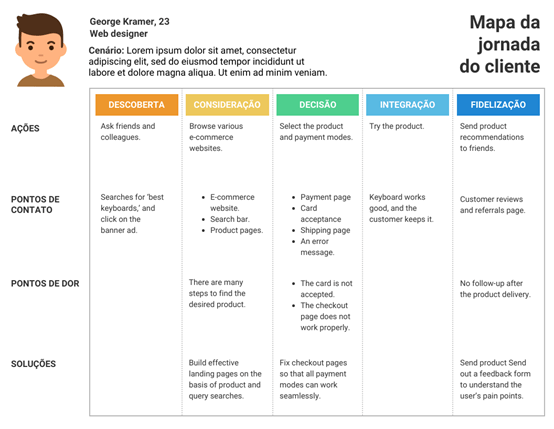
Create visual personas like this representing two or three ideal customers to guide content creation to the various channels that compose your strategy:

A user persona works as a guide to defining not only topics and keywords, but also the tone of voice and channels used in marketing strategy, helping create content that offers solutions, add value and encourages users to travel through the Sales funnel.
Client journey
Understanding the customer's journey goes beyond focusing on the motivations of the public. Brands need to create content that impacts the public wherever it is.
A customer's journey from the discovery phase to becoming brand-friendly and a publicist is long, as shown in the chart below:
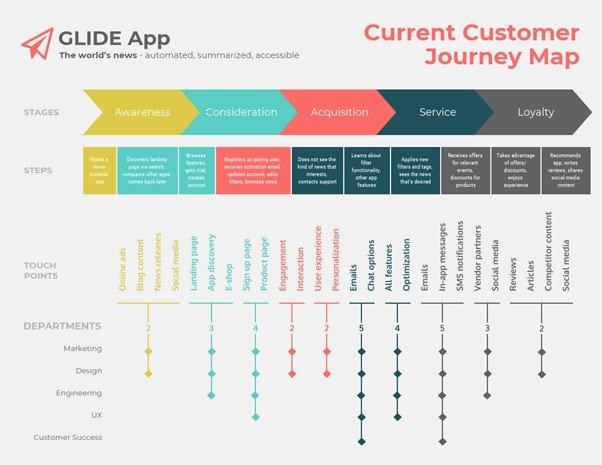
The marketing team needs to be targeted for each different step of the customer journey.
For example, a consumer at the discovery stage may not know what solution he needs. In this case, the content needs to be directed to the solution of your doubt or need, not to the sale itself.
In the consideration phase, it is necessary to offer content position your brand as the best solution, which includes competition analysis and, of course, knowing the pain points of your ideal customer.
Approaching customers at every stage of the sales funnel and making them follow from discovery to loyalty requires different content that should be mapped to target marketing efforts correctly.
Targets for content creation
Understanding who potential customers are and the stages they go through on the journey is just the beginning of the path to create successful content and generate conversions. Clear objectives and goals must be established for each content, such as:
- Mark recognition
- Ranking in search engines for certain keywords
- Increase traffic from site
- Generate conversions on landing pages
- Link building
The content needs to be created for these specific objectives, as no material can cover all of these goals. Therefore, set the goal for each content you plan to create and set a creation goal for each goal of your marketing strategy.
Content Formats
Content channels are growing consistently and this affects the way content is created. Marketing professionals need to understand which content format works best for their audience.
What formats are there? Here's a short list:
- Posts on the blog
- e-books
- Infographics
- Podcasts
- Posts on social media
- Videos
- Webinars
- White Papers
There are also several developments for each format, such as a postage of blog long format or a series of webinars, for example.
A content strategy needs to recognize which platforms the target audience uses so that marketers can choose the right content channel to reach them.
Promotion of content
The content creation process does not end when the post or video is published. For consumers to see, content needs to be promoted.
The promotion of content can take various forms:
- Advertising paid
- Internal links
- Link building through partnerships
- Newsletters
- Social networks
The content needs to be seen, and the best way to do that is to work on various forms of promotion simultaneously. Where and how these promotions will occur should be included in the content strategy.
The process of creating content
With the strategy completed, the process of content creation begins. It's better to outline the process from the beginning.
Consider designing a template for all content creators to use so that the process is simplified.
Identify your topic
Using the personas and customer journey mentioned above, marketers can set the topic for your content.
This can be done better through research:
- Customer search
- SEO search and keywords
- FAQs
- Competition research
After completing this research, marketers will be able to outline their idea of content and move on to the next step.
Construct content sketch
The contours are extremely important in the creation of content. No one wants to start writing and realizing in the middle of the way you went off the subject.
A draft of content shall contain the following points:
- A Title
- Brief description of the content
- Main subheadings
- H2 and H3 titles that answer questions or contain relevant keywords
- Main points of each subtitle
- Closure
An outline makes it easier to stay on track so that the content can achieve its goals. This process also makes creative people more productive and efficient.
Execute content creation
Depending on the type of content involved, creating content can be the easiest part of the experience.
The research has already been done and the sketch has been created. Now, it's about filling the gaps with texts, videos, visual features and data that support each point.
Once the content has been completed, it must be reviewed by the author. Having an outside share your thoughts also helps make content more accessible.
Use AI with human review
AI tools help raise questions from the public, assemble sketches and review texts. Second Google's guidance on AI-generated content, the use of AI is not prohibited; what counts is the content being useful and original. Publishing many mass-generated pages without review, just to rank, violates spam policies. Review the facts, add examples of your experience, and cite the sources.
Optimize content
For the content to have the desired range, it must be Optimized for SEO. . This is especially important for the creation of website content, which depends largely on the results of search engines to reach your target audience.
SEO management does not just mean adding keywords to content. The meta description needs to be Google-optimised and the alternative text should be added to all associated visuals.
As content is widely seen on mobile devices now, marketing professionals also need to ensure that content pages are responsive to various screen sizes.
Need help planning and optimizing your blog content?
Analyze the content
When the content creation process is complete, marketers should take time to analyze their posts.
The analysis helps marketers understand whether the content they are creating is working in the way it should. For example, analyze performance lets you know if a blog post is attracting traffic or converting customers?
Same goes for promotions. It is worth analyzing whether the content channels used are suitable for the content or the public.
There are numerous tools to analyze content success.
For example, heat map analysis displays the areas of a page where a user spent more time. This data can change the way a page is optimised
Some of the main metrics to analyze content are:
- Engagement rate (in GA4, replaces the old rejection rate)
- Conversion rates
- Engagement
- Generating leads
- Organic traffic
- Page Views
- Search classifications
- Social media metrics
Organizations can focus on different metrics, depending on their content goals. The above items are the most common types of metrics that marketers follow.
Conclusion: Make content creation a success outlining the strategy
There are several stages involved in content creation, starting with the strategy and continuing until analysis.
Even the best content can fall into oblivion if there is no strong strategy to sustain it. Content creation is not a goal in itself. Promotion and analysis are an obligation to achieve success.
We share steps to create a strategy and understand the creative process. This will help content creators develop ideas and create content that reaches and converts customers.
FREQUENTLY ASKED QUESTIONS
Why is it important to define a content creation strategy?
Defining a content creation strategy is crucial because it ensures that the resources and time invested are directed towards achieving specific goals. Without a strategy, the content may not resonate with the target audience, resulting in waste of effort and significant lack of results.
What are the main steps to create an effective content strategy?
The main steps include defining personas to target the audience, understanding the customer's journey, setting clear targets for each content, choosing appropriate content formats, and planning content promotion and optimisation. These steps help align content with the interests and needs of the target audience.
How can I choose the right content formats for my audience?
To choose the right content formats, it is essential to understand which platforms and channels your target audience uses. From there, you can select formats that best fit your audience's behavior and preferences, such as blog posts, videos, podcasts, or infographics.
Why is content analysis important after creation and promotion?
The analysis shows whether the content is achieving its goals, with traffic data, engagement and conversions, and indicates what to adjust in the strategy. Without it, you can't tell if the content is actually reaching the right audience.

Caio Nogueira is a SEO, GEO, link building and Digital PR expert and co-founder of WebSyd, website creation agency and SEO consulting founded in 2016. It acts with organic search strategies, digital authority construction and brand optimisation for search engines and artificial intelligence platforms. Throughout his trajectory, he participated in more than 1000 projects involving SEO, website development, content marketing and authority acquisition through backlinks and Digital PR. At WebSyd, it participates in the planning of strategies to increase organic visibility, lead generation and presence of companies on Google and AI-based search engines. As an author, it publishes content on SEO, GEO, website creation, link building and digital authority, sharing analyses, strategies and practical experiences related to organic growth of companies. Its contents and contributions have also been published in companies and vehicles of technology and marketing such as Wix, HostGator, Duda, Neil Patel, Locaweb and E-Commerce Brasil.
View all posts


 Estimate the cost

