This guide was developed by WebSyd from the analysis of documentation, studies, tools and specifications published by organizations such as Google, Microsoft, OpenAI, Anthropic, Vercel, Cloudflare, web.dev, IETF and Model Context Protocol.
Documented requirements, search results, scanner criteria and emerging technologies were not treated as equivalents.
When a statement comes specifically from a tool, the text seeks to attribute it to the tool. When a technology is experimental or does not have sufficient public evidence of direct impact on ranking or citation, this is informed.
The frameworks: Findable → Readable → Understandable → Verifiable → Citable → Actionable and Preparation → Presence → Action
are WebSyd editorial synthesis. . They do not represent official standards of the companies or organizations mentioned.
Last proofreading and fact-check: 6 September 2026.
SHARE THIS POST
Quick answer:AI Readiness is the ability of a website to offer conditions for AI systems to find, read, understand, verify and quote their information. Until recently, preparing a search site meant mainly ensuring that Google could find it, understand it and index it. Now a second question arises: what happens when you find, interpret or use your website is an artificial intelligence system?
Can he clearly understand who your company is? Find your services? Know what information is up to date? Identify who wrote a content? Check where a data came from? And find something really useful when you need to answer a question?
That's what this is about. AI Readiness.
In simple terms, preparing a website for AI means reducing the amount of things that the machine needs to guess.
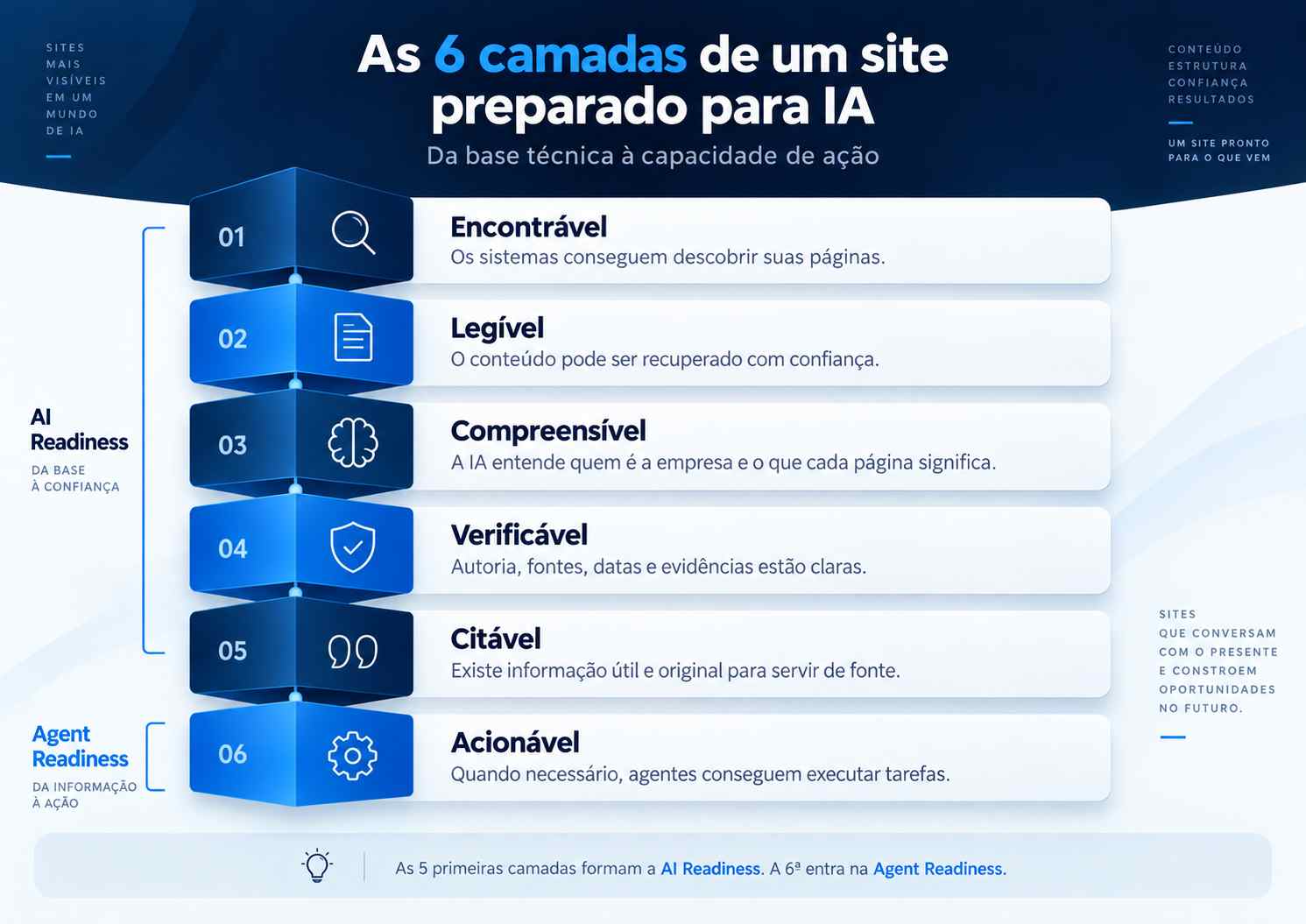
In WebSyd' editorial methodology, a site prepared for AI should be findable, legible, understandable, verifiable and citable. . When you also need to allow agents to perform tasks, there is a sixth layer: actionable.
This classification is an editorial synthesis of WebSyd created to organize the practices and evidence analyzed in this guide. It's not an official Web standard.
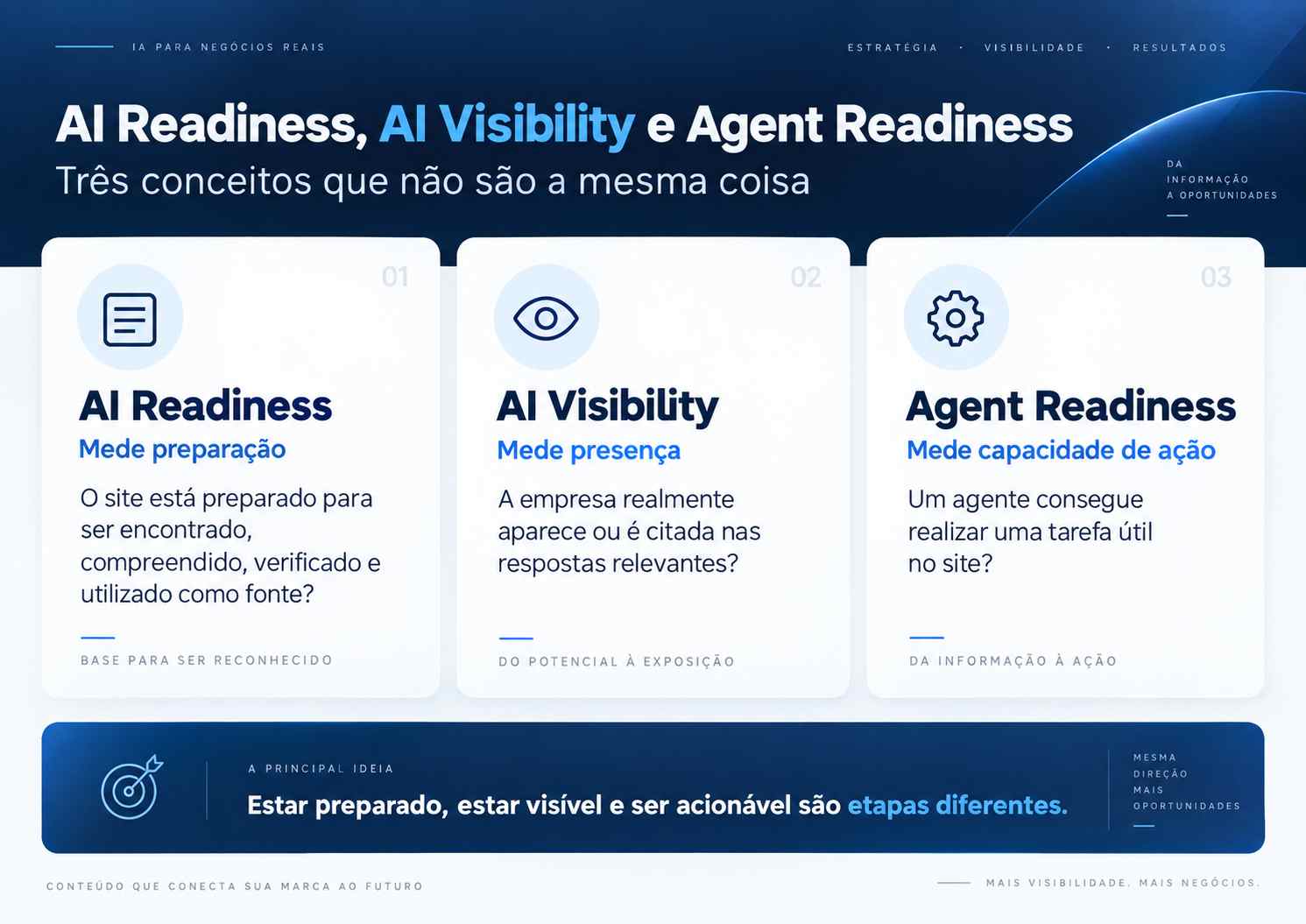
It is also important to separate three concepts that often appear mixed:
Concept
In plain language
AI Readiness
Does the site offer good conditions for AI systems to find and understand your information?
AI Visibility
Does the company really appear or is it used as a source in the relevant answers?
Agent Readiness
Can an agent perform a useful task involving the site or service?
Or, in an even simpler way:
AI Readiness is preparation. AI Visibility is presence. Agent Readiness is action capability.
AI Readiness, AI Visibility and Agent Readiness answer different questions. This is an editorial distinction used by WebSyd in this guide.
Understanding this difference avoids much of the confusion that exists today around GEO, llms.txt, agents, MCP and other recent technologies.
What is AI Readiness?
In this guide, AI Readiness is the ability of a website to provide conditions for artificial intelligence systems to discover, access, understand, check and use their information properly.
There is no single definition or score of AI Readiness shared by the main platforms analyzed in this study. Google, Vercel, Cloudflare and audit tools observe different aspects of the problem.
A tool can check if the content is accessible. Another test if an agent can navigate the site. Another measures whether the domain is effectively appearing as a source.
So one rule follows all this stuff:
An AI Readiness note is the result of an audit methodology. It is not a note granted to the site by ChatGPT, Google, Gemini or Claude.
Why did AI Readiness start to matter?
Experiences such as AI Overviews, AI Mode, ChatGPT Search, Gemini and Copilot have changed the way information can be recovered and presented to users.
In some generative experiences, an initial question can trigger several intermediate searches.
Google documents this process as wanty fan-out: the model generates related queries to retrieve different information necessary for the response.
“What is the best platform for my company to manage international payments?”
The system may need to investigate price, integrations, security, countries served, limitations and competitors before mounting a response.
It changes the way you think about content.
It does not mean creating a page for every small variation of the question. Google even warns against producing pages on a scale only to capture all the derivative queries possible and states that their systems can understand relevance even without exact correspondence between search terms and content.
The practical rule is:
cover the problem well, not just the keyword.
The six layers of a site prepared for AI
Our framework can be summarized as follows:
Layer
Question
1. Findable
Can the systems find out my pages?
2. Legible
Can you get my information back correctly?
3. Understandable
Can you understand who we are and the meaning of the content?
4. Verifiable
Can you identify authorship, sources, dates and evidence?
5. Quoted
Is there something useful and original enough to be used as a source?
6. Actionable
When necessary, can an agent perform a task?
The order is purposeful.
A company shouldn't start implementing MCP if important pages can't even be traced.
Nor does it make sense to concentrate energy on files for agents while the site has generic content, orphaned pages or ambiguous institutional information.
The six layers used in the WebSyd editorial framework. The first five make up what we call in this AI Readiness guide; the ability to act enters the Agent Readiness layer.
1. Allow the right AIs to find their content
In short: if a system in which you intend to appear cannot access the page, everything else loses importance.
This does not mean opening your site indiscriminately to any bot.
It means to understand which system is accessing and for what purpose.
OpenAI, for example, documents different agents.
OAI-SearchBot is used to allow websites to appear in ChatGPT search resources.
GPTBot it tracks content that can be used in the training of OpenAI generative models.
ChatGPT-User appears in certain accesses initiated by users themselves and is not used to decide whether a page can appear in the Search. As these requests are initiated by people, OpenAI warns that robots.txt may not apply in the same way.
A particularly useful detail: OAI-SearchBot and GPTBot settings are independent. . Therefore, a website can allow the Search crawler and restrict the crawler to content potentially used in training.
Google still has the Google-Extended, but there is an important distinction: this token controls uses related to the training of future generations of Gemini and certain uses of grounding. Google itself claims that Google-Extended does not affect the inclusion of the site in Google Search nor is it used as a ranking sign in Google Search.
The conclusion for the entrepreneur is simple:
“Blocking AI” is not a single decision. Search, training and user-initiated access are different purposes.
It's worth reviewing robots.txt, CDN, firewall and bot protection to check if the technical policy really corresponds to the company's policy.
2. Don't hide important information behind technology
In short: your website can use JavaScript. But understanding what your company does shouldn't depend on a flow that certain systems can't perform.
Modern sites can assemble important parts of the page after the browser receives the initial HTML.
For a person, this is often imperceptible.
For a client who only recovers the response from the server and does not execute the entire application, the situation may be different.
That doesn't mean JavaScript is bad. Google claims that it can process content in JavaScript when it is not blocked, although it recognises that SEO on sites heavily dependent on JavaScript frameworks tends to be more complex.
In technical documentation contexts, Vercel has also been recommending that content intended for agents can be recovered in a clean and predictable way, including exploring Markdown and other complementary formats. These recommendations are especially aimed at technical documentation and products, and should not be interpreted as a universal requirement for any of the institutional website.
A good practical rule is:
Your design may depend on JavaScript. Understanding your business shouldn't depend solely on him.
Company name, services, relevant descriptions, institutional information and main links need to get reliable to those who try to access the page.
3. Create clear paths between your pages
In short: before interpreting a page, the system needs to discover it and understand how it relates to the rest of the site.
Here comes known SEO fundamentals:
XML sitemap, consistent URLs, proper canonicals, internal links and good information architecture.
Google continues to recommend traditional crawling, indexing, and SEO foundations as a basis for its generative experiences.
But there's a much simpler way to assess that.
Get on the company homepage and ask:
In a few clicks it is possible to find out who we are, what we do, our main services, where we operate, what tests do we present and how to contact?
If the answer is no, there's an architecture problem that already affects humans before we even discuss GEO.
An Important Page You Don't Receive internal links of other pages and does not appear on natural paths requires more effort for any system to discover its role.
4. Make your website say it correctly when something went wrong
In short: HTTP codes are a standardized form of communication between systems. If a page does not exist, the server must communicate this correctly.
Imagine accessing a non-existent URL.
Visually, the page shows:
“Content not found.”
But the server responds:
HTTP 200 OK
To the human visitor, it seems a mistake.
For the software, the technical message is that the request was successful.
This behavior is known as soft 404.
The HTTP standard, defined by RFC 9110, uses 404 Not Found when there is no current representation of the resource and recommends 410 Gone when the server knows that unavailability is probably permanent.
Is Agentic also treats soft 404 as a relevant problem for agents. In their public scan of WebSyd, nonexistent paths returned HTTP 200 and were classified as failure in this specific test.
The error page can be friendly, offer search and suggest alternative paths.
The important thing is that she doesn't tell one story to the human and one to the machine.
5. Build pages that people and agents can understand
In short: Semantic HTML and accessibility do not only help people. Some agents also use these structures to interpret interfaces.
Web.dev explains that agents can work with three main representations of a page:
screenshot, HTML/DOM, accessibility tree.
The accessibility tree summarizes functions, names and states of interactive components.
This helps to understand why simple details make a difference.
One < button> explicitly communicates that a particular element is a button.
One <div> turned visually into a button may require more inference.
The same goes for fields without labels, overlays that hide components and interfaces that constantly change position.
Good practices include appropriate HTML elements, labels associated with forms, accessible names and predictable layouts.
Many improvements that make life easier for agents also improve people's experience.
In short: a system should not need to gather clues spread across multiple pages to find out who the company is and what it offers.
The homepage should make it clear:
who is the company, what it does, for those who work, what services it offers and where it operates.
Pages such as About, Contact and author profiles provide additional context.
It is also here that structured data can contribute.
A guy like Organisation, for example, allows to represent in a structured way information about an organization.
But it's important not to turn this into a promise that sources don't support.
Structured data can make information more explicit for machines. There is no “magic scheme for AI”.
Google explicitly states that structured data are not required for your generative search experiences and that there is no special Schema.org markup required for AI. . They remain relevant within the general SEO strategy and for specific Search experiences.
Therefore, structured data should complement an entity that is already clear in visible content.
Don't replace her.
7. Show where your information comes from
In short: Easy to understand information is not necessarily easy to verify information.
Compare two phrases:
“Companies are investing more and more in artificial intelligence.”
and:
“We analyzed a defined sample, in this period, using this methodology, and found this result.”
The second offers a clearer origin.
For content of greater editorial responsibility, it is worth explaining when necessary:
author, date of publication, latest update, sources, methodology, sample, limitations and data origin.
This helps the reader to distinguish:
What a fact, what came from third parties, what is WebSyd analysis, and what still is hypothesis or emerging technology.
This transparency also makes information easier to assign when it is summarized or reused outside the original page.
In short: a website can be technically impeccable and still not offer any information that another source has reason to assign specifically to it.
That may be the most important part of this guide.
Google has started to emphasize in its guide for generating content search original, uncommoditized, experience-based and able to add something beyond what already exists on the Web.
Compare:
“SEO is important because it helps companies to appear in the search.”
with:
“We have analyzed a proper basis for negotiations, documented the methodology and found this distribution of results.”
The first idea could be published by thousands of websites.
The second one has an origin.
This is why market studies, surveys, tools, experiments, benchmarks, case studies and specialised analyses are so interesting for GEO.
On WebSyd, the Link Building 2026 Market Study it follows precisely this logic: transform operational experience into a public material with methodology, results and limitations that can be attributed to a source.
A simple way of thinking about citadelability
Type
Example
Generic
“Backlinks help with SEO.”
Synthesized
“Google and Microsoft recommend...”
Specialized
“Based on our experience...”
Original
“We have analyzed our own base and found...”
Verifiable
Result accompanied by methodology, source and limitations
This editorial classification does not represent a ranking formula.
It serves to show a principle:
The more specific, original and verifiable information is, the more clearly it can be attributed to a source.
9. Build references about your brand outside your own site
In short: your company controls what it publishes about itself, but the Web is also formed by what independent sources publish about it.
An organization can have excellent research, specialists and cases in its own domain.
Interviews, reports, sectoral publications, reviews and other external references add new public evidence about that organization, its products and its areas of activity.
It's important not to extrapolate that.
It's not right to say:
“more backlinks make AI trust the company more.”
There is also no guarantee that an external publication will make ChatGPT, Gemini or other system name your brand.
A more precise formulation is:
Relevant external references expand the set of public evidence available on an entity.
Google itself says that its generative resources can consider what is published about products and services in different parts of the web, while recommending do not seek unauthentic mentions as a manipulation tactic.
What is the role of Digital PR?
Producing relevant information is a step.
Distributing it is another.
An excellent research that never reaches journalists, experts or publics related to the subject has less opportunities for repercussions.
Digital PR can help bring studies, experts, analyses and other assets to relevant external sources.
So, Thematic relevance matters more than simply accumulating links.
Where does BlaaS come in?
BlaaS means Backlink as a Service.
In WebSyd' operation, BlaaS works as a catalogue of publishers, news portals and other websites in Brazil and from different countries available for Link Building and Digital PR campaigns.
The catalogue organizes information as DR, estimated organic traffic, domain age, category, country and price, in addition to filters and metrics integrated with Ahrefs to reduce the time needed to find potentially suitable vehicles.
But metrics need to be put in the right place:
DR, traffic and domain age are auxiliary selection metrics. They are not internal reliable metrics from ChatGPT, Gemini, Claude or Google.
A good selection needs to consider mainly:
thematic relevance, editorial context, Vehicle quality, adequacy to the public and only then use metrics as support for screening.
A high DR site, but completely disconnected from the business subject, can be a worse choice than a highly contextualized publication in a specialised vehicle.
The BlaaS therefore enters as discovery and distribution infrastructure, not as a guarantee of ranking or citation by AI.
In short: Writing well for AI doesn't mean writing like a robot. It means writing so that people and machines can locate the facts without unnecessary effort.
The best practices here are quite traditional.
Answer the main question early.
Use titles that describe the content.
Define important terms.
Use tables when they really help compare information.
Report dates.
Identify authors.
Show us some sources.
Explain methodologies.
Avoid vague corporate language.
Microsoft reinforced several of these points by launching the AI Performance Bing Webmaster Tools. Among its recommendations are to deepen expertise, improve structure and clarity, support affirmations with data and sources and keep the content up to date.
“Our solution inaugurates a new era of strategic excellence and digital innovation.”
with:
“The tool performs 37 technical checks and shows the citation rate observed in a sample of AI responses.”
The second sentence is easier to understand, verify, summarize and assign.
This change can be summarized in:
less abstract marketing, more clear facts.
And that brings us to one of the central theses of this guide:
AI Readiness is, to a large extent, an exercise in reducing ambiguity.
11. Don't treat llms.txt and new technologies as shortcuts
In short:llms.txt, Markdown for emerging agents and protocols may be useful in certain scenarios but do not replace technical SEO, content and authority.
Few recent issues of GEO received both hype and llms.txt.
Google's position is quite objective: Google Search does not need llms.txt, Markdown or special files for a page to participate in your generative experiences. . Google also says that keeping these files for other systems does not help or harm visibility or ranking on Google Search.
At the same time, Vercel has strongly recommended llms.txt, Markdown, content negotiation and interfaces for agents in scenarios like technical documentation consumed by coding agents.
These positions are not contradictory.
They answer different questions.
Google is explaining requirements for Google Search.
Vercel's arguing mainly. documentation and technical products consumed by agents.
A clinic and API documentation do not have the same needs.
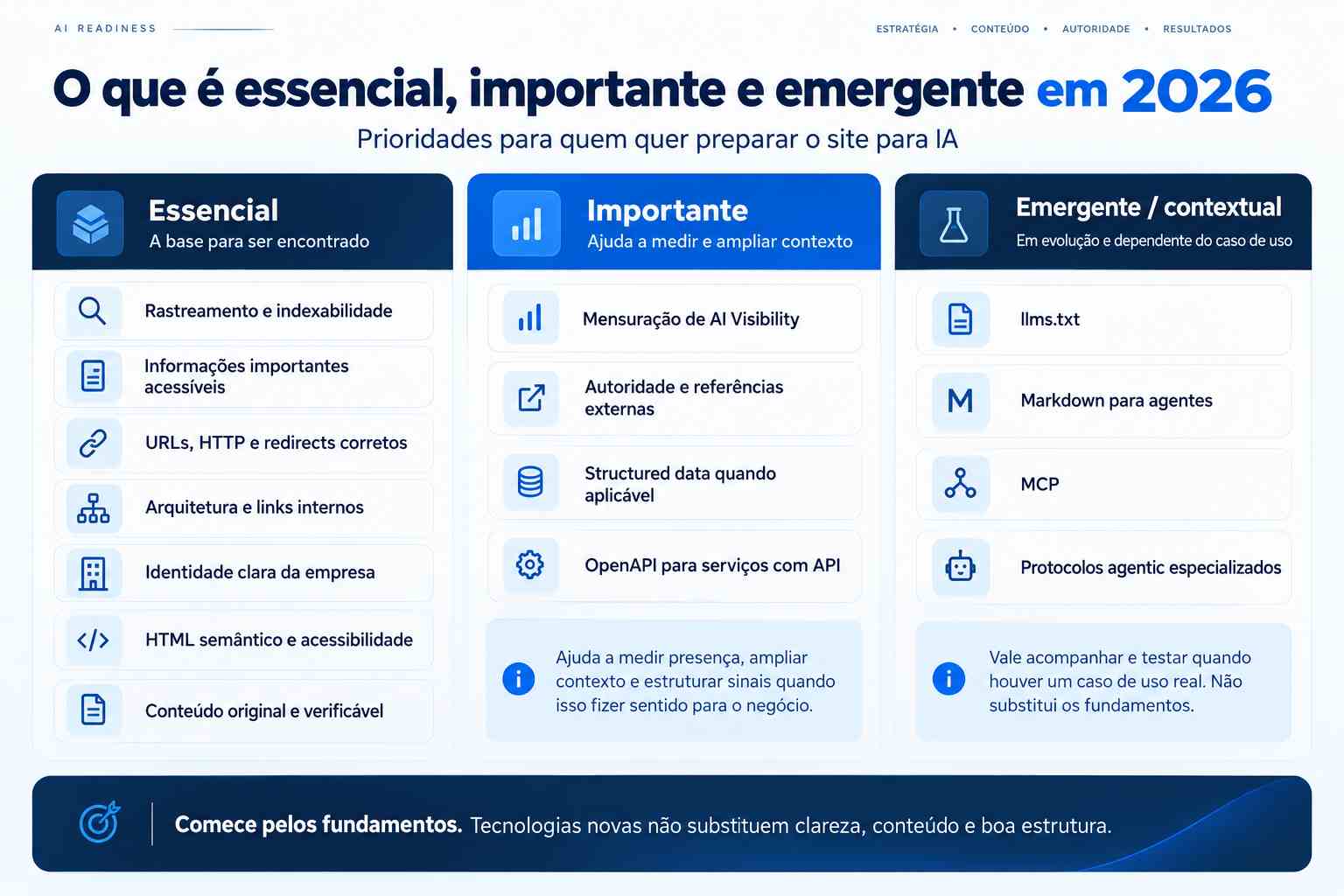
Make HTML and fundamentals work first. Then evaluate additional patterns for the systems and use cases that actually use them.
Cloudflare provides a good sense of maturity for these technologies.
In his analysis of 200,000 high traffic domains filtered into categories relevant to agents, 78% had robots.txtbut only 3.9% passed the content trading test on Markdown. . MCP Server Cards and API Catalogs together appeared on less than 15 sites in that set analyzed.
This shows a very early market.
Not implementing all this today does not mean that a site is invisible to AI.
12. Prepare actions for agents only when it makes sense
In short: there's a big difference between an AI understanding a website and being able to operate a business function.
Imagine three companies.
A consult wants to be recommended.
A hotel wants to allow an agent to consult availability.
A SaaS wants to allow an agent to create projects, consult data or perform operations.
Consulting may never need a public API.
For the hotel or SaaS, structured interfaces can become much more important.
This is where they start coming in:
APIs, OpenAPI, authentication, MCP and protocols specific to certain streams.
The Model Context Protocol (MCP) is an open standard for connecting AI applications to external systems such as data sources, tools and workflows.
But to implement MCP simply because the term is high would be to reverse the priority.
If there isn't a task that makes sense to delegate to an agent, maybe you don't need that layer.
For many service business, reach with excellence up to Quoted It's a much higher priority.
What is an agency site?
In this guide, we use agency website to describe a website or service prepared for agents not only to understand information, but also to perform certain actions in a predictable way.
This can happen through the interface itself.
Browser agents can work with HTML, accessibility tree and visual representation to navigate and interact.
Or it can happen through programmatic interfaces, such as APIs and tools exposed to agents.
The main difference is:
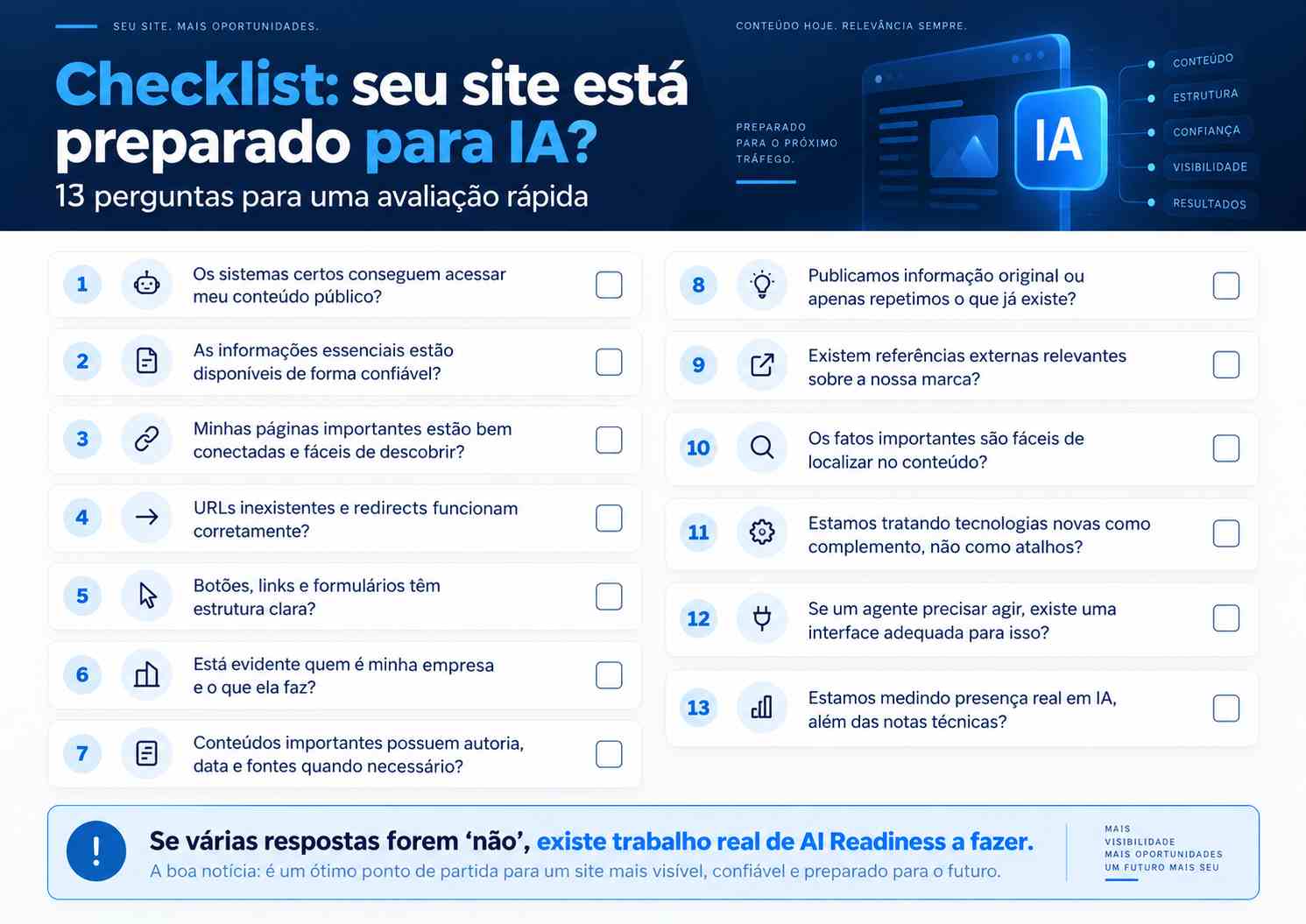
AI Readiness asks: “Can you understand my website?”
Agent Readiness adds: “Can you do anything useful with it?”
What does Is Agentic measure?
TheIs Agentic It's interesting because it looks at the second question.
The product is built by Vercel on the Ora Agent Readiness system. . Ora executes and scores the technical audit, while Vercel operates the interface, public reports, history and grouping of criteria.
The tool also separates essential, recommended and emerging criteria.
The essential criteria share a base of 80 points; recommended ones, 20; and emerging signs can add up to five bonus points. Checks related to API, OAuth, MCP, GraphQL and MCP Apps only enter when that surface is identified as applicable.
That means:
Is Agentic is not a universal “GEO Score”.
The site itself states that its reports are public snapshots and do not represent certification, endorsement, safety test or substitute for accessibility review or compliance.
What happened when Is Agent analyzed WebSyd?
In the public sweep consulted in 6 September 2026, WebSyd.digital appeared with 53/100.
The number alone is not the most interesting part.
The scanner marked positive, among other signs, content available without JavaScript, absence of general blockage in the bot detection test and redirects without certain types of stub.
It also recorded failures or alerts in tests such as:
soft 404, crawler reachability, sitemap found by scanner, Organisation in JSON-LD and more advanced surfaces involving API, OpenAPI and MCP.
There's an important editorial difference here.
When the scanner informs:
“Sitemap exist: Failed”
the responsible conclusion is not:
“WebSyd has no sitemap.”
It's:
“In that scan, Is Agentic reported that he could not find a sitemap.”
Scanners can produce false positives, false negatives or simply observe a transitory condition.
In addition, advanced criteria may have little relevance for the business model analyzed.
That's why:
do not optimise the site to get 100 on a tool. Optimize to eliminate problems that really matter to users, searchers and agents.
How to Test AI Readiness and AI Visibility
There is not a single tool today that perfectly answers all these questions.
It is more useful to see them as complementary layers:
Tool
Question that helps to answer
AI Score
Does my website present the technical signals evaluated and already appear as a source in the sample?
Is Agentic
Can an agent access and use the public surfaces of the site?
Cloudflare Agent Readiness
What emerging standards are implemented?
Google Search Console
Did my website get impressions of Google's generational experiences?
Bing Webmaster Tools
Which pages are quoted and for which grounding queries?
AI Visibility Tools
How does my presence compare to competitors?
AI Score
The WebSyd AI Score was developed to approximate two questions that usually appear separately:
“Is my website ready?”
and
“Is my domain already being used as a source?”
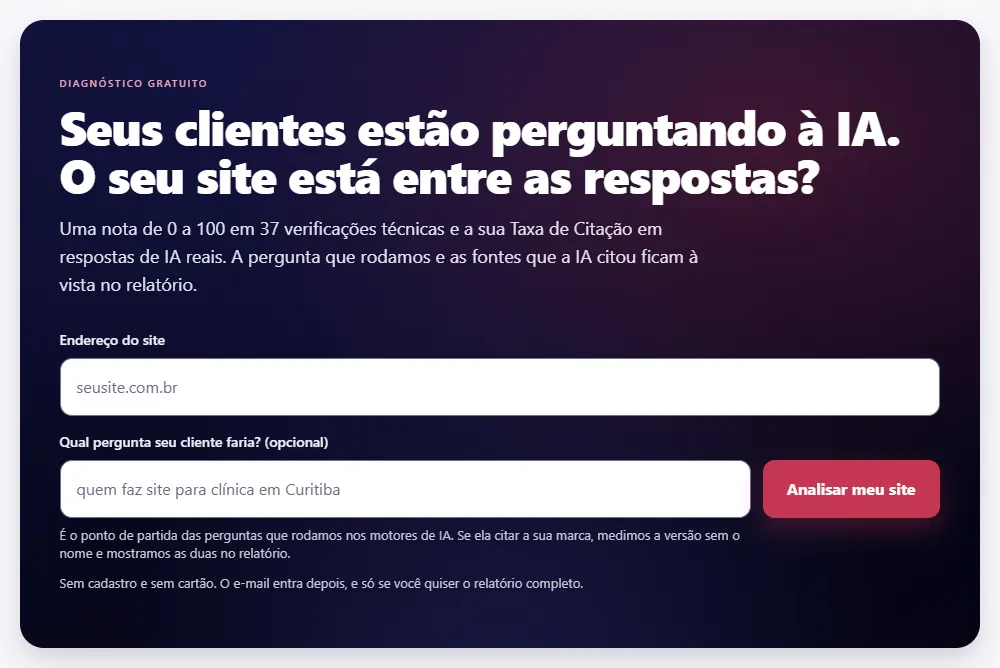
The public page of the tool gives a note of 0 to 100 based on 37 technical checks, besides a Citation Rate in Real AI Answers. . The report also presents the question and sources cited in that sample.
This allows us to diagnose different situations.
A website may have good technical evaluation and little presence in the sample.
Another may already appear as a source, but have technical problems that deserve attention.
The caveat is fundamental:
AI Score is a methodology of WebSyd. Its score is not provided by Google, OpenAI, Anthropic or Microsoft and does not guarantee future citations.
Google documentation informs that, at 31 August 2026, performance insights in generativa AI have been released worldwide.
The report includes impressions of AI Overviews and AI Mode and allows segmentation by page, country, date and device.
There is, however, a small inconsistency on the page itself: despite the world rollout note, the Troubleshooting section still mentions gradual rollout as a possible reason for a property not to view the report. Google also informs you that insufficient volume of prints can prevent your display.
Therefore, the safest formulation is:
Google declares that it concluded the global rollout on August 31, 2026, but not all property will necessarily see data in the report.
Conclusion: Prepare your site to be understood, not to win a scanner
Your site does not need to be rebuilt tomorrow because a “Web agent” has emerged.
Nor does it need to implement all new technology to remain relevant.
But there is one question that deserves to be included in the digital planning of companies:
Can an artificial intelligence system find my company, correctly understand what we do, verify our information and use our content as a source?
For most businesses, this is already an excellent starting point.
Then comes the following question:
If the user wants to, can an agent perform any useful tasks involving my company?
Then we get into Agent Readiness.
The best way to summarize this guide remains:
AI Readiness is, to a large extent, an exercise in reducing ambiguity.
The machine shouldn't have to guess who your company is.
You shouldn't have to guess which page is official.
You shouldn't have to guess if a URL exists.
You shouldn't have to guess who wrote a piece.
You shouldn't have to guess where a dice came from.
And mostly, you shouldn't have to guess. why that page adds something worth using as a source.
Being technically accessible is an entry condition.
Being useful, original, contextual and verifiable is what turns a page into a potential source.
FREQUENTLY ASKED QUESTIONS
Does my website need llms.txt to appear on Google?
Nope. Google says that llms.txt it is not necessary to participate in Google Search, including your generative experiences, and that the file does not improve or harm rankings or visibility in the Search. Other systems may choose to use it, so it can still be useful in specific cases.
I need to release all the AI bots on robots.txt?
Nope.
The ideal is to consciously decide which systems and purposes you want to allow. OpenAI and Anthropic, for example, have separate agents for search, training and certain accesses initiated by users.
Does Schema increase my chance of appearing at ChatGPT?
There is not enough public evidence to state that simply adding a certain type of Schema will make ChatGPT quote a page.
Structured data can make explicit information for systems that use it and remains important in various Search experiences, but should not be treated as AI Visibility guarantee.
Backlinks help with AI Visibility?
There is no proven equation of the type:
more backlinks = more AI quotes.
Links continue to be part of the Web architecture, and external references increase the set of public sources associated with a brand. But editorial context, relevance, content, source quality and the specific mechanism continue to matter.
What's GEO?
In the WebSyd approach, GEO brings together strategies to increase the ability of a brand and its content to be discovered, understood and used as a source in generative experiences.
Google acknowledges that the terms GEO and AEO are used by the market, but considers that within Google Search, optimizing for your generational experiences remains SEO work.
In this guide, Agent Readiness represents the preparation needed to allow an agent execute actions, in addition to understanding only information.
Clear forms may be sufficient in certain cases. In more programmatic products, APIs, authentication, OpenAPI or MCP may become relevant.
Does an institutional website need MCP?
In general, not as a priority.
MCP is particularly relevant when there is a function or data source that needs to be accessed in a structured way by AI applications.
An institutional website interested mainly in discovery and authority tends to have more to gain by solving first crawling, content, identity, verifiability and citadelability.
How do I know my GEO strategy is working?
Don't just evaluate audit notes.
Follow real presence: cited pages, grounding issues when available, mentions, share of voice and official data from platforms that offer this visibility, such as Search Console and Bing Webmaster Tools.
Caio Nogueira
Caio Nogueira is a SEO, GEO, link building and Digital PR expert and co-founder of WebSyd, website creation agency and SEO consulting founded in 2016. It acts with organic search strategies, digital authority construction and brand optimisation for search engines and artificial intelligence platforms. Throughout his trajectory, he participated in more than 1000 projects involving SEO, website development, content marketing and authority acquisition through backlinks and Digital PR. At WebSyd, it participates in the planning of strategies to increase organic visibility, lead generation and presence of companies on Google and AI-based search engines. As an author, it publishes content on SEO, GEO, website creation, link building and digital authority, sharing analyses, strategies and practical experiences related to organic growth of companies. Its contents and contributions have also been published in companies and vehicles of technology and marketing such as Wix, HostGator, Duda, Neil Patel, Locaweb and E-Commerce Brasil.







 Estimate the cost

