
How to Be Mentioned in ChatGPT: Content Optimization for AI
Summary (TL;DR)
In this post we will address how the rise of artificial intelligence is changing SEO rules and how your brand can be cited in AI-generated summaries such as Google's AI Overviews and ChatGPT.
We show why the content needs to be reliable, structured and published in authority sources to appear as a reference in the automatic responses of these platforms.
You will understand the strategic role of press releases, the importance of applying specific GEO practices (Generative Engine Optimization), how to structure content clearly, use long-tail keywords in a natural way, enrich with visual elements and distribute these contents on relevant websites.
We end with a practical checklist to optimise your website for AI, showing how to align technique, authority and distribution to turn your content into a reliable source in automatic response mechanisms.
WebSyd can be your partner at all stages of this process.

With the arrival of AI-generated summaries on Google and the growth of platforms like ChatGPT, online visibility game has changed. Knowing how to be mentioned in ChatGPT became an obligation.
Today, it is not enough to be well positioned in the traditional results: it must be cited as a reliable source by artificial intelligences.
In this article, you will discover how to optimise your website for this new scenario by applying SEO practices adjusted to the behavior of generative algorithms.
Why the AI is changing the way to do SEO
Artificial intelligences, such as ChatGPT and Google's new format, do not just show a list of links. They provide answers.
And these answers come from content that they consider reliable, complete and well structured. If your site is not one of those sources, you simply do not appear.
This means that traditional SEO techniques need to be adapted for a new goal: train AI to recognize its brand as a reference. This concept is known as GEO (Generative Engine Optimization).
Press releases: a path to be quoted
Although several factors influence the positioning of your brand in AI responses, one of the paths is the strategic use of press releases. distributed on major news portals and regional authority sites.
This is because AI tend to use structured sources, with factual language, real quotes and hosted in trusted domains.
You want to be cited in the AI searches? Talk to the WebSyd team.
1. Create content with clear and objective structure
AI values clarity. Therefore, start your texts with direct abstracts, organize the content with intertitles (H2 and H3), and answer specific questions that your target audience usually asks. This helps the AI quickly understand the value of the page.
Practical example: If the theme of your post is “How to manage social networks”, start with a direct response and then double the topics with objective subtitles.
2. Use long tail keywords naturally
Avoid exaggeration. Instead of repeating the same expression, use long and contextual variations. For example:
- how to increase organic traffic free of charge
- best SEO techniques to appear on Google
- how to optimise your site to appear in ChatGPT
These expressions are more aligned with what users and AIs currently seek.
Tip: Use tools like AnswerThePublic or Ubersuggest to map real questions and turn them into subtitles in their content.
3. Enrich your content with visual elements
The AI are increasingly considering images, graphics and videos as part of the response.
Where possible, include visual elements that complement the information. A good infographic or a descriptive alt text image can increase your chance to be quoted.
Example: A diagram explaining the functioning of ChatGPT or a graph with the growth of IA searches.
4. Produce content with real quotes
Adding expert statements, research data and reasoned opinions is essential for AI to perceive the content as human, authentic and reliable. In addition to generating credibility, this increases the semantic value of your material.
Name of sources: Whenever possible, mention research institutes, sector reports or interviews with recognized professionals.
5. Distribute your content to trusted websites
One of the secrets to be cited by AI is being present in areas of authority. This can be done through link building strategies, partnerships and external publications.
One way to find these vehicles is to use the BlaaS, WebSyd catalogue of publishers with filters by category, country, DR, traffic and price. This helps organize the curatorship before leaving for negotiation and publication. Remember that, by Google guidelines, paid publication link should take the attribute rel=”sponsored”.
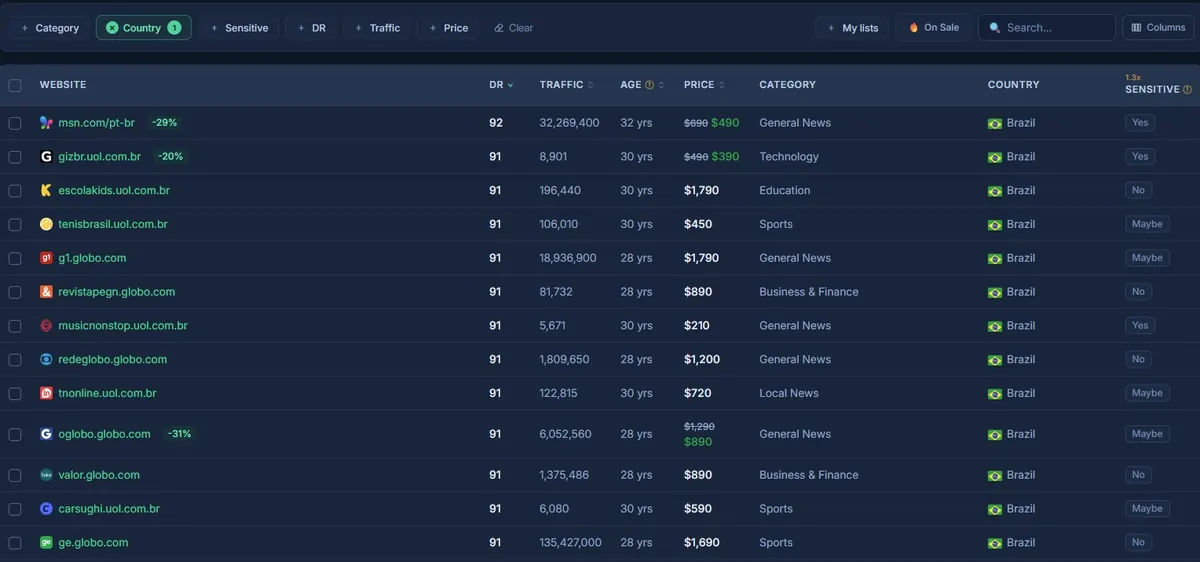
Practical tip: Invest in guest posts on your niche sites and use platforms that offer reliable vehicle curatorship. . This helps to consolidate the image of your brand in front of algorithms.
You've come all this way and you're thinking of hiring a consultant? Ask for an estimate from the button below.
6. Write press releases for AI
Press releases still work, a lot. But they need to be well written. Use titles that include brand, product/service and benefit. In the body of the text, answer “who, what, where, when and why” in the first paragraph. Finish with real quotes and links to your page.
Think of agendas that really show the importance of your company to AI, such as: “Company X is considered one of the best digital marketing companies in the country.”
The WebSyd acts as a strategic partner for brands who want to increase their organic visibility, with SEO consulting.
Quick checklist for press releases:
- Title with mark + benefit
- Initial paragraph with the 5 questions
- Quote from someone on the team or expert
- Link to official page
- Wide distribution
7. Build semantic authority
The AI works by association. If you want to be mentioned, you need to be semantically connected with the theme.
- Create content pillar with broad subjects
- Develop complementary content that links with each other
- Use questions as subtitles (e.g., What is the best SEO technique in 2026?)
- Mark with structured data whenever possible (schema.org)
Practical example: If the core content is “Digital Marketing”, produce additional posts on sales funnel, technical SEO, copywriting and automation. That shows depth in the subject.
8. Monitor opportunities
Tools like SEMrush, Ahrefs and Google Search Console help identify:
- Which pages of your website receive the most traffic
- Which keywords are bringing visitors
- Where there are gaps compared to competitors (keyword gap)
This information guides your strategy efficiently and with real focus on results.
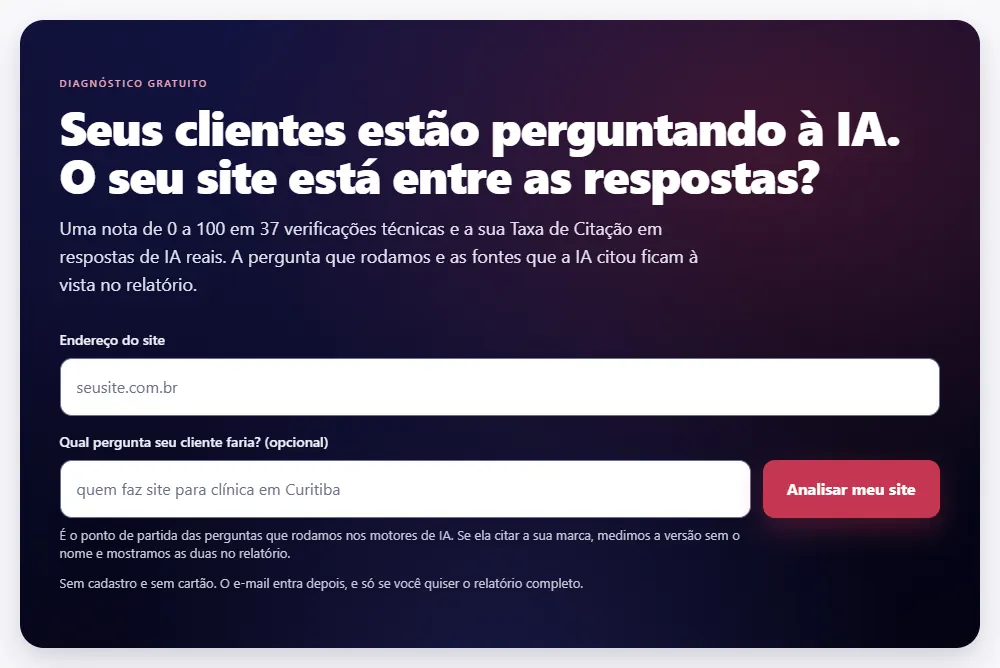
To complement these tools with a specific reading of AI, the AI visibility diagnosis the AIScore combines 37 technical checks with a Quote Rate observed in AI responses, also showing the question and sources found in the sample.
9. GEO: practical optimisation checklist for AI
With the evolution of search engines for models based on artificial intelligence, such as ChatGPT and Google's AI Overviews (formerly AGE), a new discipline emerges within SEO: GEO (Generative Engine Optimization).
Unlike the Traditional SEO, which seeks to rank well in SERPs, GEO focuses on be quoted in automatic responses that the AI deliver directly to the user.
And this quote only happens when its content meets very specific criteria of structure, trust, authority and clarity.
Below you will find a practical checklist that can serve as the basis for audit your content with focus on AI.
The more items you mark as attended, the greater the chance your brand will be mentioned directly in the abstracts generated by artificial intelligence.
Checklist for GEO (Generative Engine Optimization):
- Clarity in the Answer: Does the content respond clearly to a real doubt that the public searches?
- Natural use of keywords: Are the main keywords (including long tail) inserted fluidly?
- Structured securities: Does the content use a coherent and well-organized hierarchy of header tags (H1, H2, H3)?
- Reliable sources: Does the text present updated data, actual citations or external references?
- Multimedia Elements: Are there images, infographics, videos or other features that enrich the content?
- Backlinks and external citations: Is the content published or quoted on sites with high authority?
- Schema markup: Does the page use structured data to facilitate the interpretation of AI?
- Semantic interconnection: Is the content connected with other relevant materials (internal clusters)?
- Technical Performance: Is the page fast, responsive, safe and mobile friendly?
- Strategic distribution: Has the content been promoted on relevant portals, social networks and curated lists?
This set of practices defines whether your brand will be just another result in the searchers or a direct source used by AI to build answers.
To help companies stand out in this new scenario, WebSyd offers complete SEO services and content distribution on large portals, aligning all stages that impact the GEO in practice.
Summary: How to be mentioned in ChatGPT
Being in ChatGPT summaries or Google responses does not depend only on good SEO practices. You need to build authority, be quoted in external sources, apply up-to-date techniques and publish content that really teaches something.
For whom you wish increase organic traffic and gain relevance without relying on paid media, this is the time to act. Optimizing your AI-focused website is the new way to be found, quoted and remembered.
WebSyd specializes in content optimisation for AI, technical SEO and digital visibility strategies. If you want to see your brand being mentioned by algorithms such as ChatGPT or Google AI Overviews, talk to us.
Start applying these now SEO techniques, strengthen your digital presence and prepare your brand for the future of the search.
Ask for an estimate from the button below.
FREQUENTLY ASKED QUESTIONS
What's GEO?
GEO means Generative Engine Optimization. It is content optimisation focused on being cited by artificial intelligences such as Google SGE and ChatGPT.
Why doesn't my website appear in the AI summaries?
Probably because it's not considered reliable, complete or well distributed. The AI prioritizes sources with authority.
Press releases still work?
Yeah. Especially when published in large portals and with adequate structure. They are quickly read and indexed by the AI.
Is it worth investing in guest posts?
Yes, especially on sites with high domain authority. Platforms like BlaaS facilitate this process.
How do you know I'm being quoted by AI?
Use tools such as Google AGE Watch, Google Search Console and snippet trackers to monitor mentions and unclicked visibility.

Caio Nogueira is a SEO, GEO, link building and Digital PR expert and co-founder of WebSyd, website creation agency and SEO consulting founded in 2016. It acts with organic search strategies, digital authority construction and brand optimisation for search engines and artificial intelligence platforms. Throughout his trajectory, he participated in more than 1000 projects involving SEO, website development, content marketing and authority acquisition through backlinks and Digital PR. At WebSyd, it participates in the planning of strategies to increase organic visibility, lead generation and presence of companies on Google and AI-based search engines. As an author, it publishes content on SEO, GEO, website creation, link building and digital authority, sharing analyses, strategies and practical experiences related to organic growth of companies. Its contents and contributions have also been published in companies and vehicles of technology and marketing such as Wix, HostGator, Duda, Neil Patel, Locaweb and E-Commerce Brasil.
View all posts


 Estimate the cost

