
Institutional website: what is it and what are the best practices?
Summary (TL;DR)
An institutional website is the official showcase of a company on the internet, used to present its services, values and forms of contact professionally. It takes 9 essential steps to build an efficient institutional website, with everything it needs to make a good impression, generate trust and attract customers.
The 9 steps are: Home, Site Navigation, Sources and Legibility, CTA Buttons, “About Us”, Successful Cases Page, Show Customer feedback, Define a Marketing Plan, Create a corporate blog and invest in content.
Check out each of these steps in full throughout our post!

One institutional website It's the official presence of a company on the Internet. It works as a digital business card, where visitors find essential business information such as history, services, contact and values. It serves to strengthen brand authority, attract customers and facilitate communication with different audiences, including partners and investors. . So it's usually the first project of a company that seeks to creation of professional websites.
If you want to understand how an institutional website can generate concrete results, increase your credibility and open doors for new business, continue reading.
What is an institutional website and what is it for?
An institutional website is a digital communication channel presenting the company, your proposal, products or services, and values. It helps to position the brand in the market, conveying professionalism, security and clarity about what the business offers.
What's an institutional website for?
- disclose information about the company;
- Strengthen the image of the mark;
- Attract new customers and generate opportunities;
- Facilitate contact with different audiences;
- Support marketing actions and commercial strategies.
In short, the institutional website is no longer just a showcase and has become a strategic starting point. It is he who supports digital marketing campaigns, improves online presence and helps in gaining authority in the sector. The ideal structure also varies according to the market, as our sites by area of activity.
Why have an institutional website?
An institutional website transmits credibility, improves communication with the public and works as a foundation for marketing and SEO strategies. See the main advantages:
- Creditability and online reputation;
- Visibility and availability 24/7;
- Low cost and long-lasting return;
- Authority in its segment;
- local and international reach;
- Sales potential and lead generation;
- Loyalty and customer relationship;
- It is possible to apply SEO strategies for organic positioning.
How to create a good institutional website?
Create an efficient institutional website it requires attention to at least 9 fundamental steps, from the structure of the home page to the definition of elements that reinforce the brand identity. Each part of the site needs to be oriented to generate trust, facilitate navigation and communicate business values clearly. Shall we go?
1. Home Page
The home page should, in a few seconds, transmit who the company is, what she does and why the visitor should remain on the site. This is the most important point of the user experience, because people usually leave a page in 10 to 20 seconds if they do not understand what it offers immediately, according to the Nielsen Norman Group. . Therefore, fast loading, clean design and clarity of content are indispensable.
Take a look at our home:
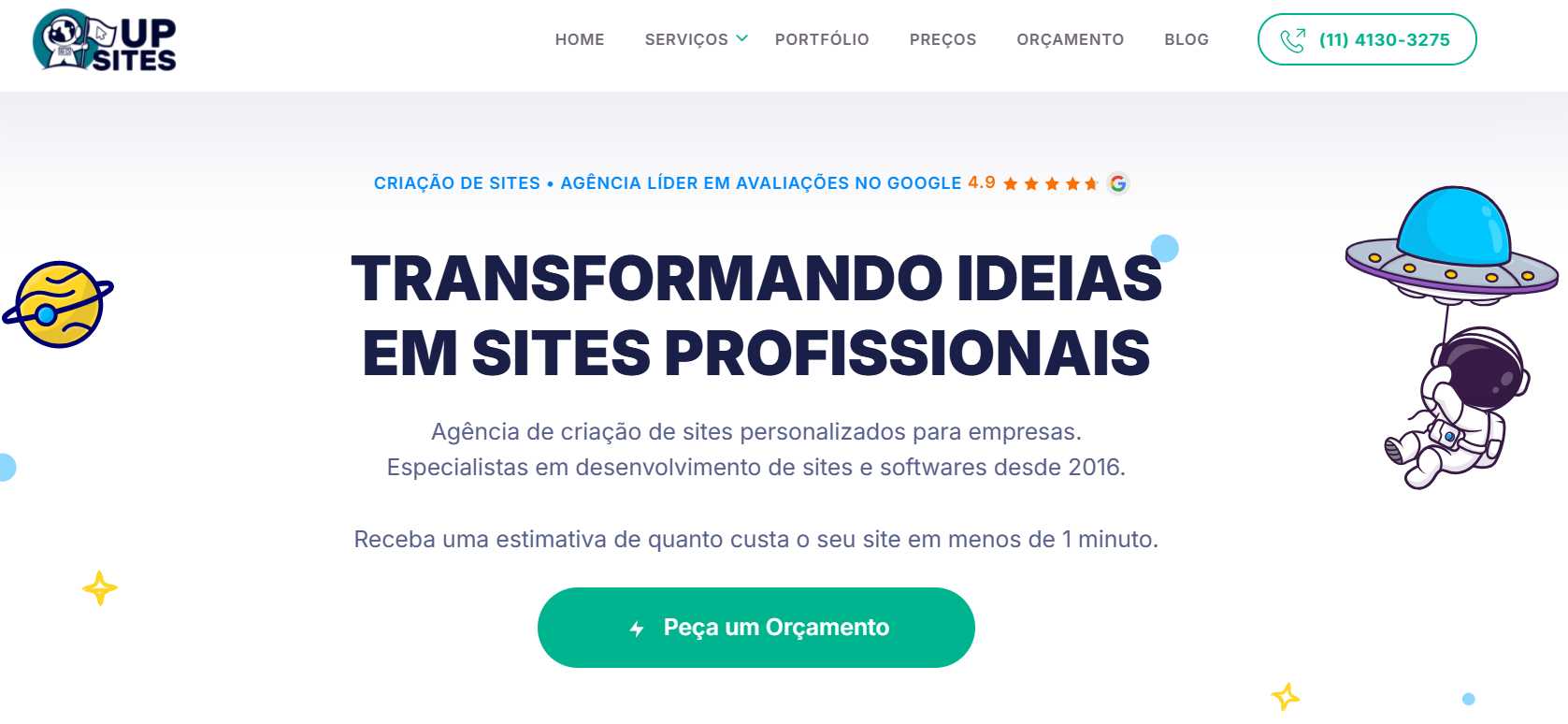
What do you need on the home page?
- Proposed clear value: say objectively what the company offers and to whom;
- Basic institutional information: mission, vision, values and competitive differentials;
- Visible contact: enter phone, email and if possible a WhatsApp button or chat online;
- Links to social networks: show that the mark is active and accessible;
- Images aligned with optimised service/product: choose real images that help contextualize;
- Clear navigation menu: facilitate the path to other important pages, website navigability It's very important;
- Logo and visual identity: use brand elements to strengthen authority and professionalism.
The home page doesn't have to be long, but it needs to be strategic. Use objective texts, organize the information blocks well and prioritize the visual hierarchy (what appears first on the screen should be the most important for the user).
2. Site navigation
Navigation needs to be simple, intuitive and fast. . Confused menus, poorly organized pages and over-clicks scare the visitor. Therefore, the institutional website should have a clear structure, with objective paths for anyone to find what they seek effortlessly.
Check out how our menu facilitates navigation:

In addition to the easy structure, ed responsiveness it is mandatory: your site should work perfectly on computers, tablets and mobile phones. This ensures good experience for users, since most accesses come from mobile devices. That is, if your site does not adapt to the mobile phone, you are missing visits and opportunities.
3. Sources and readability
To ensure legibility, use fonts of suitable size with good contrast and spacing between texts. A beautiful site, but with small letters, bad colors or too long blocks, loses engagement. Aesthetics must go along with the comfort of reading.
In a study of Northumbria University with health websites (Sillence et al., CHI 2004), 94% of participants' comments on rejected or unreliable websites dealt with design. In other words, taking care of the typography and making reading pleasant can directly impact user confidence in the brand.
The ideal is to keep text blocks with lines between 45 and 60 characters and avoid dark backgrounds with white text. This wears out the view and makes it difficult to read long-term. Think like a reader: if it's tiring, it'll come off the page. A legibility is one of the silent pillars of an efficient site.
4. CTA Buttons
Call buttons for action (CTAs) are essential to generate conversions on the site. They need to be clear, objective and visible on all pages, especially the header and footer. A good CTA turns visitors into contacts, budgets, leads or sales.
This is an example of CTA that we use:
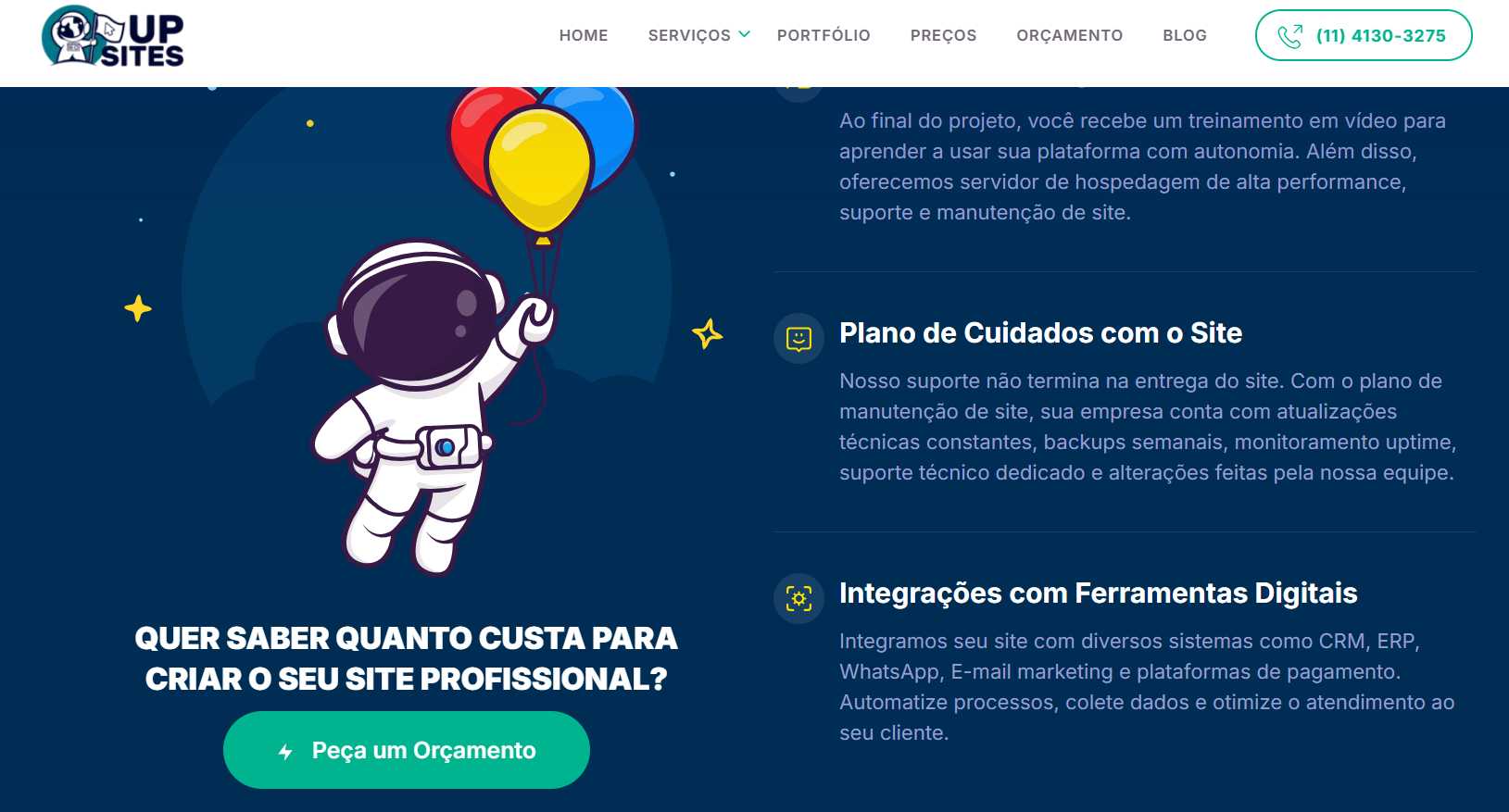
Use action verbs like “Request budget”, “Talk to our team” or “See plans”. . The strategic position and visual highlight, such as a different color or a button with edge and shadow, help the user know what to do next. A site without CTA is like a store without a service desk: people come in, but they don't know where to ask for help.
5. Page “About Us”
The “About Us” page That's where the company shows who's behind the brand and what they really believe. More than telling the company's story, she needs to create connection, trust and transmit values that guide the business.
It can also work as a sales page: this is where you present yourself, tells how the idea of business came about and what makes your company unique in the market. The aim is to highlight its differentials, generate identification and leave a good impression on who got there.
What this page must contain:
- A brief business history: how it came about and why it was created;
- the mission, values and vision of the company;
- What the company does and for whom;
- a summary of relevant achievements or results (in numbers);
- the presentation of the team or founders, with photo and position;
- Behind-the-scenes images (if it makes sense to your segment);
- A tone of light, human voice and close to the reader.
Check out some narrative structure tips for this page:
- Frame the scene: How did it all start? In what context did the company come up?
- Report a problem: What motivated the foundation of the company? What pain did you identify?
- Take the challenge: Show me how you've been trying to solve this problem.
- Get to the solution: Explain how your company has evolved and what it offers today.
- Imagine the prospects: Point the future. What do you still want to achieve?
- Include concrete data: Market time, number of customers, deliveries made, etc.
- Present real faces: Team photos, leaders or founders increase empathy.
Humanizing business is one of the central roles on this page. When the visitor sees that there are real people behind the mark, he tends to trust more and feel welcomed. Use good photos, objective texts and a coherent narrative. The first impression is also built here.
6. Successful Cases
Successful cases show in practice how your company already helped other customers solve real problems. . It's one of the most powerful ways to build trust and attract new businesses.
Each case should tell a clear story: what was the problem of the customer, how his company acted and what was the result obtained. Using simple language and concrete data (such as increased sales or cost reduction) makes content more reliable.
- Good practices for a successful case:
- present the client (name and sector);
- Explain the challenge faced;
- Show what has been done (applied solution);
- present the results with data;
- Enter statements or quotes from the client;
- Use images, graphics or videos (when possible).
This kind of content helps the visitor imagine himself having the same results, and increases his chances of closing business.
Two examples of WebSyd cases:
- MFIT: institutional site made direct in code, with own layout, SEO on-page and version for mobile phone, tablet and computer.
- PMBCN (Marist Province Brazil Center-North): WordPress site with restricted area, blog and pages mounted on Elementor, for the team update without depending on programmer.

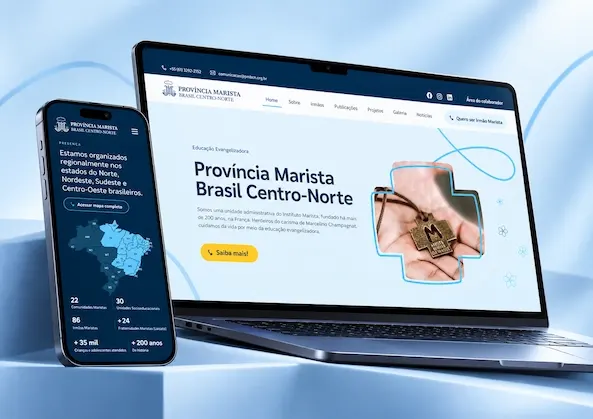
7. Show customers feedback
Testimonials are essential to convey credibility. . They function as social proof: they show that other people have already trusted their company, and had good experiences.
Even though it is simple to assemble, the testimony page is often ignored. But it can make a difference between one visitor leaving the site and another who decides to contact you.
Check out these tips to have more effective statements:
- Ask customers to tell real stories, with problems and solutions;
- Use a natural language, as if it were a conversation;
- Include name, photo and, if possible, customer's position or business;
- Use social media prints, such as reviews on Google or Facebook.
Look at this merry-go-round we use. It's a good idea for your website:
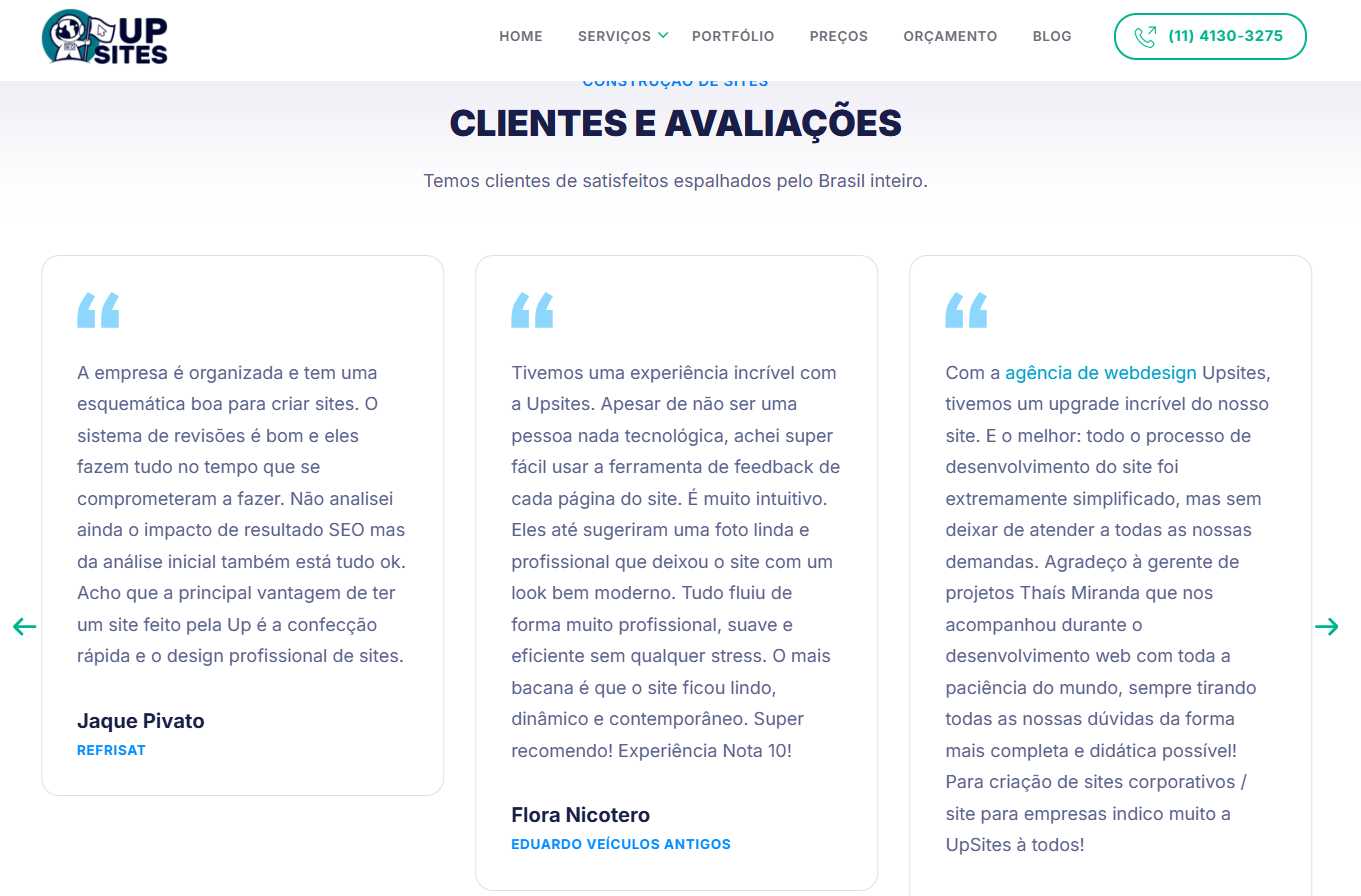
The ideal amount varies, but the more, the better, as long as they are true and relevant. Start with 5 to 10 testimonials and update as you receive more positive feedback. This shows that your company continues to produce good results.
8. Set a Marketing Plan
A good institutional website needs a digital marketing plan to attract qualified visitors and generate concrete results. Without a strategy, it is easy to waste time and money with disconnected and ineffective actions.
The marketing plan defines which channels to use, such as SEO, social networks, paid ads, email marketing and others. It should be aligned with the company's main goal, whether it increases sales, generates leads, launches a product or strengthens the brand.
Check out some common goals of a marketing plan:
- Strengthen brand recognition;
- disclose newly launched products or services;
- attract visitors through strategic content;
- Increase conversions in seasonal or promotional campaigns;
- Generate relationship with customer base.
A well-defined strategy allows you to use marketing as an extension of your website, functioning as a constant growth engine.
9. Create a corporate blog and invest in content
Have one corporate blog within your site is one of the most effective ways to attract organic visitors and show authority in your sector. Google prioritizes updated sites with relevant content, and the blog is the best tool for that.
In addition to improving your ranking, the blog brings your brand closer to the public. With articles that answer questions, teach something useful or present solutions, you gain trust and generate value even before the first commercial contact.
Quality content transforms your site into an information channel, attract followers and make potential customers recognize your company as a specialist in the subject. Over time, this is reflected in more visits, more opportunities and more sales.
How much does an institutional website cost?
One institutional site usually costs from R$ 6,500 at WebSyd (measured multipage, up to 6x, with average delivery in 45 business days). From model (Express Website), the price starts from R$ 1,200 investment, plus R$ 114 per month (no changes on the site). The final value depends on the number of pages and features required, such as contact forms or content management, in addition to design and optimisation adjustments.
One one page to measure part of R$ 5,000, and projects with extra resources cost more. See the full table on how much a professional website costs.
If you want a personalised evaluation or know how much your specific institutional website project can cost, our team is ready to help you with a rapid and transparent budget.
If you want an institutional site designed to generate contacts, count on WebSyd. Get a quote.

FREQUENTLY ASKED QUESTIONS
What is an institutional website?
An institutional website is the place where a company presents its information, products and services, functioning as a digital business card. It is essential to provide credibility and transparency, as well as being the gateway for potential customers, partners and investors to know the brand.
What are the benefits of having an institutional website?
The main benefits include increased credibility, greater market visibility, the possibility of reaching local and international audiences, and the creation of a platform that strengthens consumer relationship and potential customers.
What elements should an institutional website have?
An effective institutional website should contain an attractive homepage, clear contact information, links to social media profiles, a simple and intuitive navigation menu, well-positioned CTA buttons, a “About Us” page that tells the company’s history, customer testimonials and success cases.
What's the difference between an institutional website and an e-commerce?
While the institutional website is focused on presenting the company and building its image, the e-commerce is a online store, whose main objective is the sale of products or services online. Both have different purposes, but can coexist depending on business strategy.
How much does an institutional website cost?
At WebSyd, an institutional site tailored part of R$ 6,500 (multipage) or R$ 5,000 (one page), with average delivery in 45 business days and payment in up to 6x. From model, on the Website Expresso, the price part of R $ 1,200 investment, plus R $ 114 per month (no changes to the site).

Caio Nogueira is a SEO, GEO, link building and Digital PR expert and co-founder of WebSyd, website creation agency and SEO consulting founded in 2016. It acts with organic search strategies, digital authority construction and brand optimisation for search engines and artificial intelligence platforms. Throughout his trajectory, he participated in more than 1000 projects involving SEO, website development, content marketing and authority acquisition through backlinks and Digital PR. At WebSyd, it participates in the planning of strategies to increase organic visibility, lead generation and presence of companies on Google and AI-based search engines. As an author, it publishes content on SEO, GEO, website creation, link building and digital authority, sharing analyses, strategies and practical experiences related to organic growth of companies. Its contents and contributions have also been published in companies and vehicles of technology and marketing such as Wix, HostGator, Duda, Neil Patel, Locaweb and E-Commerce Brasil.
View all posts


 Estimate the cost

