
8 SEO strategies to increase your traffic
Summary (TL;DR)
There are 8 key strategies to improve the positioning of your website on Google and attract more qualified visitors. They are:
- keyword search;
- On-page optimisation;
- production of quality content;
- link building;
- performance and safety;
- optimisation for mobile devices;
- data analysis;
- Local SEO.
These practices make your site more relevant, fast, safe and aligned with what the user seeks. With them, you increase search visibility, improve user experience and increase conversion chances.

SEO strategies are key to increasing traffic on your site. They help your content appear on Google at the right time, for the right people. With millions of pages competing for user attention, having a good positioning in search engines is no longer optional, it is a necessity.
Understanding how SEO works and apply the right techniques can put your business ahead of competition. Learn the main strategies to improve your online visibility. Continue reading and finding out how to attract more visitors in an organic and predictable way.
1. Keywords Search
Keyword search defines the path your content should follow. It is with her that you discover what your audience really looks for on Google, and how you can appear exactly in these searches. This step shows which we have prioritized in their texts, which themes have the greatest volume of demand and where are the greatest opportunities to attract qualified traffic.
The SEO Base
Keyword search is the basis of all SEO strategy. It shows which words and questions your audience type in Google and allows you to create content that delivers exactly what people are looking for. With this, you increase your chances of ranking better and attracting visitors who have a real interest in what you offer.
Keywords Search Tools and Techniques
These are the most used tools and techniques to find good keywords:
- Google Keyword Planner: free and direct from Google;
- Ubersuggest: shows ideas, volume and competition;
- SEMrush and Ahrefs: complete tools for analysis and strategy;
- Topics on high and frequent doubts: Analyze forums, social networks and “People also ask” on Google;
- Trends and seasonality: Observe Google Trends to anticipate time or event searches;
- Sales funnel: choose words for each step of the customer journey.
Using these techniques allows you to assemble more efficient content, with more chances of attracting traffic and generating conversions.
Choosing Strategic Keywords
The best keywords are those with clear intent and aligned to its content. It's no use attracting visitors who have no interest in what you offer. Here are some tips for choosing keywords with the most result:
- Prefer terms that solve a real user problem;
- Bet on long tail keywords (more specific);
- Evaluate the search volume, but also consider competition;
- Use words that connect with yours Sales funnel;
- Stay tuned for the intent behind the search (informative, transactional etc.);
- Check that the term is growing in Google Trends.
2. On-Page Optimization
The on-page optimisation applies the keywords to content and improves its structure for Google. It's at this stage that you organizes the site to be relevant, accessible and easy to understand, both for users and searchers. See what needs to be done to apply the SEO on-page effectively:
- Choose keywords compatible with the content of the page;
- Use these words in the title (H1), subtitles and paragraphs in a natural way;
- Write short URLs that describe the content well;
- Add attractive meta descriptions with the main keyword;
- Optimize images with descriptive file names and ALT text;
- Ensure that the text is scanned: short sentences, subtitles and lists;
- Avoid excess keywords, use synonyms and variations.
This step increases the chance of your site to appear for those who are really looking for what you offer.
Improving Content Relevance
Improving the relevance of content is aligning what you write with what the audience is looking for. The secret is to answer the user's questions with clarity and depth. Check out these tips to improve relevance:
- directly answer your audience’s questions;
- Use accessible language, but with authority on the subject;
- Create titles and subtitles with keywords and clarity;
- Keep the content up to date and in line with the current time;
- Use real examples, studies and data to increase credibility.
Content that generates value keeps the reader engaged, attracts links and shares and increases the chances of conversion.
Key Element Optimization
There are several on-page elements that you can optimise to improve the visibility of your site in search engines:
- Titles: must be clear, objective and contain relevant keywords;
- Meta Descriptions: do not affect the ranking, but attract clicks;
- Headers (H1, H2, H3): organise the content and help in scanning;
- Image Tags (ALT): improve accessibility and reinforce SEO;
- Friendly URLs: short, descriptive and keyword if possible.
Strategic Use of Keywords
Use keywords with balance and naturality. Filling the text with forced repetitions (word stuffing) may harm the user experience and be penalized by Google. Prefer work with variations and synonyms the main keywords, keeping the focus always on the usefulness of content. Good SEO is the one that the user doesn't even notice, but feels the impact.

3. Quality Content
Quality content is the SEO engine in 2026. Relevant, well-structured and engaging texts are what makes your site if highlight on Google, and convert visitors to leads and customers.
Google itself, in its guide on how to create useful content, explains that its systems prioritize content “useful, reliable and created to benefit people”. . This means that to rank well, your content must go beyond the keywords: it needs to deliver real value.
Tips for creating quality content:
- respond directly to the doubts of your audience;
- Write clearly and authoritatively using enveloping language;
- Consult reliable source data and update your content frequently;
- Use optimised multimedia content (such as images and videos).
- Prioritise depth: fully answer the user's question. The size of the text, by itself, is not Google's criterion.
The Importance of Quality Content
Quality content is decisive for your site ranking well. Google and users value texts that really solve problems and offer a good experience. . See in this comparison how quality content differs from shallow and bad content:
| Content quality | Impact on SEO and experience |
| Quality content: | Greater engagement, more backlinks, better ranking |
| Bad content: | Low engagement, low relevance and difficulty ranking |
Strategies to Create Quality Content
Check out best practices to ensure excellent and effective content:
- Meet your audience: understand your pains and questions;
- Based on keyword search: use relevant terms naturally;
- Focus on useful content based on real data;
- Create engaging texts and use enriching visual resources;
- Always update: keep the content relevant and accurate;
- Preserve originality: duplicate content harms SEO.
The Constant Content Update
Upgrading your content is essential to maintaining SEO performance. Google values active and up-to-date websites, which indicates relevance. Regular reviews help maintain the accuracy of information, improve rankings and renew public interest. Updated content attracts clicks, strengthens confidence and keeps your site relevant over time.
In the review, look also content gaps: topics that competitors already cover and that their site does not yet address, be it in an entire theme, be it in a missing section within a post. Competing analytics tools help you find these themes, and often just add a section to the content that already exists.
Take advantage of the review to strengthen internal links. . Pages with good potential and low performance gain strength when they receive links from other relevant pages of the same site, with descriptive anchors that make sense to the reader.
4. Link Building (SEO OffPage)
Link building is the process of conquering links from other sites pointing to your. . These links are external signs of authority and relevance, fundamental to improving ranking on Google's result pages.
The SEO OffPage, especially the construction of links, is like a digital reputation system: the more reliable sites point to yours, the greater your credibility in the eyes of search engines.
The Importance of Links in SEO
Links are seen as recommendations that strengthen the authority of your website. When trusted websites link to you, Google interprets this as a sign of quality, which favors your positioning.
According to Moz, backlinks continue to be one of the main ranking factors of Google.
Strategies to Build Quality Links
| Strategy | How it works | Advantages and care |
| Guest Posting: | You write guest articles on relevant blogs | Increases authority and traffic, but requires original content and aligned to the public |
| Link Earning: | Create exceptional content that naturally attract links | Sustainable and effective in the long term, but depends on the quality and dissemination of content |
| Partnerships and Collaborations: | Firm connections with brands, blogs and influencers of your niche | Generates value exchange and mutual exposure, but requires authentic relationship |
| Dead pages of competitors: | Find pages of competitors that have gone off the air (error 404) and still receive backlinks, create better content on the same theme and warn sites that point to the dead page | Offers a useful replacement for those who have a broken link, but requires really equivalent content and polite contact without insistence |
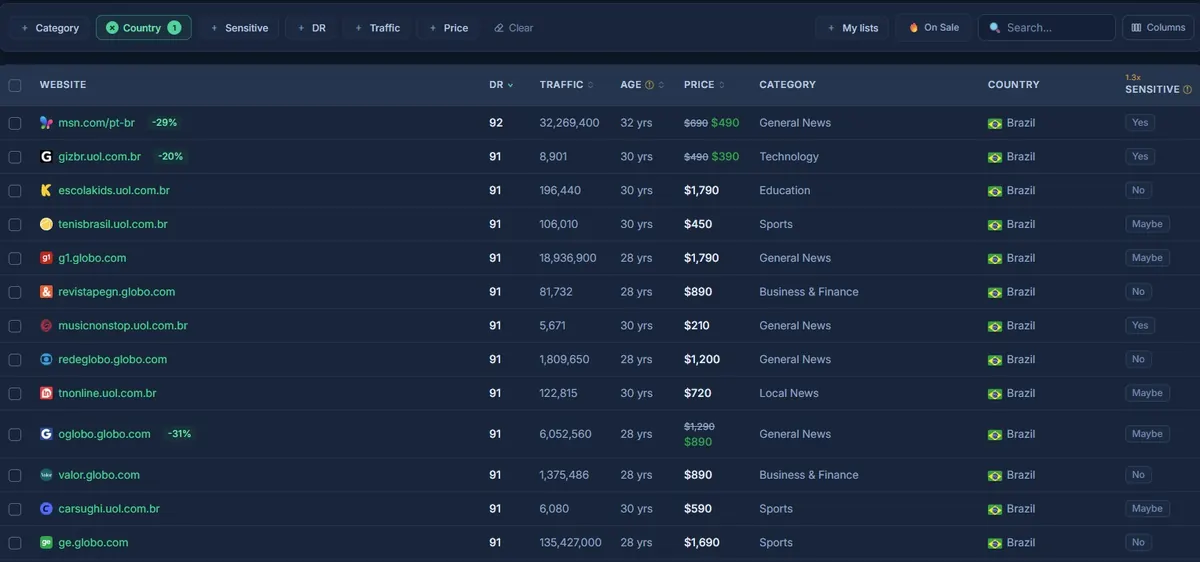
In implementation, the prospecting can be organised with a catalogue of publishers like the BlaaS, platform of WebSyd' own for content strategies and link building, which allows to evaluate opportunities by theme, country, DR, traffic and price.
Link Construction Care
Avoid artificial practices such as private blogging networks (PBNs) or paid links used to manipulate rankings. Google's spam policies consider this type of link a violation unless it is identified with rel="sponsored" or rel="nofold". When there are sponsored publications, prioritize relevant publishers for your niche, with careful editorial selection and transparency.
Always prefer relevant, natural and obtained links through ethical strategies. Building authority takes time, but ensures lasting results in SEO.
Example: link building and digital PR for design.com
For design.com, WebSyd client, the Ahrefs estimate for Brazil shows that organic traffic has gone from less than 5,000 to about 50,000 visits per month in April 2026, after the start of the link building and digital PR. “We’re starting to see a positive traction,” the client wrote in an email of 8/4/2026.
5. Technical SEO
Technical SEO is the internal optimisation set that make your site more accessible to search engines and users. It covers improvements in the code, structure, usability and performance of the site. If these elements are poorly configured, the rest of the SEO strategy can be compromised even if the content is excellent.
Load Speed
Slow sites lose users and may lose space on Google. A loading speed directly impacts the visitor's experience, and Google uses Core Web Vitals (LCP, INP and CLS) on its ranking systems, although the relevance of content continues to weigh more. To improve, optimise images, activate cache, use file compression and choose a fast and reliable server.
Image Optimization
Optimized images help the site load faster and improve SEO. Use light formats (such as WebP), compress files without losing quality and add descriptions (attribute alt). This improves accessibility and allows images to appear in the search results.
URL Structure
Clean and descriptive URLs facilitate indexing and improve usability. Avoid confusing codes and symbols. Prefer short structures, with keywords and separated by hyphens (e.g. /servicos/sites-wordpress). This helps Google and users understand the content of the page.
Sitemaps and Robots.txt
The sitemap guides Google on which pages to track and the robots.txt defines what to avoid. The sitemap should include all important pages of the site and be up to date. The robot.txt file prevents access to duplicate or unnecessary pages, improving indexing efficiency.
Structured Marking
Structured marking organizes the content of your website so search engines understand better. With it, it is possible to highlight information such as reviews, prices and events in the search results (Google stopped displaying enriched results of frequently asked questions, FAQs, in May 2026, and step by step, HowTo, had already been removed in 2023. Structured data remains useful for products, ratings, events, articles and breadcrumbs: using Schema.org in these cases increases the chances of gaining rich snippets and attracting more clicks.
Technical SEO is indispensable for your site to achieve its full potential on Google. Ignoring it is like building a beautiful house with a fragile foundation.
Did you find technical SEO complicated? WebSyd can help you. Talk to our team and consult for free.
6. Optimization for mobile devices
Having an optimised website for mobile devices is indispensable to current SEO. With the growth in the use of smartphones and tablets, search engines began to prioritize sites that offer good experience on these devices. If your website is not responsiveHe'll lose positions, and visitors.
Strategies for Responsive and Friendly Sites for Mobile Devices
Check out some good practices to ensure a functional and efficient website on any screen:
- Responsive Design: use a layout that automatically adjusts to all screen sizes;
- Compatibility Tests: evaluate the performance of the website on different browsers and mobile devices;
- Load Speed: implement features that speed up the load, such as compression and cache;
- Font Sizes and Buttons: choose readable fonts and buttons large enough to touch small screens;
- MetaTags: ensure that metatags are properly configured to guide searchers on the content of the page.
Impact of Google Mobile-First Indexing
Google now uses mobile version from your site as a basis for sort and index your content. . This means that it is the mobile version that Google indexes and ranks: whatever is not on your phone (texts, links, structured data) may not be considered, even if the desktop version is excellent.
In short: optimizing your website for mobile phones is no longer a differential, it's an obligation. Sites that ignore this are losing relevance on Google and damaging its results.

7. Analysis and Monitoring
Data analysis is what turns effort into a real result in SEO. Monitoring metrics allows you to evaluate whether your strategy is working, identify bottlenecks and evolve based on concrete data. Without this step, any optimisation could end up being a long shot.
Measuring is what differentiates strategy assumption. See the main reasons for analyzing your SEO data:
- Performance assessment: check for increased traffic, engagement and conversions;
- Identification of problems: detects technical errors, broken links or low performance content;
- Continuous optimisation: use the data to adjust your actions and evolve your strategy intelligently.
Key-Metrics and Analysis Tools
Check out the most used tools to analyze and track SEO metrics:
Ahrefs
Ahrefs is one of the most complete tools for SEO analysis. Its robust and up-to-date database allows you to understand and improve various aspects of your online presence.
- Keywords search: identify relevant terms, assess volume and competition;
- Backlink analysis: find out who points to your website and monitor the profile of competitors;
- Technical audit: identify problems such as slow pages, tracking errors and duplicate content;
- Rank Tracking: follow how your keywords evolve over time;
- Competition analysis: See what strategies are working for other sites in your niche.
Moz
Moz is a reference in SEO and offers practical tools for optimisation. It combines technology with educational content to support beginners and experts.
- Moz Pro: integrated tool with resources for auditing, tracking and keyword research;
- Local Moz: focuses on local companies, ensuring correct presence in directories and maps.
- Whiteboard Friday: weekly educational content with practical tips and clear explanations about SEO.
Google Search Console and Google Analytics
Google's free tools are essential for any SEO strategy. O Google Search Console show how your website is viewed by Google: tracking errors, indexing, device performance and keywords that bring organic traffic.
The Google Analytics allows monitor the behavior of users: more accessed pages, engagement rate, average engagement time and conversions. With this data, it is possible to understand if the content is delivering value and how to improve it.
Metrics to Monitor
Keeping track of the right metrics is fundamental to making more precise decisions. See what should be monitored frequently:
- Organic Traffic: number of visitors coming from search results;
- CTR (Click Tax): number of clicks in relation to the number of prints in SERPs;
- High Performance Keywords: terms that generate more access and results;
- Conversion Rate: percentage of visitors performing strategic actions on the site;
- engagement rate and average engagement time (GA4): indicate how engaging the content (are analysis metrics, not ranking factors);
- Keyword Ranking: position of strategic keywords in search.
How to Interpret Data and Adjust Strategies
Interpreting the data is what turns numbers into action. When analyzing reports, look for patterns, gaps and opportunities. Check out these three steps:
- Identify trends: assess changes over time and the impacts of implemented actions;
- Compare with competitors: See where you're losing space and where you can move on.
- Try and adjust: test new approaches based on data and re-evaluate the results.
SEO analysis should be continuous. It is what ensures that its strategy evolves with the behavior of the public, the criteria of the searchers and the movement of the market.
For strategies that also include GEO, it is worth adding a AI visibility diagnosis traditional metrics. The AIScore brings together 37 technical checks and a Quote Rate observed in a sample of responses generated by AI.
8. Local SEO
The Local SEO it is essential for companies that serve customers in specific regions. It increases visibility in search engines when someone seeks products or services “near me”, helping Physical enterprises attracting more customers from your area.
Who benefits from local SEO?
Local companies that depend on face-to-face visits or regionalized care have direct gains from this strategy. Examples:
- Restaurants and bars: attract customers looking for nearby food or dish reviews;
- Consultants and clinics: help patients find location, time and recommendations;
- Local services (scanner, electrician): are easily found in searches as “scanner in the X neighborhood”;
- Neighborhood shops: may disclose promotions and facilitate access to the physical address.
If your business is local, a site designed for your segment facilitates this work. See examples of site creation by segment.
How to apply local SEO in practice:
Check out the step by step to put local SEO into practice:
1. Optimize the Company Profile on Google (formerly Google My Business):
- Fill out all information: name, address, telephone number, time and category;
- Publish real and updated photos;
- Respond to assessments with cordiality;
- Activate direct messages, if possible.
2. Use keywords with location:
- Ex: “Labour lawyer in Campinas”, “flowering in the Center of Rio”;
- Include these variations in the pages, titles and descriptions of the site.
3. Appear in local directories:
- Prioritise the Company Profile on Google, Apple Business Connect (Apple Maps), Bing Places and your industry directories;
- Keep identical name, address and phone number in all locations.
4. Encourage customer reviews:
- Positive reviews increase your reputation and ranking in local searches;
- Ask for feedback after sale or service.
5. Create content with a regional focus:
- Post articles or posts on events, neighborhoods or topics relevant to your city. This shows local authority and improves the indexation.
Advanced SEO Strategy
Advanced SEO strategies help your site stand out from competition and track digital market changes. It is not enough to optimise the basics: you have to go further by combining technology, user behavior and innovation.
1. Semantic SEO
Understand the intent behind the search, and not just the keyword typed. Use full questions, synonyms and answers in the content. Example: instead of “marketing consultation”, use it too “How to Improve Sales with Consulting”.
2. Spotlight Snippets
Featured snippets are direct response snippets displayed at the top of Google. Create lists, objective paragraphs and abstracts in topics. Answer common questions in your niche clearly.
3. Trend Monitoring
Follow Google algorithm updates (e.g. Google Core Update) and use tools like Google Trends and Semrush to adapt your content.
4. Optimization for AI and Voice Search
Optimize content with natural language and question/answer format. Example: “How to change a faucet?” instead of “tap change”.
5. User Experience (UX)
To improve the user experience on your website, be aware of these tips:
- Improve loading time (use Google Pagespeed Insights);
- Ensure responsive cellular design;
- Facilitate navigation with visible simple menus and CTA.
Conclusion
Investing in local SEO and advanced strategies is the most efficient way to improve your online visibility, attract qualified customers and remain competitive. According to State of Search Brazil (Hedgehog Digital, 2022), 70% of Brazilians Google before buying. . In this scenario, being well positioned is no longer a differential: it is a strategic need.
Do you want to have an optimised site from the start and focus on results?
Talk to WebSyd and transform your digital presence with those who understand performance, SEO and growth for local and national companies.
SEO is a powerful tool in your marketing arsenal, and using it effectively can make all the difference in your online presence and overall success. If you need it, click on the button below to make a SEO Consultancy Specialized with us!
FREQUENTLY ASKED QUESTIONS
What is SEO and why is it important?
SEO means Search Engine Optimization, which is the process of optimizing your website to get organic traffic from search engine search results. It is important because it helps increase the visibility of your site, which can lead to more visitors and potentially conversions and sales.
How does search for keywords in SEO work?
Keyword search involves identifying the words and phrases that people use in search engines that are related to their business or content. This step is crucial because it allows you to optimise your website and content for these keywords, increasing the chances that your site will be found by users.
What are the essential elements of on-page optimisation?
Essential elements of on-page optimisation include the strategic use of keywords in titles and content, the creation of attractive meta descriptions, the use of header tags to structure content and image optimisation. These practices help improve the relevance and usability of your site, factors that search engines consider when determining ranking.
What is link building and why is it important?
Link building is the process of getting hyperlinks from other sites to yours. It is important because search engines use these links as an indicator of the quality and relevance of your site. Reliable and relevant site links can significantly improve your ranking in search results.

Caio Nogueira is a SEO, GEO, link building and Digital PR expert and co-founder of WebSyd, website creation agency and SEO consulting founded in 2016. It acts with organic search strategies, digital authority construction and brand optimisation for search engines and artificial intelligence platforms. Throughout his trajectory, he participated in more than 1000 projects involving SEO, website development, content marketing and authority acquisition through backlinks and Digital PR. At WebSyd, it participates in the planning of strategies to increase organic visibility, lead generation and presence of companies on Google and AI-based search engines. As an author, it publishes content on SEO, GEO, website creation, link building and digital authority, sharing analyses, strategies and practical experiences related to organic growth of companies. Its contents and contributions have also been published in companies and vehicles of technology and marketing such as Wix, HostGator, Duda, Neil Patel, Locaweb and E-Commerce Brasil.
View all posts


 Estimate the cost

