
SEO on page: best practices to optimise your content
Summary (TL;DR)
In this post, we address the importance of SEO on page as an essential part of an effective digital marketing strategy.
SEO on page involves applying techniques and optimizations within a website to improve your search engine performance and provide a more satisfying user experience.
We discussed the definition of SEO on page, its differences in relation to SEO off page, and we offer some recommended practices for optimizing content such as focus on keywords, creating relevant materials and the importance of Meta Description.

Quick answer: SEO on page is all you optimise within your own page so that Google and the reader understand what it's about: title and meta description, a clear H1 and intertitles, content that responds to search, short URL, internal links, lightweight images with alternative text and fast loading. SEO off page is what happens outside the site, such as backlinks and brand mentions.
In this way, it is essential that you put into action some practices of SEO on page in your marketing plan.
After all, if you want your business to stand out in an increasingly competitive market and users have a satisfactory experience by contacting your brand, it is essential to use certain techniques to optimise the performance of your website,blog or landing page.
What is SEO on page?
When we talk about digital channels, search engines are crucial for a brand to strengthen its authority and presence within its market segment.
Not for nothing, more and more companies have invested time and resources in techniques of WITHOUT (Search Engine Marketing, or Marketing for Search Mechanisms).
Within this set is the SEO (Search Engine Optimization), which has several developments and among them is SEO on page.
In practice, it represents a set of techniques and strategies to optimise your pages and offer an even better user experience. As a result, their ranking also tends to improve.
To be clearer, how about a practical example? At the time of write a text for your blogYou define a keyword first, right?
Search engines
Besides, you try to use it throughout the article in a balanced way, don't you? This is a common practice when we talk about SEO on page, to direct that content users really interested.
For search engines, this is paramount, since Google's goal is to ensure that the user finds exactly what he seeks when typing one or more words in his search. But it doesn't come down to content, since it needs the best access conditions. So, um... responsive site It's important, too.
Speed also counts: Google considers a page that is the largest element of which it loads in up to 2.5 seconds (LCP). In other words, what's the point of preparing a complete ebook on an important subject for your persona If she gives up before the page opens?
Experience
In practice, SEO on page represents everything that can be done so that the user has a more satisfying experience when accessing your page. Whether it is when you find content that is really useful to him, or if you are able to navigate more effectively. That is, as the name already indicates, it represents everything within its pages.
With the digital transformation, it is not enough to have the best product or fairest prices, it is necessary that your company can stand out and draw the attention of its target audience. From these small actions put into practice, it is much easier to impact who you really want to attract to your business by increasing your chances of conversion.
What are the differences with SEO off page?
SEO on page is very important for your marketing planning to earn fruit for your business, however, it is not the only topic within SEM and SEO that you need to pay attention to. Often, you end up focusing only on the quality of what is on your pages and forget that external factors also have their importance.
So, the SEO off page should also be inserted in your planning. As the name already indicates, these are the factors outside their addresses that end up interfering in the user experience and, consequently, in its ranking. After all, it is of no use to offer the best content and usability if, in practice, nobody accesses your site.
In addition to the sponsored links, which generate traffic through paid ads, you can also attract users to your pages organically. And that's exactly what the SEO off page has to offer when working properly: organic flow through techniques put into action outside your online domain.
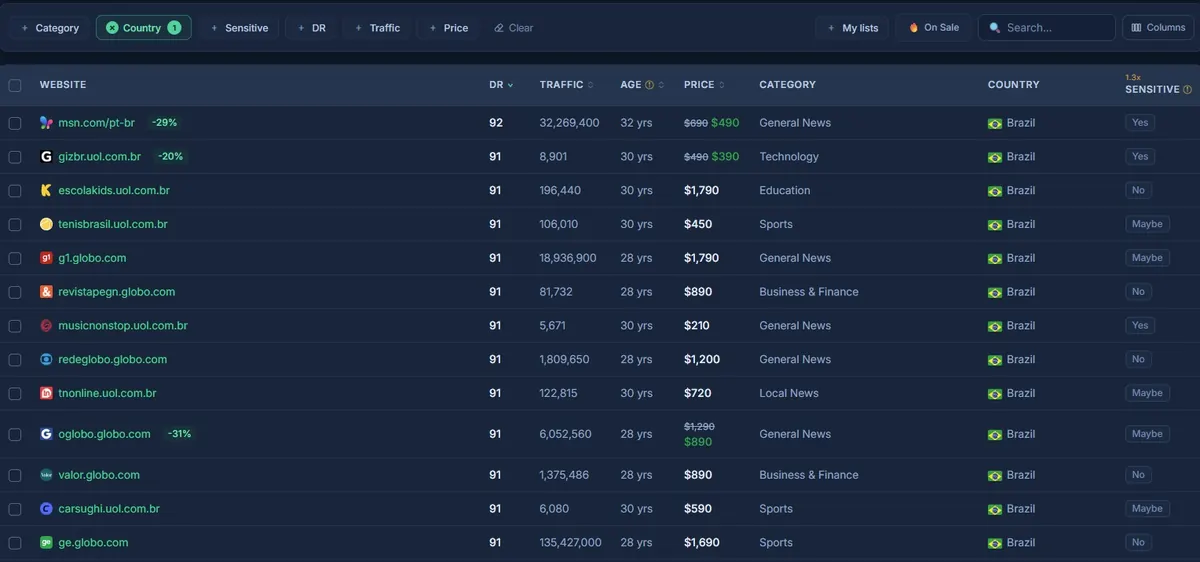
In practice, the Off-page SEO includes actions such as backlink conquest, guest posts and Digital PR. For the prospection of such vehicles, BlaaS brings together publishers that can be filtered by category, country, DR, traffic and price.
Guestposts
Investing in practices such as guest posts is an effective way to strengthen your SEO work off page. With content rich and relevant to your persona, published on partner sites, you can strengthen the authority of your brand and, from breakup, still attracts user to your address and also from your partner.
Another example of SEO off page is to mount a link building strategy. . This produces quality materials so that they are used as reference by other relevant pages. After all, the more addresses suggesting your domain as a source of credibility, the more relevance your brand will have in its niche acting.
Social networks also take visitors to the site and help disseminate content, even without direct effect on ranking. One of the most common goals in these platforms is to increase the scope of publications. Therefore, they are an important support for SEO off page.
Therefore, in addition to investing in actions within your pages, it is essential to do equally quality work on sources and paths that can attract more users to your blog. When work is done together between internal and external factors, the trend is that their websites stand out even more.
What are the best practices to optimise your content?
Now that you are already more familiar with the concept of SEO on page and its importance for the planning of Digital Marketing, how about knowing some practices that can strengthen this work?
We have separated some important tips to enhance the relevance and authority of your pages. Check it out!
Meet your audience
The first step to do a relevant SEO job on page and off page is to get to know your target audience in depth. Set a persona and monitor your behavior, which will facilitate the identification of what your demands and objectives are. Thus, it is easier to offer the right content and experience.
Focus on keywords
With the first step done, identifying the keywords that most are sought by users you want to attract becomes easier. Then, just work articles, landing pages, ebooks and other materials using the most searched terms to increase the chances of your pages being seen.
Offer relevant content
The internet is full of companies looking for ways to attract customers, so you need to make materials that are really relevant to your users. Therefore, it is not enough just to think about the volume of publication or size of articles, it is essential to produce with quality and ensure that you really help your persona.
The more content helps the user to learn or solve a problem, the greater the chances of conversion. Page time and bounce rate are good indicators for you to evaluate this, but Google does not confirm them as rating factors.
Don't forget Meta Description
Small SEO details on page can also make a big difference, and one example of this is Meta Description.
In practice, it is a short and simple excerpt of what will be addressed in that content and which will be displayed to users who do a Google search.
The meta description is not a classification factor, but Google can use it as an excerpt from the result, and a clear text, with about 150 characters, helps the user choose his link. Google can also rewrite the snippet when another part of the page responds better to the search.
SEO on page is therefore a key part in the success of any strategy in digital scenarios. Within an increasingly competitive market and trying to attract even more demanding users, it is essential to adopt practices such as those mentioned above. This is to boost the performance of your pages and achieve the best possible results.
Now that you know how SEO works on page and what you can do to improve it, how about doing a more comprehensive evaluation of their strategies? ? After all, every detail can ensure a better user experience and bring your company closer to one more conversion. So, know how to do a full SEO audit for your blog!
Content produced by Rock Content.
Want to review the SEO on your site's website page?
FREQUENTLY ASKED QUESTIONS
What is SEO on page
SEO on page refers to a set of optimisation techniques applied within a website, with the aim of improving user experience and increasing site relevance in search engines such as Google.
What's the difference between SEO on page and SEO off page?
SEO on page focuses on internal site improvements such as content, keywords and usability. SEO off page involves external actions, such as link building and social media presence, to increase site authority and attract traffic.
How can SEO on page improve my ranking?
Applying good SEO practices on page, such as strategic use of keywords and page optimisation, the site becomes more relevant to search engines, increasing the chances of being displayed in the first positions of results.
What is the importance of Meta Description in SEO on page?
The meta description is the summary that can appear below the title in the search result. It does not influence the position, but a clear text helps the user to choose your link; Google can exchange it for another part of the page when it finds it more useful.

Caio Nogueira is a SEO, GEO, link building and Digital PR expert and co-founder of WebSyd, website creation agency and SEO consulting founded in 2016. It acts with organic search strategies, digital authority construction and brand optimisation for search engines and artificial intelligence platforms. Throughout his trajectory, he participated in more than 1000 projects involving SEO, website development, content marketing and authority acquisition through backlinks and Digital PR. At WebSyd, it participates in the planning of strategies to increase organic visibility, lead generation and presence of companies on Google and AI-based search engines. As an author, it publishes content on SEO, GEO, website creation, link building and digital authority, sharing analyses, strategies and practical experiences related to organic growth of companies. Its contents and contributions have also been published in companies and vehicles of technology and marketing such as Wix, HostGator, Duda, Neil Patel, Locaweb and E-Commerce Brasil.
View all posts


 Estimate the cost

