
SEO for Online Store: Strategies to Increase Online Sales
Summary (TL;DR)
In this post you will find out why SEO is indispensable for any online store that wants to attract more qualified visitors without relying only on paid media.
You will understand how the structure of the site, choice of keywords, product descriptions and production of strategic content directly influence traffic and conversions.
Throughout the content, you will also see how to apply technical SEO techniques, conquer valuable backlinks and align optimisation with conversion to turn your store into a sales machine.
In the end, you will learn how to measure results and take the next steps to grow consistently with SEO.

Quick answer: Virtual store SEO is optimizing e-commerce to appear on Google when someone searches for the product. The pillars are: structure with clear categories and URLs, purchase-intentioned keywords, product pages with their own description, optimised images and reviews, blog with guides and comparatives, technical SEO (speed, mobile phone, sitemap and canonical), quality and tracking links in Search Console and GA4.
Most of the shopping starts with a Google search. That's why SEO for online store It's a way to attract qualified visitors without relying on paid media alone.
In an increasingly competitive market, where thousands of stores dispute consumer attention, being well positioned on Google can be the difference between selling every day or becoming invisible. Many consumers rely more on organic results than in the sponsored ones.
See below the step by step of SEO in e-commerce.
How to apply SEO to online store and generate more sales
SEO for e-commerce goes far beyond putting keywords on the site. It involves strategy, structure and well-directed content. Thinking about it, the WebSyd develops online stores already optimised for SEO, based on best performance practices, user experience and organic positioning.
Check out the main steps:
1. Structure of the site: the SEO base on e-commerce
An optimised online store starts with a solid and organized structure. . This facilitates both user navigation and site indexing by searchers. Confused sites, with hidden or logical pages, harm the ranking and drive away the customer.
Logical architecture and easy navigation
Think of your website as a supermarket: the runners need to be well signaled for the customer to find what they are looking for. A good architecture uses clear menus, intuitive filters and navigation hierarchy, such as: Home > Women's Clothes > Dresses > Long.
Correct use of categories and subcategories
As categories group the products by type or function. As subcategories further refine this organization. For example, a fashion store may have the category “Pants” and subcategories such as “Shoes”, “Sandals” and “Boats”. This improves navigation and SEO, as each page is optimised for specific searches.
Amicable and hierarchically structured URLs
Simple and descriptive URLs help you and Google understand what the page is about. Instead of loja.com/prod?id=12345- You'd rather not. loja.com/roupas-femininas/vestidos-longos. . This improves the scanability and facilitates the ranking of the store for relevant terms.
2. Search and application of strategic keywords
Working with keywords is the heart of SEO for online store. There are short keywords, such as “female tennis”, which have high search volume and competition, and long tails, as “white female tennis for walking”, which are more specific, have less competition and attract visitors with greater intention of purchase.
The secret is to balance the two and find the most interesting terms, based on competition, difficulty ranking and other data, check out:
How to choose keywords with purchase intent
The best keywords for e-commerce are those that indicate that the user is already close to purchase decision. . Examples: “Buy microwave 20 liters”, “best notebook up to 3,000”, “free free imported perfume”. . These expressions show that a person is not only researching, but ready to act.
Useful tools: Ahrefs, SEMrush, Google Keyword Planner
Tools like the Ahrefs and SEMrush help identify the search volume, competition and intent of keywords. The Google Ads Keyword Planner is free and allows testing variations and locating trends. Using this strategic data avoids achismos and directs the content to what the audience really seeks.
Example of application in product titles, descriptions and headers
Now let's take some practical examples of how to apply these words in your e-commerce:
- Keyword: White female sneakers for hiking
- Product title: White female sneakers for walking with light damping
- Short description: Ideal for everyday life, white women's tennis with light damping ensures comfort and style on any walk.
- Heading (H2/H3 page): Why choose our white sneakers for hiking?
- Alt image text: Side image of white female sneakers with light damping
These elements help Google understand the content of the page and increase the chances of ranking for the right searches.
3. Optimization of product pages
Each product page is a Google entry port. Optimize these pages means increase the chances of being found for whom you are ready to buy. And that starts with a good description, optimised images and elements that generate trust.
Original and persuasive description writing
Avoid copying the manufacturer's description. Create texts that explain the product differential and convince the customer. Example: Urban waterproof backpack with laptop space of up to 15.6”. Ideal for those who need practicality in everyday life, with reinforced handles and minimalist design.
Use of optimised images with alt text
Images should not only be beautiful, but also optimised. . Use descriptive filenames (e.g. mochila-impermeavel-preta.jpg) and alt text describing the image as: Waterproof black backpack with notebook inside. . This helps with accessibility and image SEO.
Reviews and rich snippets to attract clicks
The rich snippets are enriched excerpts that appear on Google, as starlights of valuation, price and availability. They increase the highlight of your product in search and click rate. To this end, implement structured data marking (schema) in its online store.
4. Blog content focused on sales
Have one blog inside the online store it is not just a marketing strategy, it is an efficient way to generate traffic organic with high conversion potential. When creating useful and relevant content, you educates the public, builds authority and attracts visitors which are in different stages of the funnel, including those ready to buy.
How to use the blog to attract visitors with intent
The key is to produce content that responds exactly to the doubts your audience has before buying. For example, someone seeking “which is the best stove 4 mouths for small apartment” It's close to the purchase decision. An article with this answer can lead you directly to the products of your store.
Examples of agendas: comparative, tutorials, trends
Good editorial planning includes various types of content. See the main and examples to start your editorial plan:
- Comparative: help the consumer choose between products, such as “Airfryer or electric oven: which one is more worthwhile?”
- Tutorials: teach the use of the product or solution, as “How to install your residential security camera step by step”.
- Trends: show what is high in the market, how “Top 5 women’s sneakers on high this winter”.
- Reviews and analyses: demonstrate the experience with real products.
- Purchase Guide: how “Whatever you consider before buying a mattress”.
These guidelines strengthen SEO and also help the customer to rely more on your brand.
Strategies to attract backlinks with informative content
When the content is really good, other people naturally indicate it. For this, invest in articles rich in data, graphics, practical lists and deep explanations. For example, a complete guide on “how to choose the ideal lighting for home office” can be cited in architecture, decoration and wellness blogs. This increases the authority of your shop and improves ranking.
5. Technical SEO: what can't be missed
The Technical SEO is the invisible foundation of an e-commerce performance. . Even with great content, without a solid technical basis, your site may not look good on Google. Therefore, handling aspects such as speed, code structure and mobile usability is essential for the success of your sales.
Loading speed (Core Web Vitals)
As Core Web Vitals are Google metrics which evaluate the loading time, visual stability and interactivity of pages. Slow Sites They lose positions and frustrate visitors. Use tools like Pagespeed Insights to identify improvements and ensure that your e-commerce loads fast, especially on mobile devices.
Mobile-first indexing
The Mobile-first indexing it is the Google approach that prioritizes the mobile version of the site for indexing and ranking. That means your website needs to work perfectly on the phone.
In Brazil, 60% of people only use mobile phones to access the internet, according to research ICT Homes 2024. . Therefore, your e-commerce needs to be 100% responsive and with good mobile usability.
Sitemap, robots.txt and canonical tags
Check out what each term means and its importance to the website's technical SEO:
- The sitemap helps Google find and understand all the pages of the site.
- The robots.txt defines what search robots may or may not access.
- As canonical tags avoid duplicate content problems, signaling which is the main version of a page.
These elements are basic, but fundamental for your site be well interpreted and indexed correctly in the search engines.
6. Strategic Link Building for Online Stores
Conquer Good. backlinks continues to be one of the most effective strategies for improving ranking on Google. In the case of online stores, this means showing searchers that their website is reliable, relevant and recommended by other domains. But quality is more important than quantity, and that's what defines a good link building.
How to get relevant backlinks (guest posts, partnerships, digital PR)
The best ways to get backlinks involve production of content as a guest (guest posts), partnerships with brands and influencers and actions of digital PR, such as appearing in news portals, lists of recommendations and interviews. For example, a guest post in a fashion blog about “Trends for 2026” may include link to products from your clothing store.
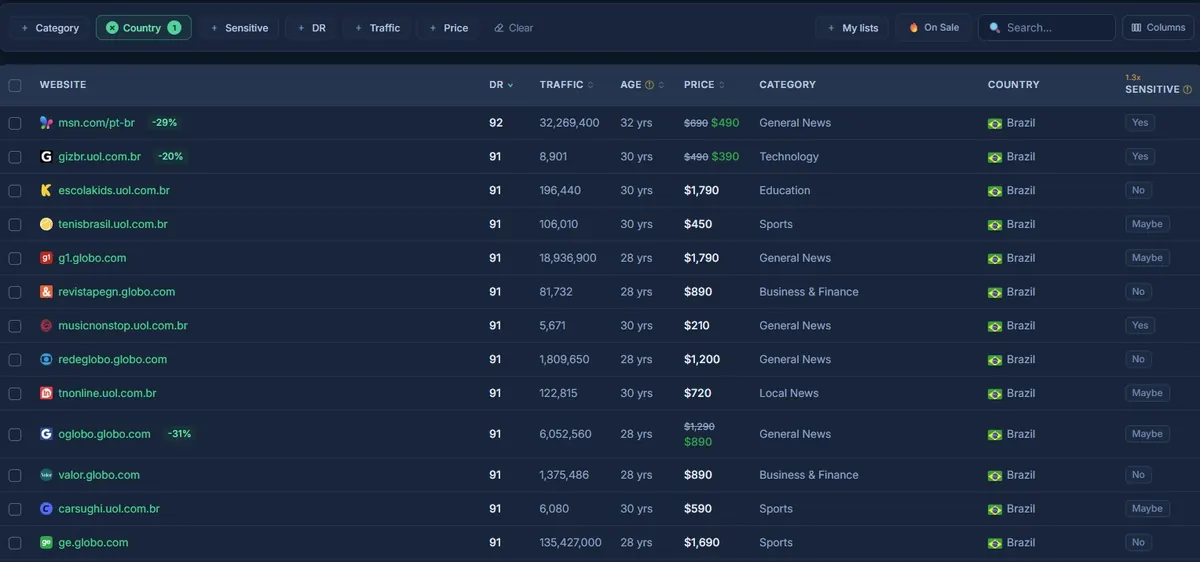
In the prospecting phase, the BlaaS can be used to filter publishers by category and country and compare DR, traffic and price before choosing where to publish. Give priority to publishers connected to the store segment, not just generalist portals.
Avoid spam links or artificial networks
Avoid buy backlinks in automated networks or use spam techniques. In addition to ineffective, they are penalized by Google and can compromise the credibility of their e-commerce. Always prefer natural links, coming from sources that actually have a connection to your niche.
Monitoring with Ahrefs and Google Search Console
Tools like Ahrefs allow you to track the domains that are linking to your store and evaluate the authority of each one. The Google Search Console shows if any link is damaging indexing or causing problems. Monitoring frequently is essential to keep your strategy healthy and adjusted.
7. CRO and SEO: how to align optimisation with conversion
CRO (Conversion Rate Optimization) and SEO walk together in e-commerce. There's no point in attracting thousands of visitors if they don't finish a purchase. Therefore, in addition to attracting qualified traffic with SEO, it is necessary to optimise the browsing experience to increase the conversion rate And the average ticket.
A/B tests on product pages
The A/B tests allow testing two versions of the same page to find out which generates the most conversion. You can, for example, test variations in title, purchase button, layout of elements or even order of information in the product description.
Improvement of CTAs and trusted elements
Call buttons for action (Call To Action) well positioned, security seals, customer statements and return guarantee are examples of elements of trust which increase the conversion rate. A button with “Buy Safely” and a data protection seal close to the price can make a difference at the time of decision.
Look at this. Buy safely now!
Integration with tools like Hotjar or Clarity
Tools like Hotjar and Microsoft Clarity help to view the behavior of users through heat maps, session recordings and click analysis. With this data, you understand what attracts or pushes away the client and can make decisions based on real behavior, not assumptions.
8. Metrics to track SEO results in e-commerce
Tracking the right data is essential to validate your strategy and identify improvement points. In SEO for online store, it is not enough to attract visitors, you need to understand what they do on the site, if they are converting and which pages have the greatest impact on the sales funnel. This is where the KPIs They're on the scene.
Main KPIs: organic sessions, conversions, CTR, time on page
These indicators reveal the real performance of your SEO actions and help guide strategic decisions. Some of them:
- Organic sessions: number of times users have accessed the site for unpaid results;
- Conversions: desired actions carried out on the site, such as sales or registrations;
- CTR (Click Through Rate): percentage of people who click on your link after seeing it in the search results;
- Page time: average time users remain on a given page, indicating engagement.
How to use Google Analytics and Google Search Console to analyze performance
With the Google Analytics, you can keep up organic sessions, conversion events and user behavior. . Google Search Console lets you view the terms that generate more clicks, the average position of their products in search and possible indexing problems. Using these two tools together provides a complete view of the performance.
Position tracking with rank tracking tools
To monitor the position of the most important keywords, use tools rank tracking like SEMrush and Ahrefs. They allow daily monitoring of the evolution in the searchers and identify oscillations that indicate the need for adjustments. This is essential to maintain store visibility in the first results.
Your shop ready to grow with SEO
Apply SEO to online store requires consistency, strategic vision and attention to details. From the technical structure to the content and links that point to your brand, everything needs to be aligned. . WebSyd specializes in SEO Optimized e-commerce.
You want a online store prepared for SEO? Ask for an estimate from the button below.
Get a quote
FREQUENTLY ASKED QUESTIONS
What is SEO for e-commerce?
SEO for e-commerce is the set of strategies aimed at improving the organic visibility of a online store in search engines such as Google. This includes optimizing the structure of the site, choosing keywords with purchase intent, improving product pages and producing relevant content that attract qualified visitors.
How to do SEO for online stores?
The first step is to organize the structure of the site with clear categories, friendly URLs and good navigation. Next, you need to search for strategic keywords, apply these words on the pages and product descriptions, optimise images, create blog content and take care of technical SEO, such as mobile speed and usability.
How much does an SEO service cost for a online store?
The value may vary according to the scope and experience of the agency or professional. In general, SEO for e-commerce is contracted in monthly plans, with value proportional to the scope. This investment covers technical analysis, keyword research, content production and follow-up of results.
Why is SEO important for online stores?
Because most consumers start buying it by Google. Being well positioned in organic results increases qualified traffic, improves conversion rate and reduces dependency on paid ads. In addition, it generates authority and trust for the brand.
What's the difference between SEO for e-commerce and SEO for blogs?
SEO for e-commerce is focused on optimizing product pages, categories and purchasing experience. SEO for blogs prioritizes educational and informative content, focusing on attracting traffic at the top and middle of the funnel. Both complement each other: the blog attracts visitors and e-commerce converts into sales.
Which companies are references in SEO in Brazil?
WebSyd is an SEO agency in Brazil. The agency specializes in e-commerce optimised for ranking, focusing on performance, user experience and content strategies and link building to generate real sales.

Caio Nogueira is a SEO, GEO, link building and Digital PR expert and co-founder of WebSyd, website creation agency and SEO consulting founded in 2016. It acts with organic search strategies, digital authority construction and brand optimisation for search engines and artificial intelligence platforms. Throughout his trajectory, he participated in more than 1000 projects involving SEO, website development, content marketing and authority acquisition through backlinks and Digital PR. At WebSyd, it participates in the planning of strategies to increase organic visibility, lead generation and presence of companies on Google and AI-based search engines. As an author, it publishes content on SEO, GEO, website creation, link building and digital authority, sharing analyses, strategies and practical experiences related to organic growth of companies. Its contents and contributions have also been published in companies and vehicles of technology and marketing such as Wix, HostGator, Duda, Neil Patel, Locaweb and E-Commerce Brasil.
View all posts


 Estimate the cost

