
Ranking site on Google: 6 steps to position on the front page!
Summary (TL;DR)
In this post, we will address a complete guide to help you rank your website on the first page of Google.
We will explore from the identification of strategic keywords to the analysis of competitors and the continuous improvement of their pages.
We will discuss the importance of focusing both on ranking and traffic, highlighting how to create relevant content that meets users' search intentions.
Finally, you will learn how to measure results and replicate the strategy to optimise other keywords, ensuring a steady flow of growth for your website.

Quick answer: to rank a site on Google, choose keywords with search intent aligned to business, create the page that best responds to this search, optimise title, headers and internal links, ensure a fast and traceable website and get links from relevant websites. The results usually show up in months, not days.
When a company creates strategies to rank site on Google, the intention is for pages to be found in searches. Preferably on the front page, right?
Unfortunately, as the competition for good placement on Google is very large, it is common for people to feel frustrated.
But to help you rank your site on the first page of Google, we share this complete guide for your strategy.
In short, this is the process:
- Find the keywords that you still don't get a good position on Google.
- Understand why the pages of your competitors are better than yours.
- Compare your page with the competitors' and improve it.
- Repeat the first 3 steps for the next keywords.
See in the video below a complete step by step:
Step 1: Find the keywords that you still don't have a good position on Google
First, let's define what is a good position on Google. Although usually this is defined as “the first page of Google”, the best thing really is to secure the first positions.
Let's better understand what this means in the graph below Click Through Rate.
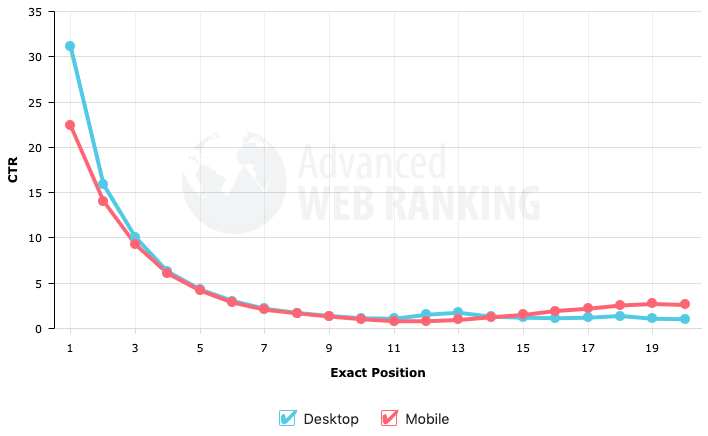
Source: https://www.advancedwebranking.com/free-seo-tools/google-organic-ctr.
In this graph, data from the first 19 are presented. Google results for a series of keywords. And it's possible to realize that only the first results have a good click rate result.
With this, if we consider a keyword with 10,000 searches per month, we have the following situation:
| Initial position | Final position | Growth of accesses per month |
| 5ª | 4ª | 210 new visitors |
| 20ª | 10ª | 8 new visitors |
As you can see, it's much more worth moving from 5th to 4th position than from 20th to 10th. So what you should do is work with those keywords with positions from 2 to 10, which will result in the best results.
For this, you can filter out the keywords for which your site is positioned between 2nd and 10th position.
Step 2: Choose keywords to rank site on Google
With the result of which keywords your domain has positions from 2 to 10 on Google, it's time to act.
Which keywords should I start the optimisation work with? For the answer, see some important tips.
a. Keywords that generate the biggest traffic to your website
In general, keywords that already perform the best results for your site, but do not yet occupy the first ranking positions, should be chosen.
b. High volume of searches
Next, we need to pay attention to the volume of searches. After all, doubling the traffic of something that has zero search volume will remain zero.
Below, see an example of a low search volume. Note that this would not generate such positive results for the company even if it went from position 3 to 1.
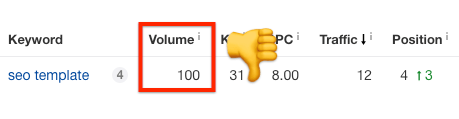
Source: https://ahrefs.com/blog/how-to-rank-higher-on-google/.
c. Low ranking difficulty
The difficulty of ranking a keyword ranges from 0 to 100. And those words with numbers closer to the upper limit, they'll be harder to work on.
Thus, different from the volume of searches (which should be high), the difficulty of ranking should be low.
d. High commercial value
By understanding what these keywords are, it will be even clearer what the priority of your work should be.
Let's take an example of a bakery in Campinas. By being able to rank first for the keyword “Padaria em Campinas”, it is practically guaranteed that the business will grow.
On the other hand, when ranking 1st for the keyword “home-made bread recipe” the chances of having direct results for business are much lower.
That is, even if the volume of searches for “home-made bread recipe” is higher, the financial results are not as positive as those of the keyword “Padaria em Campinas”. All of this is connected to search intention.
And. Keywords that are not tag names
At this point, it is necessary to consider whether the keywords you are looking to improve ranking are not a brand of another company.
See the example below:

Source: https://ahrefs.com/blog/how-to-rank-higher-on-google/.
At first, this may seem like a great keyword to seek better positions because:
- It has a high volume of searches;
- Mean difficulty/high;
- In the example the site is already positioned at 6°.
But by observing which pages are in positions 1 to 4 for this keyword, we have several results from Google itself.
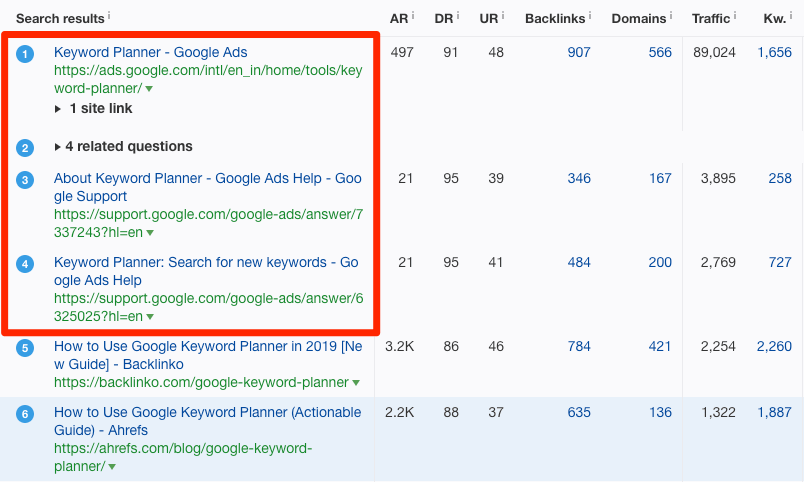
Source: https://ahrefs.com/blog/how-to-rank-higher-on-google/.
This is because “Keyword Planner“ It’s a Google product. And in this way, it will take a very large effort (or even impossible) to improve the ranking of this page.
f. Keywords that do not have snippets or other highlights in SERP at positions above your own
A SERP (Search Engine Results Page) is the entire results page of Google. In some SERPs we have prominent elements, such as featured snippets. You have probably already used these results to quickly find some quick response on Google.
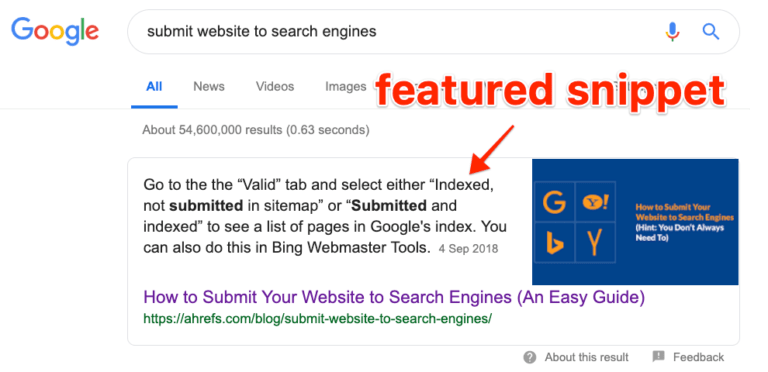
Source: https://ahrefs.com/blog/how-to-rank-higher-on-google/.
As you can imagine, reaching a privileged position like this requires quite an optimisation of the page, and of a site with great authority.
So at this first moment, the ideal is no. choose these keywords more complex to begin with.
Step 3: Understand why the pages of your competitors are better than yours
There are several reasons for a page to have better ranking positions on Google than yours. Understanding these reasons is very important in order to create an effective strategy.
The most traditional reasons are:
- Quantity of reference domains, which in other words means how many different sites are linking to yours.
- Authority of the backlink pages.
- Authority of your website.
However, another very important factor, which we will address first, is the call search intention.
Search Intent
The intention of searching is nothing more than the real reason why people use searchers. And Google understood that people are not just doing research to buy things on their platform, but are mainly seeking knowledge.
Therefore, by typing “link building” into Google, you will not find as the first result a company that offers this service. On the contrary, the first results will be of informative pages on the subject.
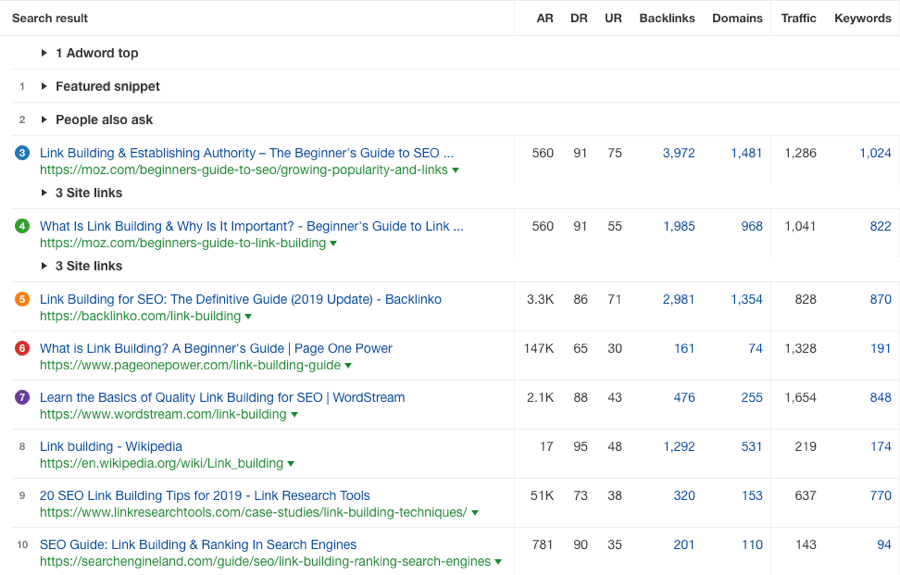
Source: https://ahrefs.com/blog/how-to-rank-higher-on-google/.
And what does that mean to you that you want to understand why your competitors' pages have better Google positions than yours?
This means that you should evaluate the content of these pages, to then improve yours.
If your competitor can explain in a clearer, more interesting and informative way to users about any subject, the chances of Google ranking this page better are great.
To do this analysis, the following criteria must be considered:
- Type of content;
- format of the content;
- The quality of the information contained in the content.
1. Type of content to rank site on Google
There are basically 3 types of content:
- Blog posts;
- Product description;
- Catch pages (landing pages), where visitors arrive to have access to rich materials such as ebooks or webinars.
2. Content format
Content formats apply to blog posts and landing pages. For blog posts, it is possible to work with lists, tutorials in step, tips and also opinion content.
For landing pages, it is possible to use some tools developed by your company to attract visitors, budget calculator, among others.
3. The quality of the information contained in the content
Finally, but not least, you must produce quality content for your future customer. It is of no use to produce content of different types and formats, if the quality is bad.
Therefore, the focus should always be on solving the search intention of users, either by solving doubts, explaining processes or even listing tips.
Now let's go back to the traditional reasons we quote above, so you understand how to work each one of them.
a. Amount of referenced domains
Ahrefs conducted a study with almost 1 billion pages to understand that there is a clear relationship between reference domains and keyword ranking.
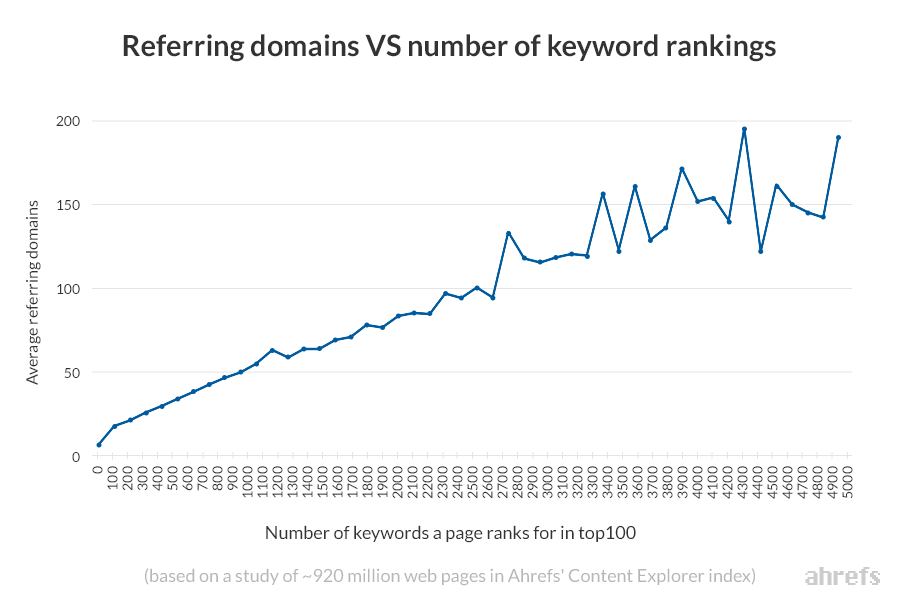
Source: https://ahrefs.com/blog/how-to-rank-higher-on-google/.
Thus, it is possible to conclude that the more domains with high authority link to your site, the better your results will be on Google.
Consider a practical example:
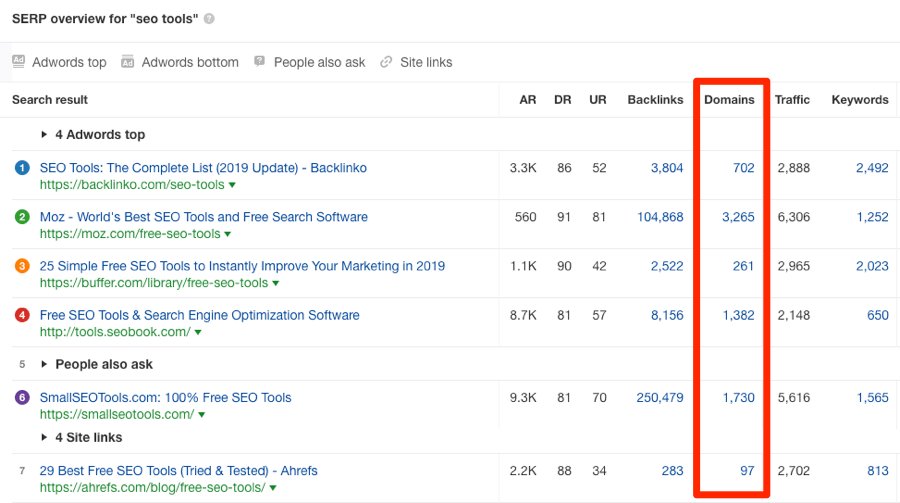
Source: https://ahrefs.com/blog/how-to-rank-higher-on-google/.
In this example, you can see that the page in position 7 has much less referring domains than the pages in the above positions.
However, as there are other determining factors for this prominent position, simply having links from many domains will not make you reach the coveted position 1.
b. Backlink Page Authority
When you receive a link from another site it is necessary to check two things:
- Link Contextuality: The link should be primarily on a site of the same niche as yours. If it is a site from another niche, the ideal is that at least it is contextualized during the text.
- The Strength of the Domain: This means that when your site is quoted on another page with equal or greater force than yours, it will generate a positive impression to Google.
See the example below:
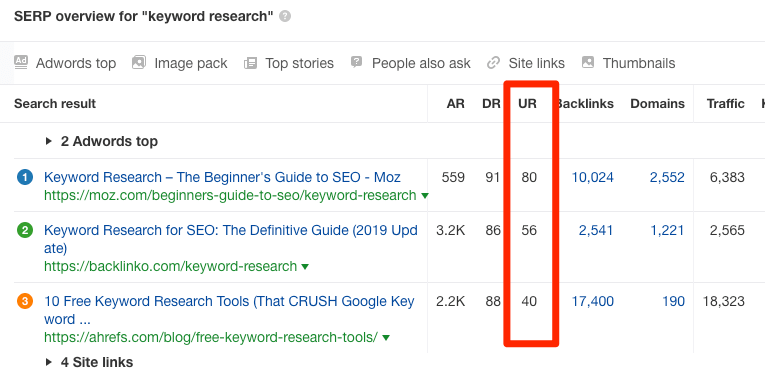
Source: https://ahrefs.com/blog/how-to-rank-higher-on-google/.
Observe the UR (URL Rating) and Backlink in this example. The result that appears in 3rd place has more backlinks than the results in positions 1 and 2.
However, the UR of these first two pages is higher than that of heading 3. This shows that the quality of backlinks is more important than the amount of backlinks.
c. Authority of your website
Understanding the authority of a page is a bit complex even for Google.
While Gary Illyes states that they do not use site authority metrics, John Mueller says Google observes some metrics to map this type of information.

However, even if it is a question full of doubts, it is interesting to always invest in strategies to improve the overall authority of the site.
One way to do that is to get it. good backlinks as explained above. And of course, investing in content production quality, and that answers the questions of users who are accessing your site.
Step 4: Compare your page with that of competitors and improve it
Now that you know what are the points where your competitors are better than you, you need to improve your pages. Understand how to improve each point in the sequence.
If the number of reference areas is the main problem
You should increase the amount of quality backlinks to your page. This can be done through:
- Publication of guest posts (publish texts in other domains relevant to your niche and cite your website).
- Digital PR actions and editorial partnerships (studies, own data, interviews) that generate mentions and links on relevant websites. Avoid creating own site networks (PBNs) just to generate backlinks: this practice violates Google's spam policies.
- Buy backlinks of a company specializing in SEO.
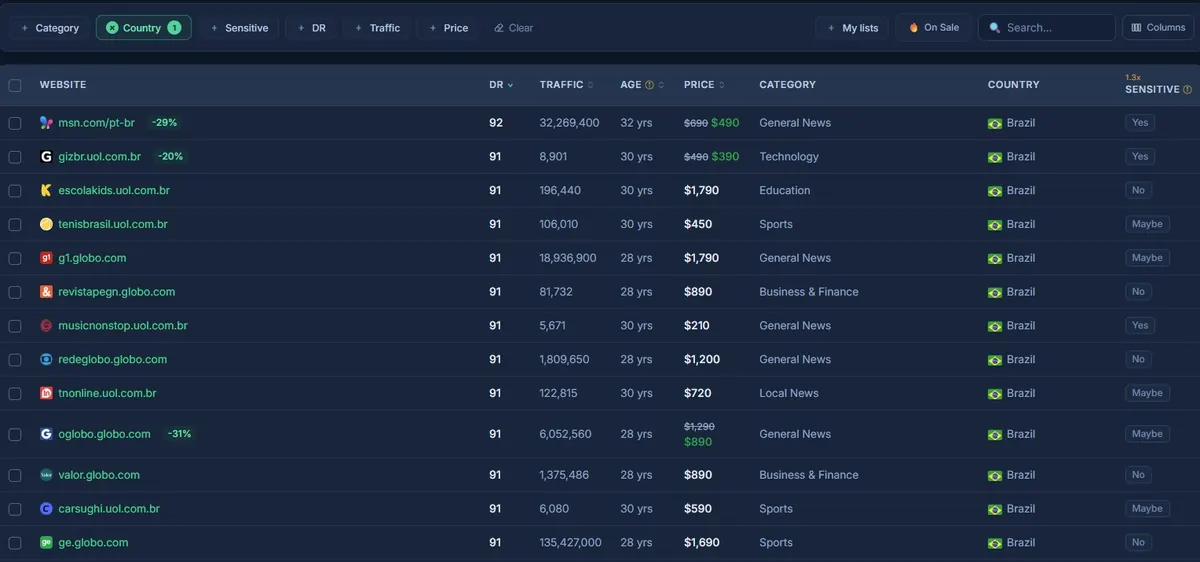
To map new reference domains more quickly, the BlaaS allows you to search publishers and compare category, country, DR, traffic and price before publication.
If the authority of the backlink pages is the main problem
- Seek to improve the quality of your backlinks (see above).
- Create a strategy to internal linking on your website.
Ideally, you do both. But if you cannot create good backlinks in the short term, you can first invest in a solid strategy of internal links. This way you will be able to see an improvement in the authority of your website.
If the authority of your website is the problem
This is the hardest point to work with, as it takes more time and dedication to achieve results.
But in general, working on the other points quoted in this text you will already see an evolution in your authority. After all, you will be providing better content for your visitors, in addition to being quoted in other areas of high authority.
And also remember whenever:
To rank site on Google, there are hundreds of factors to improve the authority and position of pages in keywords searches.
Therefore, several actions will impact its results:
- Ensure a good experience for your user;
- Invest in SEO of your website and each content produced;
- Have one responsive site And fast.
Step 5: After making the improvements you need to check the results
In addition to evaluating and acting on all the points mentioned above, it is necessary to measure the results.
Something very positive about digital marketing is precisely this power to evaluate the actions taken, and understand if they were the best choices.
For this, you should regularly evaluate whether the pages you have optimised are presenting better results for keyword searches. In addition to monitoring your main competitors as well.
Step 6: Repeat the first 3 steps to other keywords
Being able to rank a keyword among the first 1-5 Google positions will already be a great achievement for you. However, reaching more and more well placed pages is even better.
So, after you organize the workflow and tools needed to do all this for the first keyword, the ideal thing is that you continue for others later.
Be careful not to just focus on ranking and forget about traffic
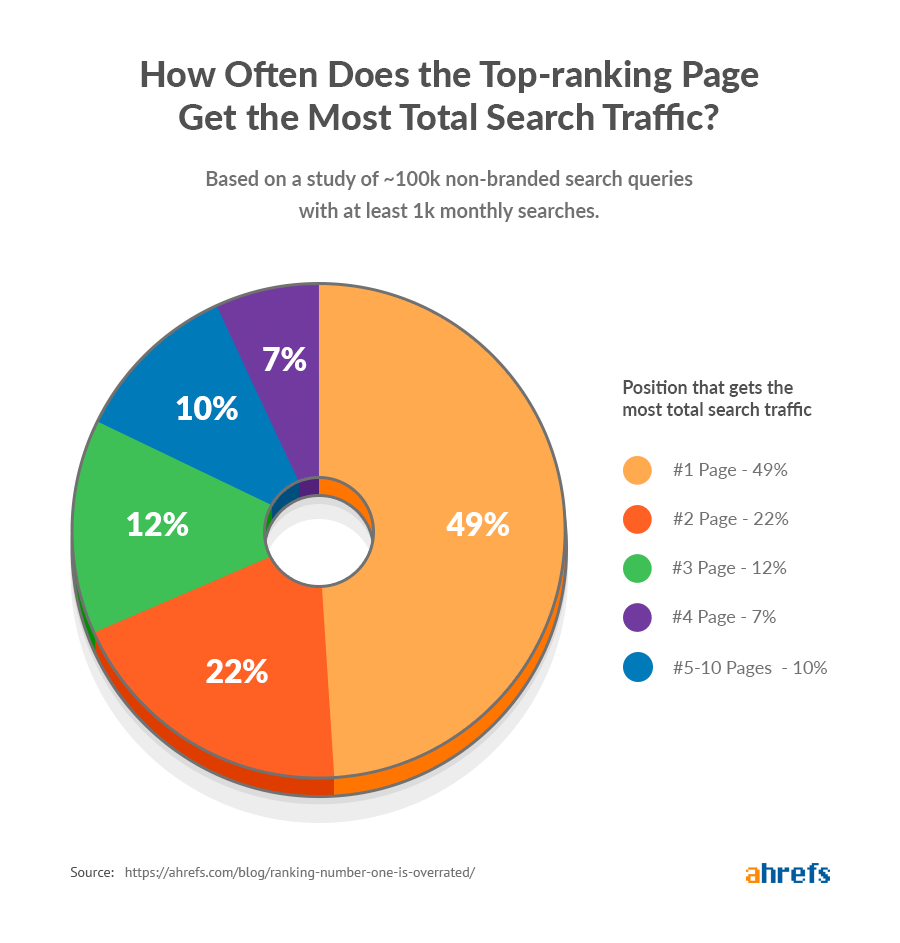
In a search, Ahrefs found that from the top 10 pages to more than 100,000 keywords, only in 49% of cases these pages were the ones that generated the most organic traffic for companies. See the chart below:
Source: https://ahrefs.com/blog/how-to-rank-higher-on-google/.
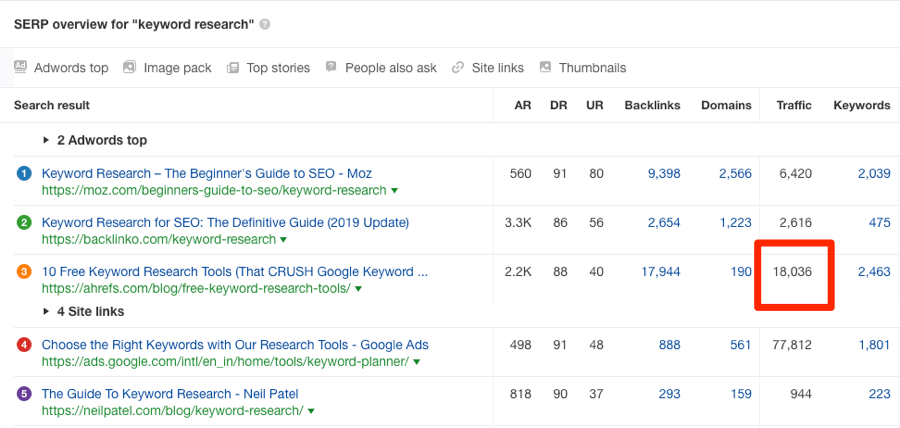
For this relationship to be clear, let's show one more important example:
Source: https://ahrefs.com/blog/how-to-rank-higher-on-google/.
In this ranking, you can see that even though the Top 1 page is not for the keyword search, the Ahrefs page in position 3 is the one with the most traffic.
In addition, in the final column “Keywords” of the table, we realize that the page in position 3 is ranked for more than 2,400 keywords. As a result, the traffic generated is much greater.
Therefore, it is important that in addition to investing individually in improving each page of your site, you produce relevant content and that you can have great results for even more than one keyword at the end.
It is of no use to produce an article about “home-cooked wheat bread”, and then another article on “industrial wheat bread”. In that case, the best option is you. create content really rich and that addresses both keywords.
As a result of a well-thought-out strategy, more qualified visitors will reach your site, and consequently you will win more and more customers.
How to produce this type of content to increase traffic?
- Address the subject with as much detail as possible (minimum 1000 words per content);
- Create a page that transmits authority on the subject (up-to-date content, with data, images and examples);
- Hit the content approach according to user search intention.
- Try to reach prominent positions such as featured snippets
Conclusion
As you noticed, positioning a page on the first page of Google is not something simple. Also, it's not an exact science.
But starting with the key words most relevant to your business is the best option.
Therefore, try to understand which keywords are more likely to generate results, and invest their time and dedication in them.
By following the steps listed in this guide, you will be closer to achieving your goals.
FREQUENTLY ASKED QUESTIONS
How can I identify the most important keywords to optimise on my website?
Use SEO analytics tools to identify keywords where your site is already ranking between 2nd and 10th position and which have high search volume and low level of competition.
What are featured snippets and how can I achieve that position?
Featured snippets are highlighted responses that appear at the top of Google results. To win them, create content that responds directly to users' questions clearly and concisely.
Why is domain authority important for ranking on Google?
The domain authority is a metric that indicates the relevance of your website. The higher the authority, the more chances your pages have of ranking well in search results.
How should I proceed after optimizing a page?
After optimizing a page, regularly monitor search results to assess the impact of changes. If necessary, make additional adjustments and repeat the process to other important keywords.

Caio Nogueira is a SEO, GEO, link building and Digital PR expert and co-founder of WebSyd, website creation agency and SEO consulting founded in 2016. It acts with organic search strategies, digital authority construction and brand optimisation for search engines and artificial intelligence platforms. Throughout his trajectory, he participated in more than 1000 projects involving SEO, website development, content marketing and authority acquisition through backlinks and Digital PR. At WebSyd, it participates in the planning of strategies to increase organic visibility, lead generation and presence of companies on Google and AI-based search engines. As an author, it publishes content on SEO, GEO, website creation, link building and digital authority, sharing analyses, strategies and practical experiences related to organic growth of companies. Its contents and contributions have also been published in companies and vehicles of technology and marketing such as Wix, HostGator, Duda, Neil Patel, Locaweb and E-Commerce Brasil.
View all posts


 Estimate the cost

