
Optimize Digital Portfolio for SEO: Step-by-step Guide to 2026
Summary (TL;DR)
In today's post we will talk about the importance of optimizing your digital portfolio with SEO strategies to attract more qualified visitors and appear in Google's top positions.
We approach how the correct use of keywords, site structure, image optimisation and technical SEO can transform your portfolio into an effective and relevant showcase, capable of generating opportunities even without relying on social networks.
In conclusion, we show that, in addition to visual beauty, a portfolio needs to be functional and strategic.
A well-optimised website ensures organic visibility, credibility and continuous presence in searchers, following user behavior trends and providing consistent results for those who want to grow intelligently in 2026.

Quick answer: to optimise a digital portfolio for SEO, search the words that your customers use (service + specialty + city), give each project a page of its own with title, description and text about the challenge and result, optimise the images (file name, alternative text and weight), leave the site fast and good on the mobile phone and search links from sites in your niche.
Having a digital portfolio is essential for those who want to show their work professionally and win new opportunities. But creating a beautiful presentation is not enough, if no one finds your site, all effort loses impact. That is where the importance of optimizing digital portfolio for SEO: make your content visible to those who really search for the services you offer.
With competition increasingly fierced by online attention, investing in SEO for digital portfolio is more strategic than ever. The way people look for professionals on the internet is changing rapidly, and appearing in Google's top positions may be the difference between conquering new projects or becoming invisible.
Adjust your portfolio to meet the criteria of modern algorithms helps gain authority and generate business organically.
If you are wondering how to appear on Google with a portfolio, this step by step guide will show you exactly what to do. Let's talk about keywords, site structure, image optimisation, on-page SEO techniques and more, all with examples.
Importance of SEO for Online Portfolios
Having a good visual material or amazing designs is only half the way. If you really want to stand out, you need to work the online portfolio With strategy. Optimization is what makes your site appear to potential customers, partners or recruiters the moment they seek exactly what you offer.
Check out below why investing in SEO for portfolios is so important:
1. Increase organic visibility
An optimised SEO portfolio increases your presence in organic searches, i.e. in Google's natural positions without needing paid ads. The more optimised your content is, with good keywords, correct structure and relevant content, the more it appears for those who really look for your services.
That generates a continuous flow of qualified visitors, increasing your chances of conversion and strengthening your image in the market consistently over time. An invisible portfolio is like a closed window, SEO is what opens this showcase for the world.
2. Enjoy the growth of local and niche searches
Many people seek looking for specific professionals for specific needs and close to them.
With a well done SEO, your portfolio can appear in research such as “residential architect in Rio de Janeiro” or “childbook enlightener in BH”, connecting you directly with those who are really willing to hire.
Localization and specialty segmentation is no longer a differential, it is a strategic need for those who want to grow.
3. Building authority and credibility
When your portfolio appears in Google's top positions, it immediately conveys a feeling of authority. . Even if the customer does not know your work yet, the fact that you are at the top passes the message that you are reliable, relevant and a reference in your segment.
This psychological effect is very strong in the behavior of the current consumer. Working SEO is not just about attracting traffic, it's about building a solid reputation without spending a fortune on advertising or promotions.
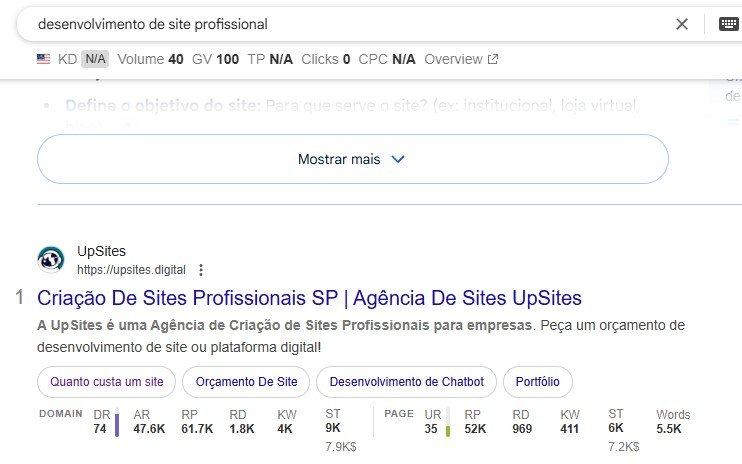
See the example of the search for “professional site development”: in print, WebSyd appears first, which reinforces the perception of reference in the theme.
4. Generate opportunities without relying on social networks
Although social networks are important channels of dissemination, they are extremely volatile: algorithms change, organic reach falls, and maintaining relevance requires daily effort. SEO for portfolios allows you to create a own, sustainable and less subject to external change.
This means that you generate visits and opportunities continuously, even if your social media pace decreases or platforms change their reach policies. Your website becomes a stable and independent source of new business.
5. Track user behavior trends
With the advancement of artificial intelligence and new search forms, such as voice searches and conversational commands, the way people interact with search engines is changing rapidly. Having a portfolio prepared for SEO not only improves your position today, but also ensures that you are ready for the next market movements.
To know if your portfolio already appears in the AI responses, do the Free diagnosis of GEO.
Sites with clear and well-structured answers are more likely to be cited by AI searchers.
Step by Step to Optimize Your Portfolio
In order to turn your portfolio into a truly successful showcase on Google, you need to follow a strategic process involving research, structuring and technical adjustments. In this SEO 2025 guide, we will show you in a practical way what you need to do so that your digital portfolio is found by those who matter most: your future customers, partners and recruiters. Check out the step by step:
1. Do a smart keyword search
Before any technical adjustment, you need to understand what terms people use to look for professionals in your area. Search specific keywords defining their services, for example: “residential interior designer”, “Photographer of weddings in SP”.
Search for it too Long tail variations, which tend to have less competition and attract a more qualified audience. A good SEO starts with a solid base of relevant and strategic keywords.
2. Structure your portfolio with SEO on-page
Each page of your portfolio should be optimised individually. This means using keywords in the title (H1), descriptions (H2 and H3), paragraphs and friendly URLs. In addition, create attractive titles and meta descriptions, which summarize the content in a strategic way to increase the click on the searches.
The organization and hierarchy of content facilitate browsing and help Google understand what each page is about. So always structure your SEO pages.
Here's an example of our own website:
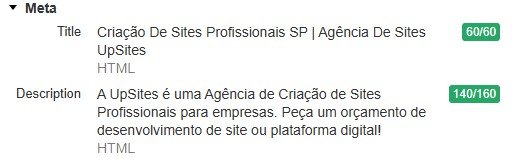
In this example we can check the Meta Title and Meta Description of our Home. See that they are optimised with keywords, and the recommended number of characters. This makes the algorithm read our page more easily.
3. Optimize your images correctly
Images are the heart of a portfolio, but also need to be optimised. . Work with optimisation of images for SEO, using descriptive file names, alternative text (alt text) and compressing the size of files without losing quality. This improves the uploading the site, helps Google index your images and improves user experience, an increasingly relevant factor for ranking.
4. Take care of technical SEO
The Technical SEO for portfolios it involves adjusting internal aspects of your site to make it more accessible and understandable for search engines. This includes setting up XML sitemap, fixing 404 errors, ensuring that your website is secure (SSL), optimizing loading time and ensuring that all pages are responsive to mobile devices.
A fast, safe and functional portfolio improves not only your ranking but also the experience of those who access it.
5. Create strategic and contextual content
It is not enough just to show beautiful images. Create relevant content around your work (such as project descriptions, backstage, used techniques, delivered solutions) generates more contextual keywords and increases the length of stay on the site.
Think like the user: the more relevant information he finds, the greater the confidence in his competence and the greater the chance of conversion.
6. Work mobile performance
Mobile traffic is dominant. Your portfolio needs to load fast, be easy to navigate on your mobile phone and have all the elements adjusted for smaller screens. Test your site on different devices and eliminate any interaction difficulties.
Google index sites by mobile version; if it is bad or incomplete, the portfolio may lose positions.
7. Search for quality backlinks
Have others Relevant websites pointing to your portfolio is one of the most powerful SEO strategies. Look for opportunities to participate in interviews, write articles for blogs from your niche, disseminate projects on inspirational platforms and participate in awards or specialised directories.
Quality Backlinks strengthen your authority and help the site in search, as long as they come from relevant websites and are not purchased.
Common Errors That Harm Digital Portfolio Optimization for SEO
Even with the best of content, some structure and optimisation errors can seriously compromise your portfolio's search performance. Often, small slips that seem harmless are responsible for making your site lose positions in Google Or push away visitors.
So it's fundamental to know what to avoid and how to fix quickly, ensuring that your portfolio is not only beautiful but also strategic and functional. See the most common errors:
1. Do not use keywords in a strategic way
Many portfolios simply ignore the use of keywords or insert terms in a forced and random way. To correct this, it is essential to include keywords naturally in the titles, descriptions and alternative texts of images, always prioritizing user experience. No exaggeration, but also without neglecting the optimisation.
2. Ignore loading speed
If your website takes a while to open, the visitor simply leaves, and Google also penalizes slowness. To resolve, optimise the size of images, use cache and choose a good hosting service. Speed is an important factor for retaining visitors and ranking.
3. Disorganized or polluted Layout
A confused portfolio, with too much information or difficult navigation, discourages the user. The correction here is to bet on a clean design, with clear visual hierarchy, good section divisions and intuitive navigation, that guide the visitor naturally to the projects.
See this case of our InterActive customer, where they show their main excursions in detail:

4. Do not have a responsive site
Today, not having a website that adapts to the mobile phone and tablet harms experience and indexing. To fix, adapt your layout for mobile-first, adjust buttons, text and images for all screen sizes and ensure a fluid browsing experience regardless of the device used.
5. Do not invest in social proof and authority
Portfolios that do not show customer ratings, success cases or partnerships lose credibility. The solution is to include real testimonials, logos of customers served, awards or certifications, reinforcing the trust of those who access. Showing authority is fundamental to converting visitors into real opportunities.
Optimization Checklist for 2026
To ensure that your portfolio is really ready to stand out in searchers by 2026, it is essential to apply a complete and strategic optimisation. Thinking about it, we've created a practical summary with the main points that you can (and should) start working immediately to strengthen your SEO for portfolio, improve responsiveness and website performance, and attract more opportunities. Check it out:
- Do a smart search for specific keywords from your niche;
- Optimize titles, descriptions, URLs and images for SEO on-page;
- Use alt text on all images and compress files for fast loading;
- Work on technical SEO: sitemap, SSL, bugfixing and mobile-first;
- Produce strategic descriptions and tell stories around the projects;
- Test and optimise the site for different mobile devices;
- Search relevant backlinks to increase portfolio authority;
- Keep the layout clean, intuitive and with fluid navigation;
- Enter social proofs, success cases and certifications to generate trust;
- Regularly update the portfolio to maintain relevance in search results.
Is it worth investing in SEO for portfolio?
Investing in SEO for portfolio is to build, little by little, a solid digital presence, capable of generating new projects, opportunities and consistent visibility over time. The combination of a well optimised, fast, responsive and strategically thought-out site is what will highlight you in the increasingly competitive market.
You want help positioning your portfolio? Meet the SEO consulting WebSyd and ask for a budget.
FREQUENTLY ASKED QUESTIONS
Why is it important to optimise my digital portfolio for SEO?
Because without optimisation, your portfolio may not be found by those who really look for the services you offer. With well-applied SEO, your site appears in Google's top positions, generating more qualified visits and real business opportunities.
Which elements of the site should I optimise to improve my positioning?
You must work titles, descriptions, URLs, images and content with strategic keywords. In addition, it is important to take care of technical SEO, such as loading time, mobile responsiveness and security (HTTPS).
Can I generate results only with social networks, without SEO?
It can, but it's risky to rely on social networks alone, because algorithms often change and organic reach has been falling. With SEO, you build your own stable and continuous traffic source without relying on external platforms.
How does SEO help build authority for my portfolio?
Being among the first Google results conveys confidence and positions you as a reference in your niche, even if one has never heard of you before. SEO not only attracts visitors, it strengthens your online reputation.

Caio Nogueira is a SEO, GEO, link building and Digital PR expert and co-founder of WebSyd, website creation agency and SEO consulting founded in 2016. It acts with organic search strategies, digital authority construction and brand optimisation for search engines and artificial intelligence platforms. Throughout his trajectory, he participated in more than 1000 projects involving SEO, website development, content marketing and authority acquisition through backlinks and Digital PR. At WebSyd, it participates in the planning of strategies to increase organic visibility, lead generation and presence of companies on Google and AI-based search engines. As an author, it publishes content on SEO, GEO, website creation, link building and digital authority, sharing analyses, strategies and practical experiences related to organic growth of companies. Its contents and contributions have also been published in companies and vehicles of technology and marketing such as Wix, HostGator, Duda, Neil Patel, Locaweb and E-Commerce Brasil.
View all posts


 Estimate the cost

