
SEO for Service Providers: How to be found on Google by your customers?
Summary (TL;DR)
In this post you will learn how SEO can transform the visibility of service providers by helping your company to appear in Google's top positions, attract more qualified customers and reduce dependency on paid alerts or ads.
You will understand the importance of defining specific and local keywords, optimizing your website, and correctly structuring your pages for each service offered.
We also show how to register and manage Google My Business, produce relevant content with regional focus and conquer strategic backlinks to increase your authority.
All of this with practical examples, free tools and applicable tips that help any provider (from therapists to electricians) grow organically and steadily.

Quick answer: SEO for service providers is making your business appear on Google when someone seeks the service in your region. The path: choose words with service and city, have a page on the site for each service with visible contact, complete the Company Profile on Google and request reviews, publish useful and local content, get partner links and track everything in Search Console.
You may be the best at what you do, have excellent service and satisfied customers, but if people don't find your company on Google, your growth will always depend on indications or social networks. And here's an important piece of information: 68% of online experiences They start with an online search. In other words, those who do not appear in research simply do not exist for most consumers. It is precisely at this point that the SEO for service providers.
It is the set of strategies that helps your site or page to appear among the first results of searches made by those who are looking for exactly what you offer. From an electrician to an aesthetics clinic, every service provider can (and must) be found organically without having to pay for advertising for it.
If you want to increase your visibility, attract more customers and make your business grow with consistency and credibility, come check out this content. Let's show you how to use SEO in favor of your service and finally be found by those who really need you.
Why SEO is essential for service providers
If your company provides any kind of service, whether face-to-face or digital, SEO is one of the Smarter strategies to attract the right audienceWithout relying on media pays all the time. He positions you in the search engines when someone searches for what you offer. Check out the main reasons:
Client today searches everything on Google
Today, most customers search online before hiring a service. . If anyone's looking for “scanner in Belo Horizonte” or “graphic designer for social networks”That person already has a real intention of hiring. And if you don't show up at that time, the contestant will come for you.
Organic traffic is more reliable than ads
Many users rely more on organic results than on sponsoredBecause the user feels that he is discovering alone what he needs, without pressure. Being among the first Google passes credibility and professionalism, and all that without spending on ads.
Helps generate qualified leads with purchase intent
Unlike social media, where people aren't always looking for something to buy, on Google the scenario is another. The person you're looking for is interested. SEO attracts exactly this audience, in pain, urgently or with a desire to solve a problem. So, the leads that arrive via organic traffic are much more qualified and ready to close deal.
Lower cost in medium/long term
Unlike ads that require constant investment, SEO is a construction: the more you work with the digital presence of your service, more results reap over time. . The return pays off, because the content and structure of your site continue to work for you 24 hours a day without needing a daily budget to appear.
Step 1: Set the right keywords for your service
Before any optimisation, you need to know what people type in Google when they seek your service. This is what will guide your entire SEO strategy. No use trying to guess or use very technical terms: the secret is in understand how your audience speaks, seeks and expresses the pain they want to solve.
Examples of local searches
Most people looking for a service want someone close, available and specialised. So, use keywords with geographic location It's one of the most effective ways to appear for those who are really close to hiring.
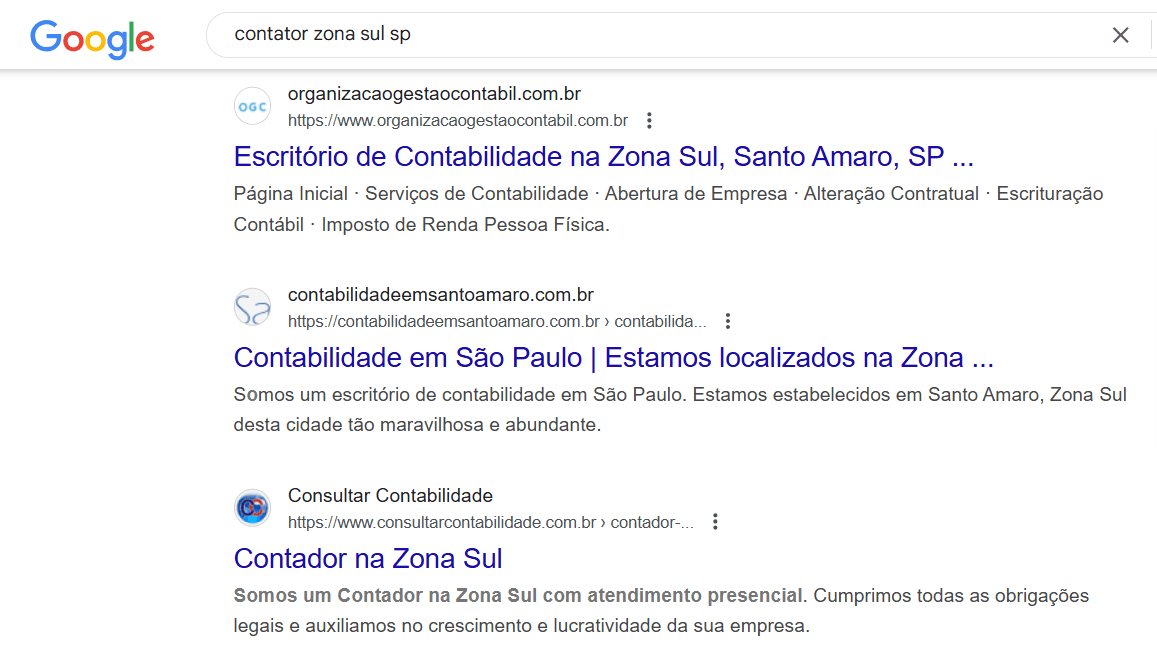
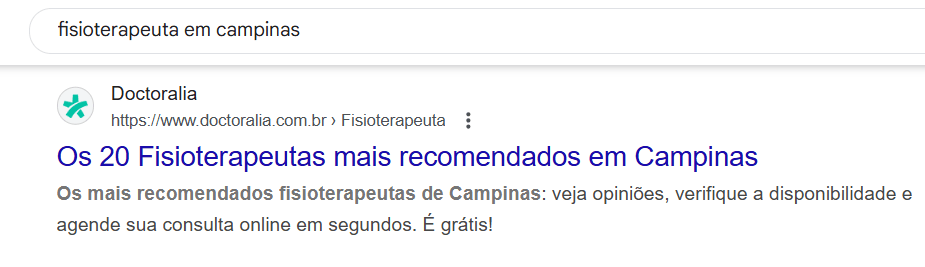
Terms like “physiotherapist in Campinas”, “counter south zone SP” or “dentist in Florianópolis Center” are much more strategic than generic words like “physiotherapy” or “counter”.
In the example above it is clear how efficient to use location in keywords for those who offer a local service.
Free search tools
You don't need to be an expert to find out good keywords. Tools like Google Suggest (the suggestions that appear when you start typing) and Ubersuggest are Great starting points. . Simply enter your service and explore the suggestions that appear. Look at the example below:
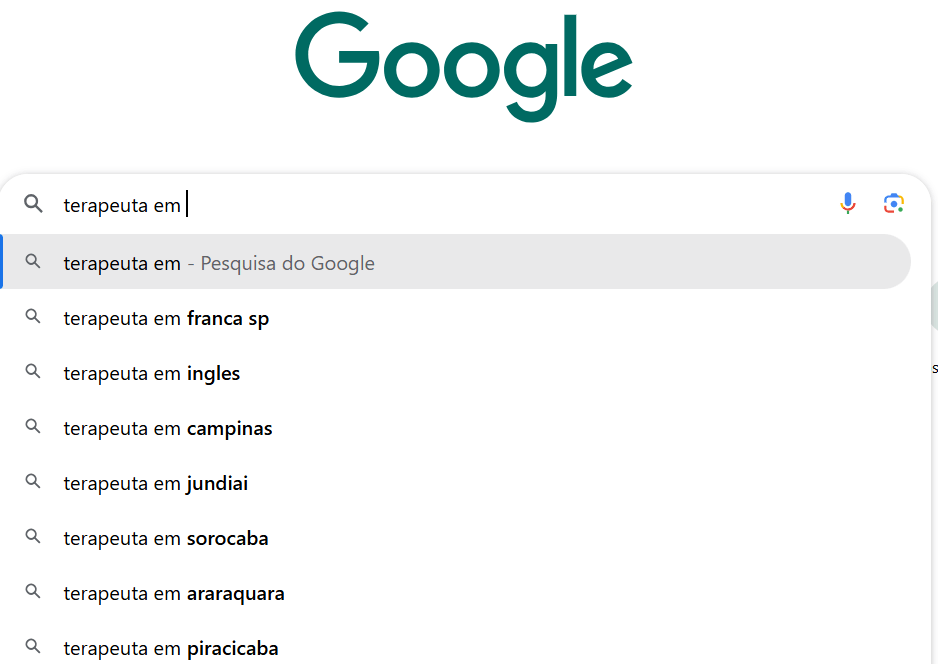
For example, if you are therapist, typing “therapist in” on Google, he may suggest: “therapist in São Paulo”, “therapist in Campinas”, “holistic therapist in Belo Horizonte”. . These are exactly the searches you can use in your SEO strategy.
Avoid generic terms and prefer words with specific location or niche
Try to compete for very generic words like “lawyer” or “clinical” It could be a gunshot to the foot. They are broad terms, with a lot of competition, and do not indicate the actual intention of the user. Prefer to be specific: “family lawyer in Porto Alegre”, “post-surgical rehabilitation clinic in Rio”.
Look at this comparison of competition between generic term and specific term:
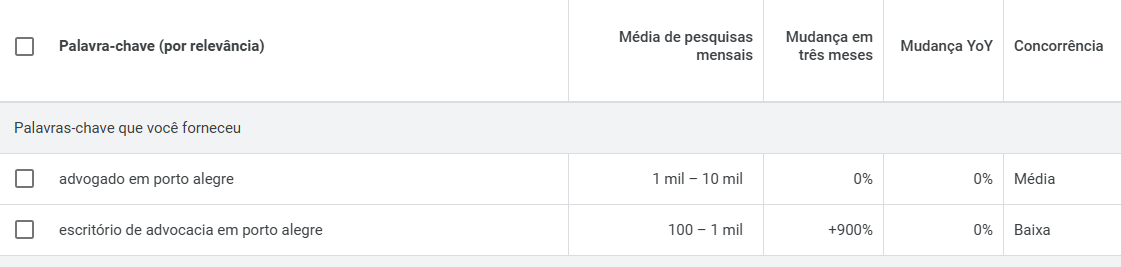
The more specific the term, the more qualified the public is. This reduces the number of uninterested accesses and increases your chances of closing down with those who really need your service.
Step 2: Optimize your website (or create one)
It's no use having good keywords if your website isn't ready to receive them. The structure of your page needs to be aligned with SEO criteria so Google understands what your service is about and shows your site in search. The first step is rephrase your websiteAnd if you still don't have one, that It's time to create with a focus on performance. . If your site hasn't been thought of for that, see how we work the site creation by segment for service providers.
Title (Title Tag) with keyword
The title of the page is one of the most important elements for Google and the user. It appears in the search results and directly influences the click. Use the main keyword at the beginning of the title. For example: “Physiotherapist in Campinas”.
Look at this example of Bike and Beer, a site created by WebSyd, where the title already says everything that leads expect: Largest Bicycle Page in Brazil
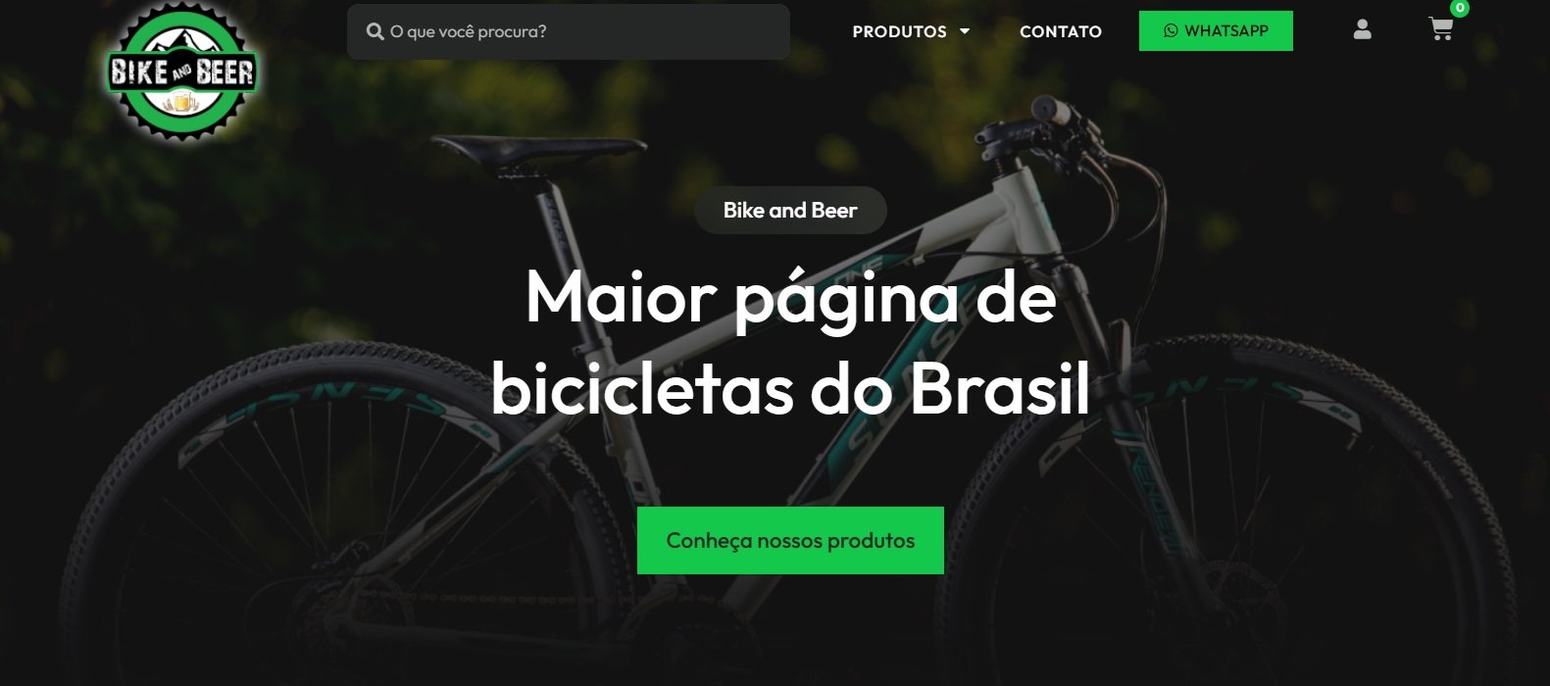
Avoid generic titles like Home or “Homepage”. Be direct, descriptive and think about how the customer would look for this service on Google.
Meta description calling for action
The meta description is that little text that appears below the title in Google results. Although it does not influence ranking, it impacts the click a lot. . Use this space to explain what you offer and encourage action.
For example: “Now schedule your session with a physical therapist in Campinas. Personalized service, flexible schedules and great cost-benefit!”
Page content explaining the service and benefits
The main content of the page should explain clearly what you do, for whom is the service, how it works and what are the differentials. . Avoid long, vague texts. Prefer to use objective questions and answers, topics and even statements.
For example, if you are an accountant, tell them that you serve MEIs, small businesses, open CNPJ, tax returns and that you are available by WhatsApp. This helps both Google and the visitor to understand your proposal.
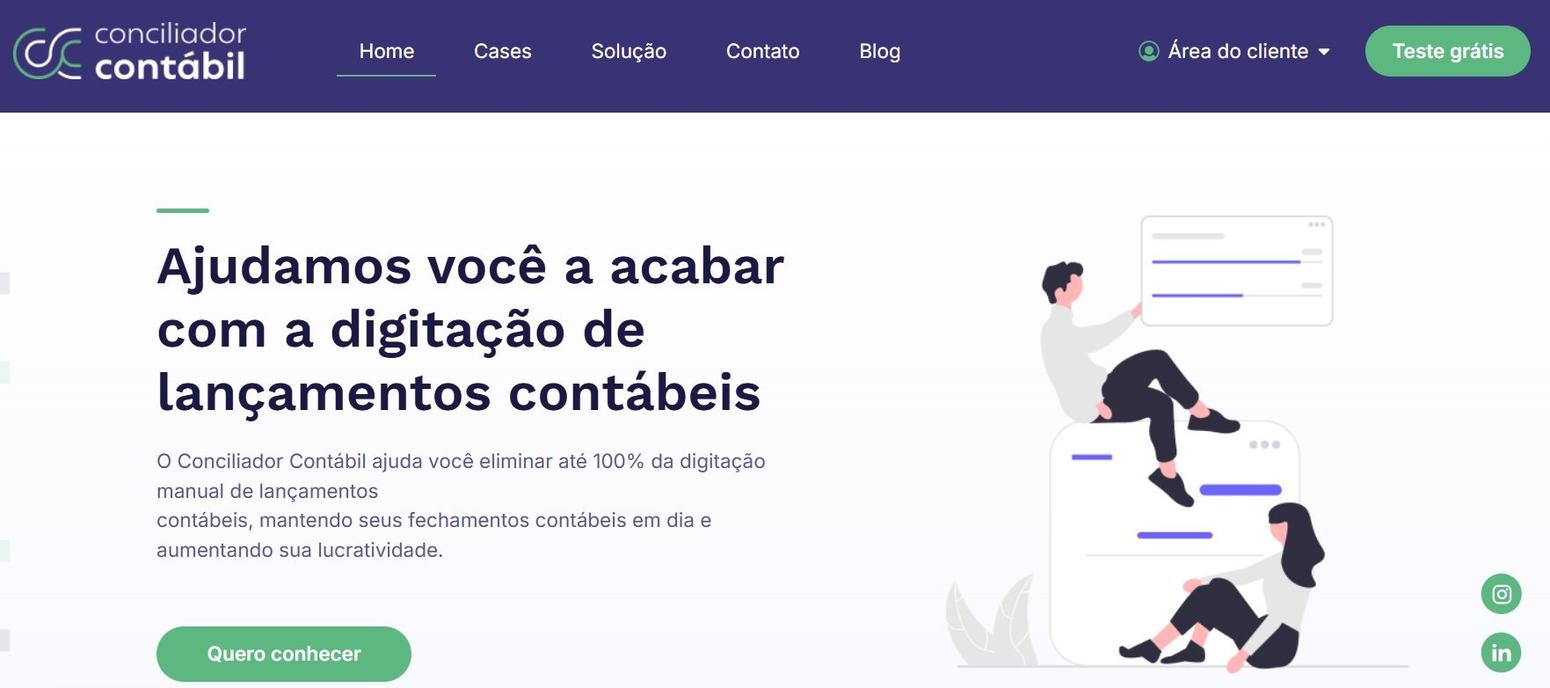
Below, another site created by us. See how all the content already transmits clear and direct information:
Address, phone and link to WhatsApp visible
A common mistake is to keep the means of contact hidden. Stop Local SEOThat's a problem. The ideal is that your website display address, phone, and mainly a WhatsApp button fixed or highlighted.
Here at WebSyd, the WhatsApp button is always highlighted, fixed and on all pages of the site:

In addition to facilitating customer contact, Google also understands that your business is real, localized and active, which helps rank.
Create a page for each service (instead of everything in one)
If you offer more than one type of service, avoid putting everything on a single page. The ideal is create a separate page for each, with keywords, content and its own structure.
For example, if you are a therapist and offer acupuncture, reiki and wind therapy, create a page for each practice. This facilitates the ranking of each service individually and increases its chances of being found in specific searches.
Look how we organize our services on separate pages:

Step 3: Register and optimise the Company Profile on Google
If you provide local services and want to appear on Google more prominently, the Google Company Profile It's indispensable. It is what allows your service to appear on the map, with telephone, address, reviews and route for the customer. Also, it is free and very simple to use. A well optimised profile can put you at the top of local searches even without having a website.
Complete all information: name, category, description, photos, schedule
By creating your Company Profile on Google, fill in all fields carefully. Choose the correct category (e.g. plumber, psychologist, graphic designer), write a clear description of what you do and include actual photos of the service, physical space or your service. Profiles with real photos are more reliable and usually receive more contacts.
Also, keep your schedules up to date. If it's closed and someone comes to the scene for wrong information, it can generate a negative evaluation, something that weighs on ranking.
Ask for customer reviews (reviews are decisive)
Google reviews work as a social proof. A profile with 5 or 10 positive reviews already conveys more confidence than one without none. Ask satisfied customers to leave a comment, especially mentioning the type of service you have provided (this also helps in SEO).
Example: “I hired Bruno to review the electric part of my house here in Curitiba. It was punctual, quick and very thoughtful. I recommend!”. . The more specific the evaluations are, the better for who you're looking for and for Google's algorithm.
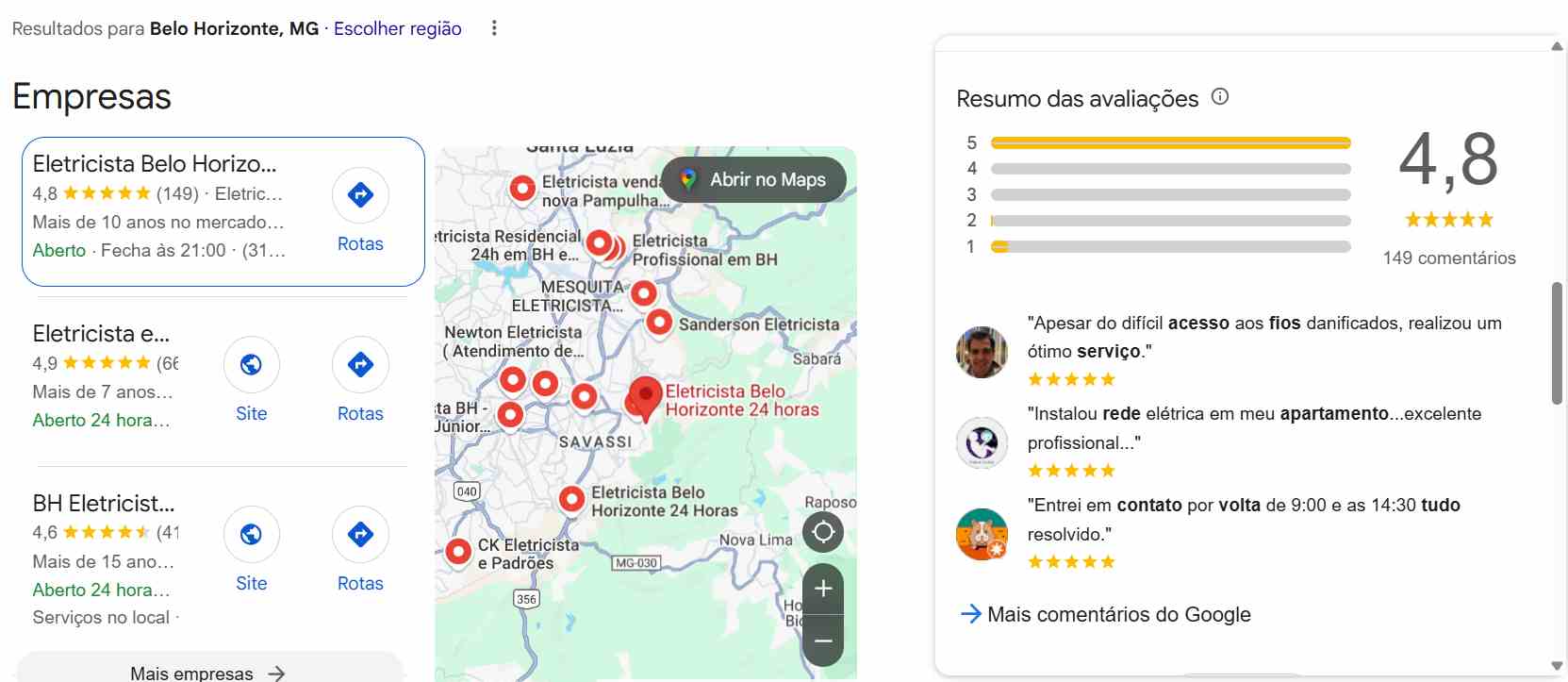
Positive and recent reviews help the profile stand out in local searches, as in the example above.
Answer all reviews, good or bad
Showing that you care what customers say is a sign of professionalism. Thanks for the personalised answers, and if you get a review, respond with respect and propose solution. . This shows that you are open to improvement, which also transmits more security to future customers.
For example: “Hello, Ana! We're sorry we didn't meet your expectations. We have already adjusted our service schedule and hope to be able to serve it better at a next opportunity.” This attitude counts points both with the customer and Google.
Post updates, photos and offers on the profile
Google values active profiles. You can use the Posts feature within the Company Profile on Google to show news, promotions or simply reinforce your presence. A new service? Poste. Did you make a nice call? Post pictures and tell the story.
Example: “Today we have completed a complete plumbing project in a building in the centre of Belo Horizonte. One more happy customer!”. . That's it. Humanizes your profile and increases local engagement.
Step 4: Produce useful and localized content
One blog or tips section on your site is one of the most efficient ways to generate authority and organic traffic. In addition to answering your audience's most common questions, the content helps highlight your website on Google and position you as an expert in your field. And best of all, it's free and scalable.
Blog with tips, frequently asked questions, real cases
Create Texts answering real questions that your clients make you often. Example: “Do I really need to maintain in the air every 6 months?” or “How much does a psychologist visit in São Paulo cost?”. . Also, count real cases (without exposing the customer) to show how you solve concrete problems.
This is another example of the Accounting Conciliator, a site created by WebSyd:
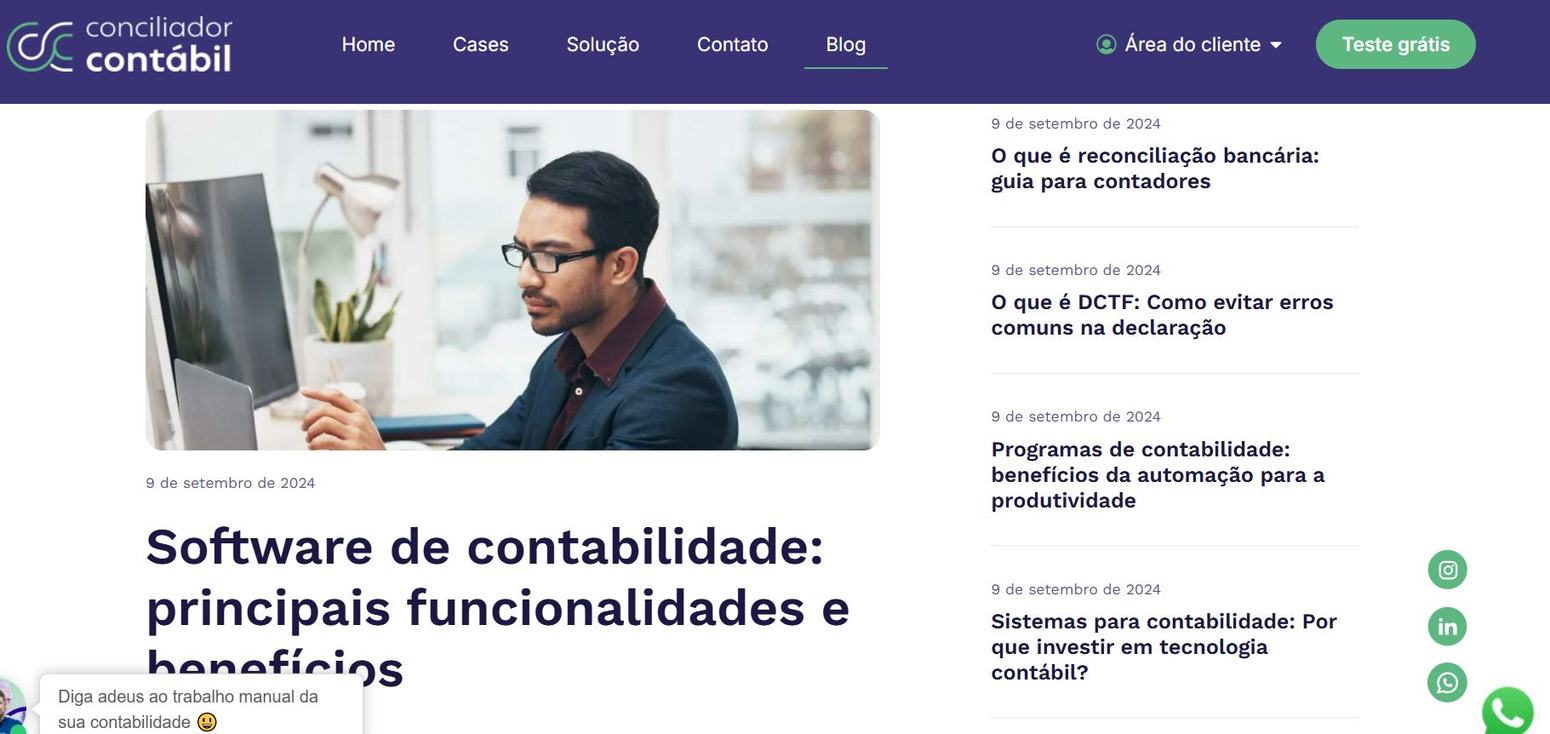
This helps not only in ranking, but also in the trust of the visitor, who realizes that you dominate the subject.
Calling titles: “How to choose a reliable electrician in \[city]”
That's a powerful formula: combine a common doubt with the location of the service. . Titles with this format have great chances of appearing for those who are looking for a real solution, intending to hire. And when the customer clicks and finds a clear, well written and useful content, trust grows.
Other examples: “5 signs that your pet needs bath and toast in Salvador”, “When to look for a family lawyer in Curitiba” or “Checklist to hire a plumber in Florianópolis”.
Use your experience to generate authority in content
You must have solved dozens or hundreds of problems in the day to day of your service. Use that to your advantage. Tell me how you treated a client, what was the problem, how you solved it. These details make the content more human, create connection with the reader and generate trust.
A plumber can write: “This week I attended a customer in Guarulhos with a classic problem: hidden leak behind the wall. We use detection equipment without breaking everything, locate and resolve in less than 24 hours.”
Include local keywords and natural variations
When writing its contents, insert naturally terms such as city, neighborhood, type of service and keyword variations. . This helps Google understand that its content is related to local searches. But attention: no exaggerating or repeating too much, this may have an opposite effect.
Example: instead of repeating “scanner in Porto Alegre” ten times, it varies with expressions like “hydraulic professional in the south zone”, “residential plumbing service”, “all over the metropolitan region”, etc. This makes the text lighter and still optimizes for different searches.
Step 5: Make local and strategic link building
Have others sites pointing to your helps Google understand that you are a reliable source. This process is called link building, and in the case of service providers, the ideal is to focus on local partnerships and registrations, which show its relevance in the region where it operates. The more strategic this process, the more authority your site conquers.
Registers on sites like Pointer, GuideMore, Yelp, Habitissimo
These search and comparison portals are sources of traffic and trust for Google. Be registered with name, phone, address and link to your website strengthens your local position. . In addition, some users still access these websites directly to seek reliable providers.
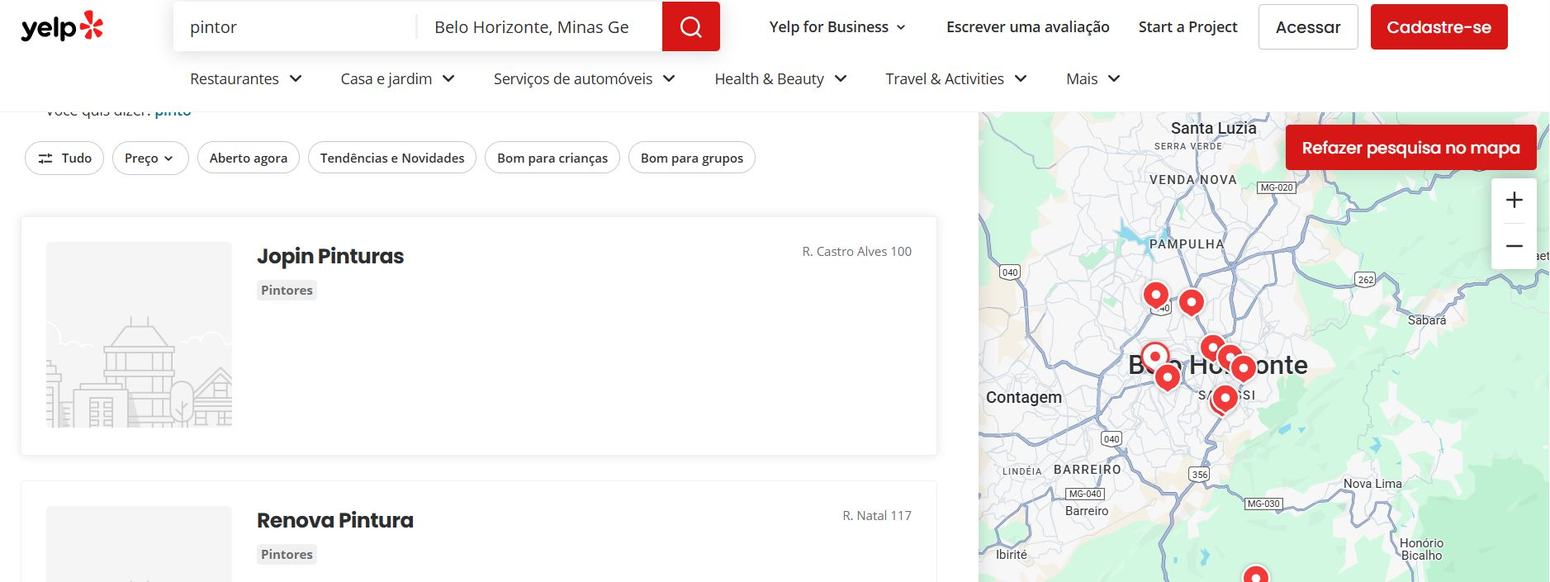
Example: if you are a painter in Belo Horizonte, have active profiles in the GuideMore and Yelp can make your name appear for those who seek “paint BH reviews”. . This generates valuable traffic and links to your domain.
Partnerships with neighborhood blogs or commercial associations
Local blogs and neighborhood portals generally accept content or partnerships from providers in the region. You can write an article, give an interview or offer an exclusive discount to readers, in exchange for a link to your website.
Example: one psychologist can collaborate with a blog of mothers in the north of São Paulo, with a type content “How to deal with school anxiety at the beginning of the year”. . In addition to generating visibility, this helps SEO with relevant and targeted link.
Request backlinks from local partners and suppliers
If you work with suppliers or have partners in your city, enjoy this network. It can be the supplier of construction material, a printery that prints its pamphlets or even a salon that indicates its services.
Ask them. add a link to your website in the tab “partners” or “clients served”. . This not only improves your ranking but reinforces the local presence of your brand digitally.
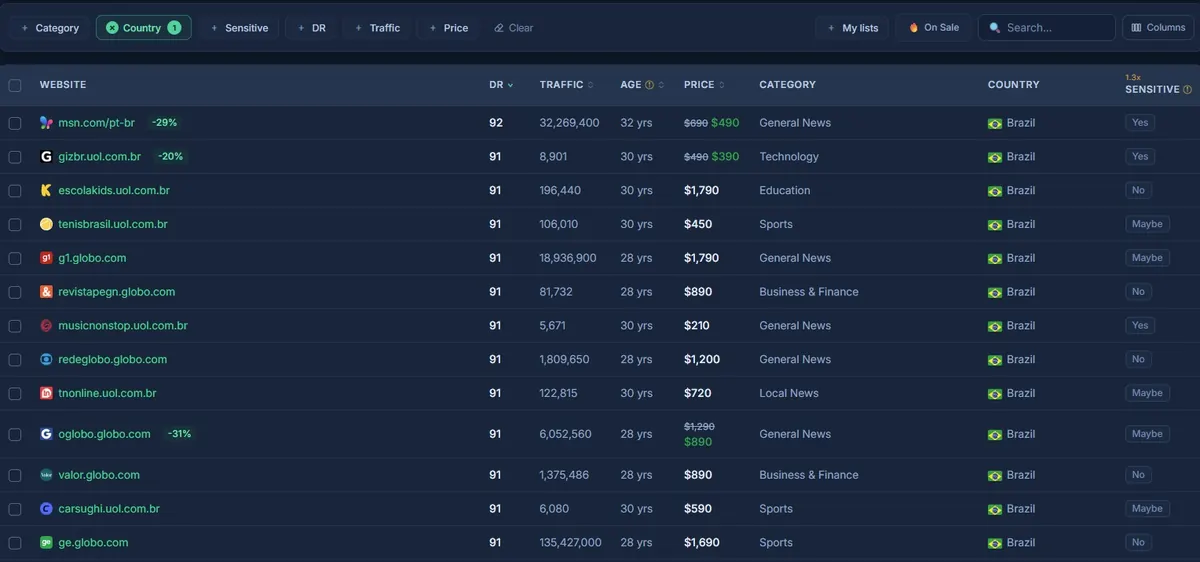
To expand the prospection beyond local records, the BlaaS allows finding publishers from the same sector or market and comparing their metrics before seeking a publication.
Step 6: Follow the results and optimise continuously
SEO is not a task with beginning, middle and end. It's a continuous process of testing and adjusting. Therefore, monitoring your website data is as important as applying strategies. Free tools like Google Search Console and Google Analytics help you understand what is working, and what needs to be improved.
Tools: Google Search Console and Google Analytics
The Google Search Console show how your site appears in the searches, in what terms you are ranking and how many clicks you receive. The Google Analytics reveals visitor behaviors, like time on the site, more accessed pages and output rate.
For example: if you realize that many people click on “Air-conditioning installation service”, but get off the page quickly, it may not be aligned with expectation, and this deserves adjustment.
Check which pages have more clicks and what can improve
With these tools, you can analyze which pages are attracting visitors and which ones are being ignored. . This allows us to focus on what is already working and improve what is falling behind.
Example: if your post “How to hire electrician in Curitiba” is well ranked, worth adding more images, a better visible contact button and internal links to other services.
Update content and improve calls to action
Unupdated content loses value in Google's eyes. Therefore, it is important to review your texts periodically, update data, add new topics and maintain current information. And take the opportunity to reinforce the CTAs, the calls for action, as “Request a budget” or “Book Now for WhatsApp”.
A well updated content with optimised title, attractive CTA and local focus can keep your position on Google much longer, and continue attracting qualified customers daily.
Common errors that prevent service providers from ranking well
Even experienced and committed professionals can make mistakes that impair your visibility on Google. Many of these slips are simple to solve, but they continue to be neglected for lack of technical guidance. Meet the main problems that cause service providers to stay hidden in search, and how to correct them:
Site without technical SEO
One slow site, that not if adapts to mobile phone or without the safety chain (HTTPS) drives away visitors and Google. The Searcher values the user experience, and if your site takes more than 3 seconds to load or does not fit the mobile screen, you lose precious points in ranking.
Lack of specific content for the service
Have a site with little information or all focused on a single page It's difficult to rank. Google needs to understand clearly what you offer, and for that, each service needs a dedicated page with explanations, keywords and differentials.
Bad business name in the Company Profile on Google
Use generic or wrong names in Google profile may harm the location of your service. The ideal is to keep the real name of the company, without exaggeration of keywords, and ensure that it is equal on all channels (site, social networks, receipts, etc.).
Do not ask for customer reviews
Evaluations are one of the strongest factors of local ranking. Preachers who do not encourage customers to leave positive comments They lose authority in front of competitors with more stars and recent comments.
SEO for service providers is worth it?
SEO for service providers does not require large investments or mirable solutions. With consistent actions, focus on local keywords, a well-structured website and strategic presence in the Company Profile on Google, you can quit digital invisibility and start to attract qualified customers. . It is possible to even sell your service abroad using International SEO, to reach countries like England and the United States.
Also read about What Is MVP.
Do you want more customers from your region to find your service? Meet the SEO consulting WebSyd and ask for a budget.
FREQUENTLY ASKED QUESTIONS
How do I make my service appear on Google without paying for ads?
To appear on Google organically, you need to apply SEO (Search Engine Optimization) techniques. This includes using specific keywords in your website content, creating separate pages for each service, optimizing the Company Profile on Google and conquering links from other relevant websites. With consistency, your site can achieve good positioning without having to invest in paid media.
What to write on my website to attract Google customers?
The ideal is to write clearly about what you do, who your service is, how it works and what the differentials are. Use questions and answers, include keywords with location (e.g. “Campinas therapist”), and explain the benefits objectively. Testimonials, frequent questions and a good call for action also help to generate trust and conversion.
Is it worth investing in SEO even if it only serves my city?
Yeah. Local SEO is one of the most efficient strategies for service providers. Many people seek close professionals, such as “scanner south SP” or “psychologist in Salvador”. By optimizing your site with geographic keywords and keeping the Company Profile active, you greatly increase your chances of being found by those who are really close to hiring.
What is more important to rank on Google: Site or Company Profile on Google?
Both are important and complement each other. The site offers detailed content and shows professionalism, while the Company Profile on Google highlights its service in local searches with map, phone and reviews. Having a well-structured website and an optimised profile in the Company Profile on Google increases your search authority and visibility.
How do I know if my site SEO is working?
You can use free tools such as Google Search Console to see what searches your site appears in, and Google Analytics to track visits, browsing time, and conversions. Observing the increase in organic accesses and incoming contacts are also clear signs that SEO is bringing results.

Caio Nogueira is a SEO, GEO, link building and Digital PR expert and co-founder of WebSyd, website creation agency and SEO consulting founded in 2016. It acts with organic search strategies, digital authority construction and brand optimisation for search engines and artificial intelligence platforms. Throughout his trajectory, he participated in more than 1000 projects involving SEO, website development, content marketing and authority acquisition through backlinks and Digital PR. At WebSyd, it participates in the planning of strategies to increase organic visibility, lead generation and presence of companies on Google and AI-based search engines. As an author, it publishes content on SEO, GEO, website creation, link building and digital authority, sharing analyses, strategies and practical experiences related to organic growth of companies. Its contents and contributions have also been published in companies and vehicles of technology and marketing such as Wix, HostGator, Duda, Neil Patel, Locaweb and E-Commerce Brasil.
View all posts


 Estimate the cost

