
Technical checklist before hiring site development
Summary (TL;DR)
Before hiring website development, it is essential to evaluate strategic planning, visual identity, SEO, technical items and continuous support.
A well-structured website from the start increases the chances of generating results and growing with the company. Check out the full content to understand all important points.
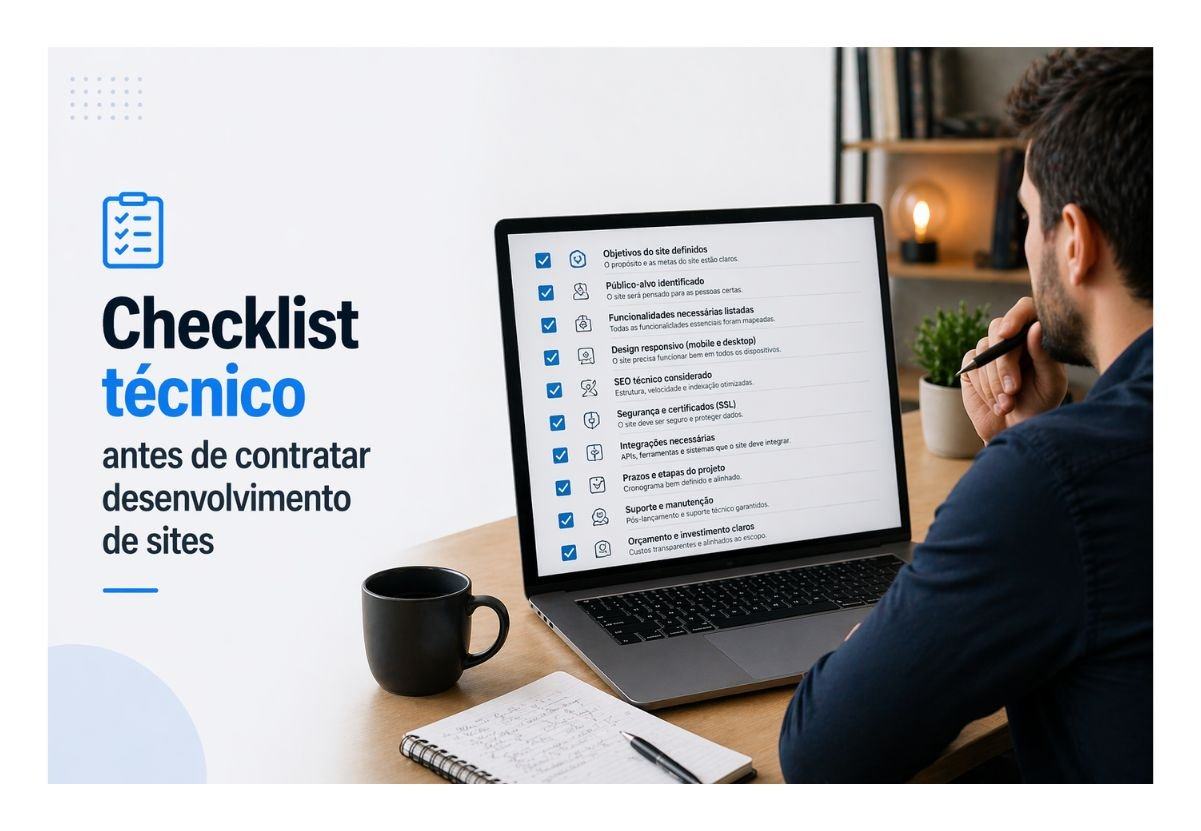
Before hire site development, it is essential to evaluate some technical and strategic points that will directly impact the result of the project. A website should not only be seen as a visual delivery, but as a digital asset that needs to generate traffic, leads and real business opportunities. Without this initial care, the risk of investing in a project that brings no return is high.
Therefore, before closing with any supplier, it is worth following a technical checklist that helps ensure that the site will be planned correctly from the base. Check out the main points that should be analyzed.
1. Strategic planning
Strategic planning is the basis of any successful website project. It defines the project direction, aligning business objectives, target audience and site structure. . Without this stage, development tends to be superficial, without focus on results and with a greater chance of rework.
Before starting the project, it is important to validate some essential points that will guide all future decisions. Check out the main ones:
Target audience and persona
Setting the target audience and creating personas is key to orient the content, design and the structure of the site. . This allows communication to be directed and relevant to those who really matter.
Examples of persona:
- Businessman seeking accounting services to reduce taxes
- E-commerce owner who wants to increase online sales
- Professional liberal who wants to capture more customers over the internet
Purpose with the site
Every site needs to have a clear objective. . Without it, it becomes just a window without defined strategy. The goal guides the type of content, features and even project design.
Examples of objectives:
- Generate qualified leads
- Sell products online
- Show services and portfolio
- Strengthening the brand and authority
Strategy to be adopted
Beyond the goal, it is necessary define which strategy will be used to achieve results. This involves SEO, content marketing, paid traffic, marketing automation or a combination of those actions.
The strategy should be thought from the start of development, ensuring that the site is prepared to attract, engage and convert visitors over time.
2. Visual identity
Visual identity represents the way your brand presents itself in the digital environment. . It involves visual elements that convey professionalism, positioning and credibility to the public. No development of a performance-oriented website, this step is essential to ensure consistency in communication and create a visual experience aligned with the company proposal.
Check out the main points that should be considered:
Colours, fonts and logo
These are the pillars of visual identity And they need to be aligned with the brand proposal. Colors influence the user's emotional perception, sources impact readability and logo reinforces company recognition.
Items to be considered:
- Main and secondary color palette
- Typography (titles and texts)
- Logo versions (horizontal, vertical, monochrome)
- Contrast for reading on different devices
- Visual consistency on all pages

Image or video types
The choice of images and videos should reflect the position of the company and contribute to brand communication. It is important to use good quality materials, aligned with the public and the segment of action, avoiding generic images that do not add value.
In addition, institutional videos, service demonstrations or testimonials can enrich the user experience and increase engagement within the site.
Inspirations
Search visual references is an important practice before starting the development of the site. Analyzing sites from competitors or companies you admire helps identify patterns, trends and good layout practices.
These inspirations serve as the basis for guiding designers in creating a more assertive visual project, aligned with company expectations and public needs.
3. Brand Perception
The perception of the brand is related to how the public sees and interprets their company. . In the digital environment, this is influenced not only by design, but also by communication, content and experience offered on the site. A well-built perception strengthens confidence and increases the chances of conversion. Check out the main points:
Voice tone
The tone of voice defines how the brand communicates with its public. . It can be more formal, technical, close or relaxed depending on the segment and profile of the ideal customer.
Maintaining consistency in the tone of voice throughout the site helps to create identity and approximation with the public, making communication clearer and more aligned with the company's goals.
Intention to Communication
The intention in the communication is linked to goal behind each message on the site. . Each page must have a clear purpose, be it to inform, educate, convince or convert the visitor.
When communication is well targeted, the site becomes more strategic, leading the user along the journey naturally and increasing the chances of generating real results for the business.
4. Optimization for search engines
Optimization for search engines, or SEO strategies, is the set of strategies that help the site to appear in Google results organically. . This step is essential to ensure visibility, attract qualified traffic and turn the site into a customer acquisition channel. Without SEO, even a well-developed site can have low performance. Check out the main points that should be considered:
Keyword Search
Keyword search identifies what terms your audience uses to seek products or services like yours. This survey guides the creation of content, the structure of pages and the definition of titles and descriptions.
When well done, the search allows you to align the site with the user's search intention, increasing the chances of appearing in Google's first positions.
Competition study
Analyzing competitors helps to understand what strategies are working on the market. This includes evaluating keywords used, content structure, type of pages and positioning in search results.
This study allows identifying opportunities, gaps and differentials that can be explored on your website to stand out in the digital environment.
SEO Strategy
SEO strategy defines as the site will be optimised over time. . It involves content planning, technical structure, internal link between content and continuous production of relevant materials.
A site developed with SEO strategy from the start has much more chances of growing consistently, generating organic traffic and sustainable results.
5. Technical items
The technical items are the essential components ensuring the operation, safety and performance of the site. They are part of the project base and directly impact the user experience and SEO. Before starting development, it is important to validate these points:
SSL Certificate
The SSL certificate is responsible for ensuring the safety of navigation, protecting the data exchanged between the user and the site. It activates HTTPS protocol and prevents “unsafe website” alerts in the browser.
By hiring development, it is important to check whether SSL is included in the project or whether it will be necessary to hire separately, since it is essential for both security and SEO.
Domain
The domain is the site address on the internet, how nomedaempresa.com.br. . Before development, it is necessary to check whether the company already has a registered domain or whether it will be necessary to acquire a new one.
Choosing a clear, short domain related to the company name facilitates brand recognition and improves user experience.
Hosting
Accommodation is the service responsible for storing the site and making it available on the internet. . The quality of hosting directly impacts the speed, stability and security of the site.
Therefore, it is important to assess whether the hosting will be provided by the contracted company or if it will be hired separately, ensuring that it supports the expected performance of the project.
6. Deadlines for launch
The launch times define how long the site will take to get out of planning until publication. . Understanding this schedule is crucial to align expectations, avoid delays and ensure that all steps are completed with quality. A well-structured project follows an organized flow, respecting each phase of development. Check out how this process usually happens:
Site Steps
The development of a site follows a logical flow of steps, where each phase depends on the previous. Knowing this path helps to understand the time needed and the importance of each delivery throughout the project.
Basic development flow:
Briefing → Planning → Content production → Design (IU/UX) → Development → Tests & Adjustments → Approval → Release
This flow may vary according to the complexity of the project, but following this sequence ensures more organization and efficiency.
7. Technical support and maintenance
After launch, the site needs to continuous monitoring to maintain performance, safety and relevance. Technical support and maintenance ensure that the site continues to function properly, following technological updates and changes in user behavior. Check out the main points:
Updates and improvements
Keep updated site is essential to avoid failures, vulnerabilities and loss of performance. This includes system updates, plugins, technical fixes and continuous improvements in structure and content. An updated website tends to perform better for both users and search engines.
Continuous monitoring and support
In addition to updates, it is important to count on constant monitoring to identify possible problemslike falls, loading errors or security failures. Active technical support ensures quick responses and avoids negative impacts on website performance and user experience.
A strategic website begins before development
Hireing the development of a website goes far beyond choosing a layout. It is a process that involves strategic planning, technical decisions and long-term growth vision. In a scenario of digital transformation, companies that structure their projects well from the beginning manage to stand out and generate consistent results.
Also read about CheckList for site recasting.
If you seek a professional, strategic and prepared website to grow along with your business, Count on WebSyd. . We are. experts in web design that unite design, performance and SEO to generate real results. Talk to our experts and take the next step.
Click the button below and ask for a quote with us now:
At WebSyd, custom-made websites depart from R$5,000 and are ready in about 45 business days; online stores take about 60 days. Get a quote.

FREQUENTLY ASKED QUESTIONS
Is it worth hiring a ready or personalised website?
Depends on the purpose of the project. Ready sites can be faster and cheaper, but have limitations on customisation and scalability. A custom site is developed based on the company's needs, offering more flexibility, better performance and greater growth potential in the long term.
How to choose the best company to develop my website?
It is important to evaluate portfolio, market experience, work methodology and support offered. In addition, make sure the company understands SEO, performance and digital strategy as this directly impacts on the results of the site.
Do I need to understand technology to hire a website?
Nope. The ideal is to count on a specialised company that guides the entire process. However, having a basic sense of goals, public and strategy helps to make more assertive decisions during development.
Can the site be integrated with social networks and other tools?
Yeah. Modern sites can be integrated with social networks, marketing automation tools, CRM, payment platforms and other systems. These integrations increase efficiency and enhance website results.
What happens if I don't maintain it on the site?
Without maintenance, the site can present flaws, become vulnerable to attacks and lose performance over time. In addition, it may be outdated in relation to good SEO practices, impairing positioning in search mechanisms.
Can I update the content of the site by myself?
Yes, as long as the site is developed with a content management system (CMS). This allows you to edit texts, images and pages in a simple way, without relying on a developer for small changes.
Does a website need security clearance even without online sales?
Yeah. The SSL certificate is essential for any type of website, as it ensures security in navigation and transmits confidence to the user. In addition, Google considers safety as a ranking factor.
How do you know if the site is bringing results?
You can track performance through tools like Google Analytics and Google Search Console. They show data such as number of visitors, traffic origin, user behavior and conversions, helping to measure the results of the site.

Caio Nogueira is a SEO, GEO, link building and Digital PR expert and co-founder of WebSyd, website creation agency and SEO consulting founded in 2016. It acts with organic search strategies, digital authority construction and brand optimisation for search engines and artificial intelligence platforms. Throughout his trajectory, he participated in more than 1000 projects involving SEO, website development, content marketing and authority acquisition through backlinks and Digital PR. At WebSyd, it participates in the planning of strategies to increase organic visibility, lead generation and presence of companies on Google and AI-based search engines. As an author, it publishes content on SEO, GEO, website creation, link building and digital authority, sharing analyses, strategies and practical experiences related to organic growth of companies. Its contents and contributions have also been published in companies and vehicles of technology and marketing such as Wix, HostGator, Duda, Neil Patel, Locaweb and E-Commerce Brasil.
View all posts


 Estimate the cost

