
React SEO: 7 good practices to position your website on Google
Summary (TL;DR)
In this post, you will learn about the main SEO practices for React sites, such as the implementation of Server-Side Rendering (SSR) and the use of frameworks like Next.js and Gatsby.
We will also explore the importance of correctly setting up meta tags, improving URL structure and managing JavaScript loading to ensure that your site performs best in search engines.

Quick answer: for a site in React appear well on Google, deliver the already rendered HTML (SSR or static generation, with Next.js or Remix), use real URLs with links <a href>, define title, meta description and canonical per page, generate XML sitemap and follow the Core Web Vitals. Google can render JavaScript, but with delay and more chance of error.
When we talk about React SEO, we are dealing with strategies aimed at optimizing websites built with the framework React, ensuring that they are well indexed and ranked on Google.
React, although it is a popular choice to create fast and dynamic interfaces, can present some challenges when the goal is to get search engines to understand and correctly classify the content of the site.
Optimization for React sites is essential to ensure that your site is not only tracked by the bots, but also compliant with the Google guidelines for better performance in search results.
Remember that in Brazil, Google receives 88.41% of the research (StatCounter, September 2026), which makes it essential to ensure that your page is optimised to appear in the first positions, increasing visibility and of course conversions.
Let's understand the main SEO challenges for React and, more importantly, how to overcome them. If you want to see your React site in Google's top positions, follow with us and discover 7 good practices that will make a difference!
Why can SEO on React sites be a challenge?
Who has worked with JavaScript SEO you know that optimizing a React site can be a little more complicated. The main reason lies in the how React generates pages in the browser.
The content of the site is dynamically loaded through JavaScript, which can create a barrier for search engines that have difficulty interpreting content immediately. The result? Empty or incomplete pages on the first visit of tracking bots.
Among the main SEO challenges for React, we can quote:
Empty first pass content
React, by default, renders the content on the client-side. This means that when the search bots arrive, the content may not be visible, making indexing difficult.
Loading time and user experience
React sites that are not optimised can be slow to load, damaging the user experience and affecting the ranking on Google.
Metadata from page
Metatags as title, description and Open Graph information are essential for SEO. In React, properly configuring them can be challenging.
This one. site type works a lot with JavaScript to render the content. If metatags are dynamically generated and not available at the first passage of loading, search engine bots may not be able to read this information.
Site map
Without a well-defined XML sitemap, search engines may have difficulty tracking and indexing all pages of the site.
These are common obstacles, but the good news is that there are practical solutions for each of them. Let's now detail 7 good practices that will help you improve the SEO of your React site and achieve great performance in search results.
Good SEO practices for React websites
We know that SEO for React sites may seem complicated at first, but with the right strategies, it is possible to overcome these challenges.
Next, we will present seven good practices that you can apply right now on your site to improve positioning on Google:
1. Implement Server-Side Rendering (SSR)
One of the most effective ways to improve SEO for React is to implement the Server-Side Rendering (SSR).
Unlike the default React rendering, which takes place on the client-side side, SSR allows the site's content to be rendered on the server before being sent to the browser.
With this, search engines can access and index the content immediately without waiting for JavaScript to load.
This not only solves the problem of “empty first-pass content”, but also improves the initial page loading speed, an important factor for both React SEO and user experience.
Quick sites are more likely to occupy the first positions in search engines.
If you're thinking about how to apply the SSR to your project, frameworks like Next.js are great options to implement this technique in a simple and effective way.
Check out the video below to understand how Next.js works in practice:
2. Using Next.js or Gatsby to facilitate SEO
Speaking of Next.js, him and the Gatsby are two highly recommended frameworks for those seeking to facilitate optimisation for websites in React.
Both offer native SSR support, solving the initial rendering problem and ensuring that search engines can read and index site content without difficulty.
Next.js is widely used for its flexibility and ability to handle different types of projects, while Gatsby is ideal for sites that need static content.
By opting for these frameworks at the beginning of the project of web design, you are already implementing a development process thought of site optimisation and performance in search engines.
And on already active websites, you simplify the SEO JavaScript process while improving the performance of your website.
In addition, both Next.js and Gatsby have a number of native optimisation tools, such as automatic sitemap generation and file compression, which are extremely useful for SEO.
3. Improve URL structure and internal browsing
The URL structure and site navigation are key elements for SEO success on any site, and this is no different for React projects.
Friendly, short URLs containing keywords related to page content are essential to help search engines understand what is being offered.
Example, if a page keyword is online accounting, a good URL is: www.nomedosite.com.br/contabilidade-online
In addition, ensuring that internal navigation is clear and intuitive not only improves user experience, but also facilitates the tracking of pages by search bots.
One good use of internal links strengthens the relevance of important pages and contributes to a better indexing of the entire site. For this to be done effectively, it is essential to create a logical hierarchy between the pages and connect those that have related content.
For example, if you have a page on “Small Business Accountancy”, you can include a link to a specific page that details the “Fiscal Advisory Services”, using a anchor text as “you know more about tax advice”.
The links should be inserted in a natural way within the text, ensuring that the reader understands what he will find when clicking.
For example, if in an article on “financial management”, you want to direct the reader to a specific service, it would be ideal to use an anchor text as “check our financial consulting services” instead of something generic like “click here”.
Another tip is prioritize links to the most important and relevant pagess, such as its main services or articles that generate significant traffic, avoiding overloading the content with many links.
If you want Google bots to track all parts of your site, improve browsing and don't forget to use descriptive and well structured URLs.
4. Correctly configure meta tags and Open Graph
Meta tags are essential for any SEO strategy. On React sites, ensuring that these tags are configured correctly is vital.
That includes meta titles and meta descriptions optimised with relevant keywords, besides Open Graph tags, which are fundamental for social networking sharing.

If your goal is to improve visibility in a specific geographical area, the setting of tags aimed at the Local SEO It's also a recommended practice.
This helps to ensure that Google displays its website to users who search certain regions, and is especially useful for companies with local focus, as a site for accounting who wants to attract customers from a city or region.
By providing a clear title and description, you help both search engines and users to understand the content of the page before clicking.
In addition, Open Graph tags ensure that when someone shares your Facebook or X page (formerly Twitter), the correct title and image are displayed, increasing the click rate.
Check out this example of use of Open Graph tags:
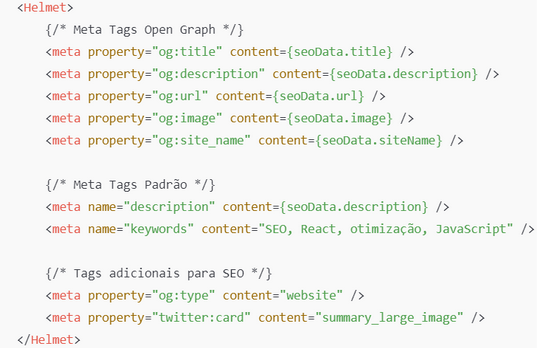
Some important information from the above example:
- og:title: is the title of the page;
- og:description: is the description of the content of the page;
- og:url: is the canonical URL of the page;
- og:image: is the URL of an image that represents the page, used as a preview when shared on social networks;
- og:site_name: is the name of your website.
Tools like React Helmet are extremely useful to manage these tags dynamically on each page of your website.
5. Manage JavaScript loading efficiently
Sites that use React are usually rich in JavaScript, which, if poorly managed, can harm both performance and SEO. To avoid this, it is essential that the loading scripts be done efficiently.
Techniques such as lazy loading help to load only the necessary features at the right time, reducing the initial loading time of the page.
In addition, reducing the size of JavaScript files by minimizing and compressing them also contributes to faster loading, improving user experience and ranking in search engines.
For React websites, this is one of the most effective practices to balance performance and optimisation, so it's one of the best practices in React SEO.
6. Create XML sitemaps and use robot.txt file
Another essential practice to ensure that your React site is well indexed on Google is create an XML sitemap and properly configure the robot.txt file.
The XML sitemap provides search engines with a complete list of all pages on your website, facilitating content tracking and indexing.
The ideal robot.txt file for React sites should be configured to guide search engine bots on which parts of the site may or may not be tracked.
In React projects, how content can be generated dynamically and rendering can occur on the customer side (client-side rendering), it is essential to ensure that important pages are accessible for indexing while avoiding the tracking of irrelevant, duplicated or sensitive pages.
These are some guidelines for an efficient robot.txt on React sites:
- Allow main content tracking: ensure that public and essential SEO pages, such as product pages, services and blog posts, are accessible to bots.
- Block irrelevant directories: block directories that do not need to be indexed, such as administration folders /admin/, duplicate or temporary pages, and JavaScript and CSS files irrelevant to SEO.
- Allow tracking of essential CSS and JavaScript files: it is important that the CSS and JavaScript files needed for page rendering are tracked, as Google needs them to render the site and evaluate the user experience.
Setting up these tools properly ensures that search engines can access the most important parts of your site and ignore those that are not relevant to SEO.
7. Implement Schema Markup for Structured Data
The schema markup, also known as structured data, is a code that you add to the pages of your website to help search engines better understand their content.
When search engines can interpret this information more accurately, they can display additional data in the results, such as valuation stars, product prices or event details.
In terms of SEO, schema markup is a way to highlight its content, increasing the chance to appear in our rich snippets, which are more visually rich and informative results displayed by Google.
For example, if your React site displays products, schema markup can provide detailed information such as price, availability and reviews, which makes your link more attractive on the results page.
That's not just improves user experience, as it can also increase the click rate resulting in more traffic to your site.
An effective way to implement it on React sites is by using the format JSON-LD (JavaScript Object Notation for Linked Data). . This data exchange format is light, easy to read and write for humans, while facilitating machine analysis and interpretation, such as search engine bots.
JSON-LD organizes page information in a way that search engines better understand content, allowing data to be displayed in a richer way in search results.
To implement this technique on a React site, you can use libraries like reaction-schema org or manually add JSON-LD in <head> from the page. By providing this extra layer of information, you facilitate the work of search engines and improve the chances that your content will be displayed more fully and relevant to users.
The next step to the success of your React site
Now that you know the main practices of React SEO, it's time to implement them and ensure your site has the performance it deserves in search engines.
Implementing Server-Side Rendering, optimizing JavaScript loading and using tools like Next.js or Gatsby are just a few ways to improve your site's SEO and gain more online visibility.
If you want to ensure that your React site is fully optimised, ask for a SEO consulting WebSyd.
With our optimisation expertise for React websites, we can help your business increase visibility, improve conversion and stand out in Google results, whether for an e-commerce, accounting site or any other niche.
Let's boost your digital presence together!
FREQUENTLY ASKED QUESTIONS
Why is SEO challenging for React websites?
SEO on React sites is challenging because content is dynamically loaded via JavaScript, which can create difficulties for search bots to interpret full content on the first visit. This can result in empty or incomplete pages for search engines.
How does Server-Side Rendering (SSR) improve SEO in React?
SSR improves SEO by rendering site content on the server before submitting it to your browser. This allows search bots to access the content immediately, solving indexing problems and improving page loading time.
What are meta tags and why are they important for SEO on React sites?
Meta tags are essential information about each page, such as title, description and Open Graph data. They help search engines and social networks understand content and display correct information on SERPs (result pages) and shares.
How does the use of XML sitemaps help SEO of React sites?
The XML sitemap facilitates the tracking and indexing of web pages by search engines, providing a structured list of all URLs. This is especially useful on React sites, where the content is dynamic and may not be immediately visible to bots.

Caio Nogueira is a SEO, GEO, link building and Digital PR expert and co-founder of WebSyd, website creation agency and SEO consulting founded in 2016. It acts with organic search strategies, digital authority construction and brand optimisation for search engines and artificial intelligence platforms. Throughout his trajectory, he participated in more than 1000 projects involving SEO, website development, content marketing and authority acquisition through backlinks and Digital PR. At WebSyd, it participates in the planning of strategies to increase organic visibility, lead generation and presence of companies on Google and AI-based search engines. As an author, it publishes content on SEO, GEO, website creation, link building and digital authority, sharing analyses, strategies and practical experiences related to organic growth of companies. Its contents and contributions have also been published in companies and vehicles of technology and marketing such as Wix, HostGator, Duda, Neil Patel, Locaweb and E-Commerce Brasil.
View all posts


 Estimate the cost

