
20 tactics to increase conversion of your site in 2026
Summary (TL;DR)
In this post, we will address 20 practical tactics to increase your site's conversion rate by 2026, ensuring that you attract and retain more customers.
We will explore strategies such as conversion funnel analysis, use of heat maps to identify flaws, simplification of user experience and interface (UX and UI) and the importance of offering strong and personalised CTAs.
We will also discuss how mobile optimisation and the use of A/B tests can positively impact your conversion rate, allowing constant adjustments and effective improvements.
We highlight the relevance of customer-oriented actions, such as providing real-time support with live chat, sending emails to recover abandoned carts and simplifying the check-out process.
Finally, we address how the use of local SEO, the implementation of a FAQ section and the promotion of user-generated content can inspire trust and improve overall customer experience. With these strategies, you will be prepared to turn visitors into loyal customers and leverage your business growth by 2026.

Quick answer: the tactics that increase the conversion of a site are: clear value proposal, visible CTA on each page, short forms, social proof, mobile speed, simple checkout, abandoned cart recovery, chat or WhatsApp for continuous questions and A/B tests. Start with the pages with more traffic and less conversion.
The ultimate goal of any company is to convert and retain its customers. A conversion refers to any desired action performed by the customer. For example, if someone opts for your email marketing, this will be a conversion. If someone buys something on their platform, that's also a conversion. Thinking about it, we brought you 20 tactics to increase conversion of your site.
It is evident from these examples that without conversions it is impossible to manage a business. Unfortunately, conversion optimisation is one of the most problematic aspects of a company's management.
Today we will simplify things for you by listing 20 tactics that will increase your conversion rate.
20 tactics to improve your conversion rate
Analyze your conversion funnel
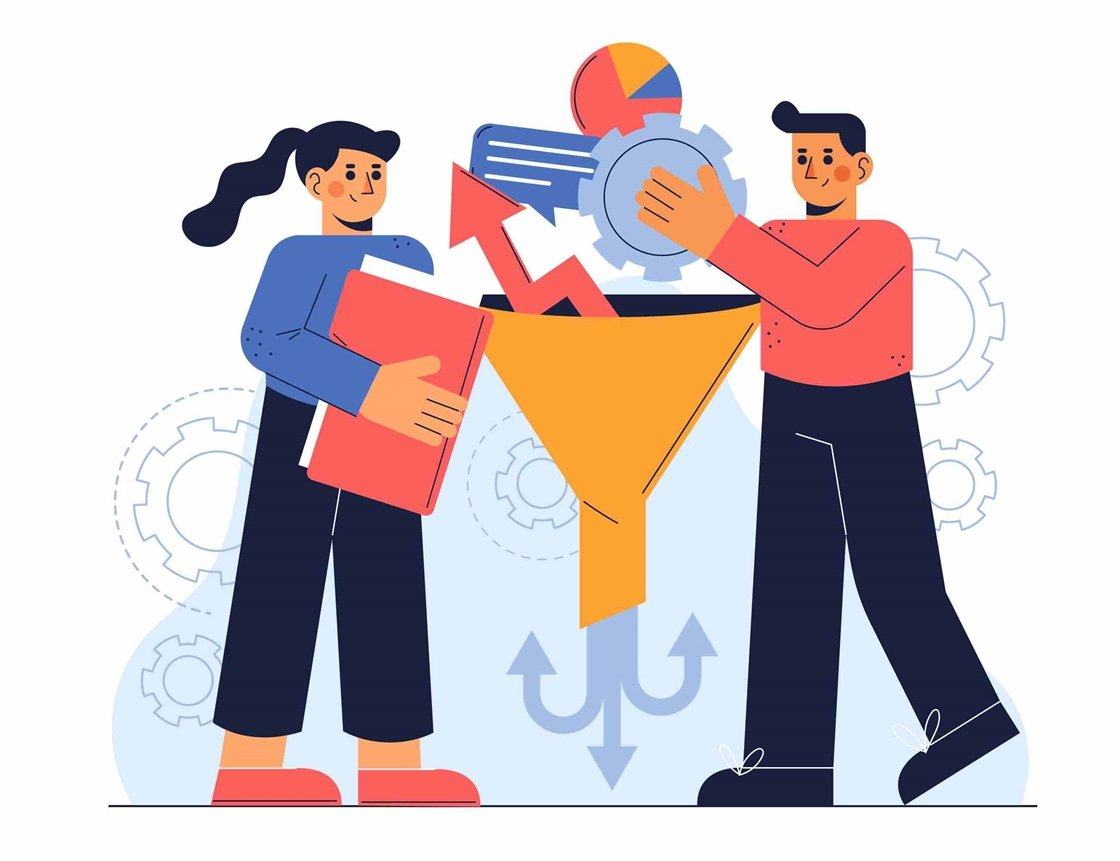
A conversion funnel is the journey your customers travel to convert. The journey begins the moment they know your brand and ends with the signature or completion of a purchase.
The better your conversion funnel, the better your conversion rate. To analyze your conversion funnel, you must go through it yourself. To do this, follow these steps.
- Search your brand online.
- Go to the first page that comes up.
- On the page you accessed, try to complete a purchase.
- Observe all the pages and steps you should follow to complete the purchase.
Going through the process will help you understand any problems and frictions. Once identified, you can start working to fix these problems and improve your conversion funnel.
Check the site's heat maps
A website heat map shows where your audience is clicking. The areas that receive the most clicks are red or orange, while the areas with the least clicks are blue or green. You can check the heat map of your website with specific tools.
The heat maps allow you to see whether your CTAs, conversion buttons and links are being clicked or not. If the heat map shows that parts of your pages leading to conversions are legal, then there is a problem.
You need to evaluate why these areas are not attracting customer attention.
Sometimes the heat map shows that clicks are high, but conversions are still low. This is also a cause for concern because it means that something is wrong in the next steps of your conversion pipeline and is not working as expected.
Therefore, analyze these patterns to find faults and correct them to improve your conversion rate.
Simplify UX and UI
The user experience and user interface are among the greatest aids or obstacles to a good conversion rate.
The better the user experience, higher chances of customer conversion. O layout from your site (IU) and the number of steps a client should go through directly determine the user experience.
On an e-commerce platform, a good UX is complemented by the following items.
- One navigation menu easy
- Precise labeling and product segregation
- Good internal search engine
- Availability of product variants on the same page
- Loading of all page modules simultaneously
There are other things too, but these are the most important. The point is, the better the UX, the more likely it will be that the customer commits to a conversion.
Offer offers and discounts frequently
Sometimes customers just need a little incentive to commit to a purchase. A great way to do this is to offer promotions and discounts.
Many customers usually stay on the wall, just waiting for a good deal to appear in their way. By offering discounts on your stock, you can make many customers capitulate and commit to a purchase.
You can make this approach more powerful by offering exclusive discounts to regular customers on your wish list items. This will also make your regular customers faithful and attract other customers.
Use strong CTAs
CTA means call to action. A CTA can be anything in its site that directly encourages customer conversion. . Some common examples of CTAs on modern sites are:
- Inscription buttons
- “Try Demo” buttons and their variants
- Pop-ups with offers and exclusivity
- QR codes that lead to business
QR codes are particularly interesting because they are very accessible and interesting. Most smartphones read QR codes directly through the camera, and on the computer it is also possible to use free online readers.
People are more likely to do something if asked. Therefore, a CTA will increase the likelihood of people converting.
Optimize for mobile phone
Mobile devices are the main navigation platform in Brazil, so a lot of their traffic comes from mobile phones. Check in Google Analytics the division between mobile and computer on your website.
It is essential that you make adjustments to ensure that customers on mobile devices have as good an experience as desktop users. Therefore, the site should look good, load fast and have no bothersome pop-ups that distract the customer.
The better their experience, the happier they'll be. And a satisfied customer is a client who converts.

This is an example of our client Viva a Cidade, which we made the site 100% compatible with smartphones. This type of care helps people who access your site via mobile phones a lot, because they become intuitive and provide a good user experience.
Run A/B tests (to see what works)
The A/B test is a method in which you try different solutions to a problem to find out which one is the best. Both solutions are employed simultaneously, but in different locations.
In optimisation conversion rate, you can try A/B tests using different CTAs, site interface changes and even descriptions of different products. The solution with good performance must be implemented, while those with poor performance should be discarded.
Highlight your exclusive sale proposal from the beginning
The exclusive sale offer or USP is the special feature or service that you offer and that your competitors do not offer.
For example, Domino’s had a USP that promised delivery in 30 minutes, or the pizza was free. IKEA sells furniture that needs to be assembled. Your USP has two strands: one is that your furniture is unique because it can be assembled and, second, they offer to ride them for free on delivery.
So find something unique that you can do for your customers and inform them at the beginning of the conversion funnel.
Local SEO
Local SEO refers to the optimisation of your website for a specific region. For example, if your company only operates in New York City, your SEO should reflect this.
Your website should use geographically specific keywords so that when people look for services in that area, your site will appear. This way you will find more people who really want to buy your things, so your conversion rate will increase.
See an example for the term Creation of websites in São Paulo:
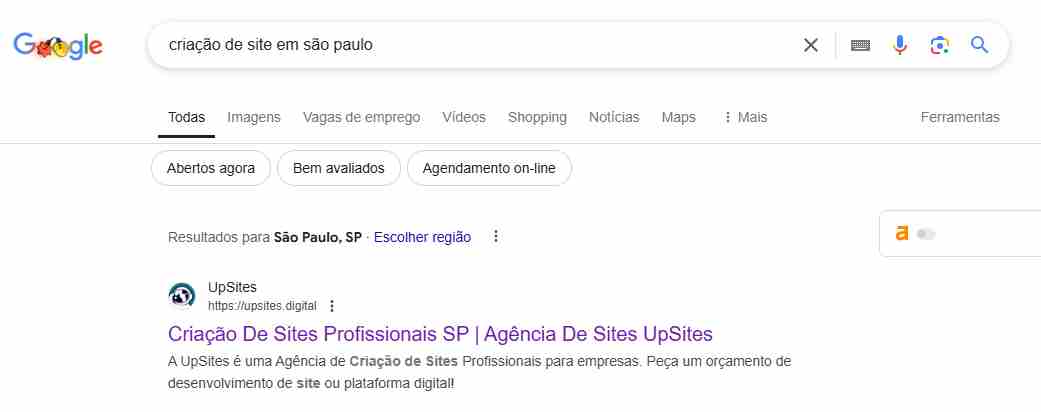
WebSyd is in first position for this search. This is important to attract qualified traffic and convert more sales of our services.
Improve page loading speeds
Slow pages lose visitors before they even load. Use the goals of Core Web Vitals as reference: LCP up to 2.5 seconds.
By optimizing the upload speed of your page, you can ensure that no one will be frustrated with your website. Frustrated customers will simply leave and you will lose conversions.
But if it all happens quickly, most customers will see your purchase to the end and you will have more conversions.
Use emails to direct abandoned carts
Sometimes customers add items to the cart and simply abandon it because the total price is out of their reach. Or they get hesitant and choose not to compromise.
An abandoned cart email brings back some of these customers. This one email should remind them of the cart and you can offer a discount to help them decide.
Start doing that, and your conversions will improve a lot.
Provide customer support with live chat
Sometimes customers may have problems browsing your website. For example, they're trying to buy something, but the page keeps locking, or the purchase button doesn't work, or they can't pay because payment processing locks. Any kind of unforeseen problem can occur.
At this point, they need immediate support. They don't have time to call an agent and wait in line until their call is answered. They also cannot send an email and wait a day for an answer.
So, you need to implement the live chat. With the live chat, an agent can contact them right there and help them with the problem. The positive experience of customers with live chat leads to more conversions.
Audit your website to eliminate problems
Website audits are needed to ensure that everything is working perfectly. Use toolkits that do site audits to find problems like:
- Broken links
- Missing Pages
- Slow loading
- Orphaned Pages
Correct them to ensure that your customers have a good experience. One professional website and fully functional also gives credibility to its brand and inspires trust in its customers. So they're more likely to buy it from you.
Make sure you have an extensive FAQ section
An extensive FAQ section is mandatory for further conversions. Sometimes customers have doubts about the products and their payment and shipping process.
They may also have other questions about your website or brand. Do some analysis of the most searched questions about your brand and create a page FAQ about them.
Make sure your customers know the FAQ page from the start, so they can access it if they need to. FAQ pages also serve to alleviate customer concerns and inspire more confidence in your brand.
The calmer the customer is, the better your conversion rates will be.
Avoid returning “No results” in the search results
If a customer is searching for a specific product on your site and it does not exist or is missing, do not show “No results”. Running into a dead end like this is not pleasant and can really take a person's breath away.
Instead, you must humanize your answer. Something like “It seems that this product has not been found” works much better. You can also aggravate this by showing a similar product.
For example, if a person wants to buy a specific hair dryer model and you don't have it in stock, suggest a similar model.
In this way, you can often convince customers to settle for an alternative and commit to a purchase. This results in more conversions for you.
Simplify the check-out process
To ensure customers convert, you need to make the checkout process very simple. If your customers have to go through several stages to finalize the purchase, there is a considerable chance that they will give up the sale and give up.
For example, if a customer needs to enter your name, address, phone number and credit card number, that's fine. Adding a two-factor authentication step is also appropriate. However, adding multiple authentication steps or requesting email marketing subscription is too much.
If you add multiple steps like these to extract the maximum from a conversion, it is more likely that you will totally lose the initial conversion. So simplify the check-out process by doing things like:
- Saving checkout information to skip this step next time
- Do not add any extra subscription contract to the checkout process
- Request two-factor authentication only if the customer is making a purchase in a drastically different region or does not follow their usual purchasing standards. This approach is flexible because it can lead to security problems.
You can use IP geolocation tools to check if your recurring customers are buying products from different regions. It can help you identify fraud attempts and protect your customers from harm.
Do not force emails and marketing messages to customers
One thing any client hates is to feel forced to do something. If your website is always asking them to do this and that (i.e. excessive saturation of CTAs), they will get irritated and leave. Then you'll lose your conversion.
Most of the time, this problem occurs when customers are bombarded with marketing emails and SMS messages. To deal with this, you can make only customers interested in your marketing receive these emails and messages.
The best way to do that is to allow customers accept to receive your marketing messages. The opposite approach is to send marketing messages to all customers by default and allow them to opt out. Don't do that, use the opt-in. That way, you won't have dissatisfied and irritated customers in your hands.
Answer customer questions about products promptly
Sometimes customers have very specific doubts about products that are not answered in the frequent questions or product descriptions. These customers have usually had bad experiences with similar products in the past, so they want guarantees.
Here's what you need to do to convert these customers.
- Have a question and answer section on each product page.
- Allow customers to ask questions in this section.
- Answer questions promptly and do your best to eliminate customer fears and confusion.
You'll get a lot more conversions that way.
Resource and other UGC assessments
E-commerce has become very popular and popular, but it brings with it its own set of problems. One of the biggest problems is the inherent mistrust that customers have in products they haven't seen personally.
They can read the product description and see the photos And videos you uploaded at the store. However, the persistent thought that the media could be tampered with still exists.
However, they can rely on the word of other customers who have already purchased the product. That's why it's important to share content generated by the user, such as customer reviews, on product pages. It is important that these assessments are natural and not bought because this only serves to increase distrust.
Good criticism will work for you, but negative criticism can also. All you need to do is respond promptly to a negative criticism and try to solve the customer problem. If you do, new customers will be less concerned and will commit to the purchase more readily.
Facilitate RMA of your products
Sometimes products can be damaged during transport. It is also possible that a product was defective and was sent by mistake. In these scenarios, do not be stubborn and simply send a replacement or return the customer's money. The more you insist, the more it will harm your credibility.
Sometimes products fail during the warranty period. In such cases, make it easier for the customer to return the product. You can do this by setting up a robust Commodity Return Authorization (RMA) process.
A strong RMA system has a number of RMA that allows customers to return defective products without using their own money. This adds a layer of convenience to the return process and makes the customer safer. That way, they will also be more comfortable buying from their brand in the future.
Conclusion: Tactics to Increase Conversion
Increasing the conversion rate is one of the most important tasks for any company that wants to grow and stand out in the market. The 20 tactics presented in this article offer practical and proven strategies to optimise each stage of the sales funnel, since the site design Even customer service.
By implementing these actions, you will not only be attracting more conversions, but also strengthening your relationship with your customers, ensuring a more satisfying and lasting experience.
Remember: the secret is to understand your customers' needs and constantly adjust their strategies to meet them in the best way. Test, measure and adjust continuously.
FREQUENTLY ASKED QUESTIONS
What is conversion rate and why is it important?
The conversion rate is the percentage of visitors who perform a desired action on their website, such as buying a product, filling out a form or signing a newsletter. It is an essential metric because it measures the success of your marketing and usability strategies, directly impacting the return on investment (ROI) of your business.
What are the main factors that affect the conversion of a website?
The main factors include: user experience (UX), design clarity and user interface (IU), site loading speed, CTA effectiveness (call-to-actions) and mobile optimisation. Other aspects such as brand reliability and clear policies also directly influence conversions.
How to identify problems in the conversion funnel?
You can identify conversion funnel problems when analyzing data such as dropout rates in specific steps, perform A/B tests and use tools like heat maps to understand user behavior. Simulating the customer journey also helps to identify frictions and obstacles that need to be fixed.
What tools can help optimise the conversion of a website?
Tools like Google Analytics, Hotjar (for heat maps), Optimizely (for A/B tests), and integrated CRMs for marketing automation are excellent for optimizing conversion. They help monitor visitor behavior, test design variations and create custom campaigns based on real data.

Caio Nogueira is a SEO, GEO, link building and Digital PR expert and co-founder of WebSyd, website creation agency and SEO consulting founded in 2016. It acts with organic search strategies, digital authority construction and brand optimisation for search engines and artificial intelligence platforms. Throughout his trajectory, he participated in more than 1000 projects involving SEO, website development, content marketing and authority acquisition through backlinks and Digital PR. At WebSyd, it participates in the planning of strategies to increase organic visibility, lead generation and presence of companies on Google and AI-based search engines. As an author, it publishes content on SEO, GEO, website creation, link building and digital authority, sharing analyses, strategies and practical experiences related to organic growth of companies. Its contents and contributions have also been published in companies and vehicles of technology and marketing such as Wix, HostGator, Duda, Neil Patel, Locaweb and E-Commerce Brasil.
View all posts


 Estimate the cost

