
Simple website or business site: what's the difference and when is it worth migrating?
Summary (TL;DR)
The development of websites for companies goes far beyond a beautiful layout: it involves strategy, technology and focus on results.
If you want to professionalize your digital presence and turn your website into a strategic asset, check out the details and take the next step with a specialised team.
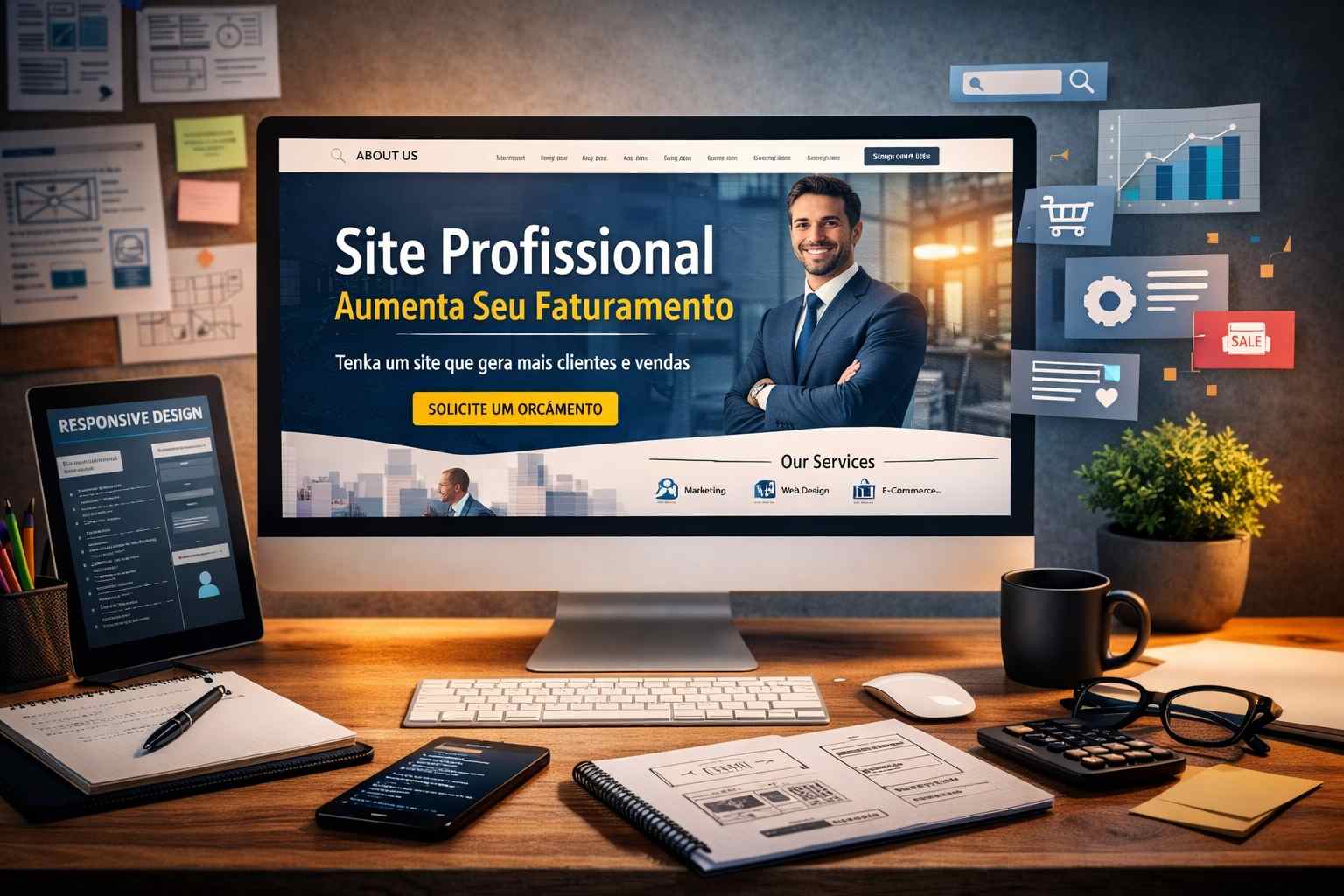
A simple website presents the company in a few pages. One business site it is planned to generate contacts and sales, integrate systems and grow along with the business. To give an idea of scale: in July 2026, the Netcraft Web Server Survey received answers of 1.49 billion sites. Even so, many companies still do not know what differentiates a business project from a basic website.
The main difference lies in the technical complexity, strategy behind the structure and focus on results. Business sites involve SEO planning, information architecture, integration with marketing tools, security, scalability and performance. It is not just about “being online”, but about building a digital asset aligned with business growth. In practice, a business site is the result of creation of professional websiteswith planning, SEO and integrations.
What is a business site?
A business site is a structured digital platform, strategic and aligned to business objectives. . Unlike a simple or personal site, it is designed to generate authority, capture leads, integrate systems, support marketing campaigns and monitor the growth of the organization. It involves technical planning, professional design, SEO, security and scalability.
What is the difference between simple website and business site?
Many companies start with a basic website only to “mark presence” online. But as business grows, the inevitable question arises: this site still represents the company and sustains its objectives? The difference between a simple site and a corporate website it is in the strategy, structure and ability to generate results.
Check out below a clear comparison between the two models:
| Simple Site | Site Thought for Company |
| Basic and limited structure | Strategic and organised architecture |
| Few institutional pages | Structured pages for sales funnel |
| Standard design or generic template | Custom design and brand aligned |
| Low focus on SEO | Technical and strategic SEO implemented |
| No integration with systems | Integration with CRM, ERP and automation |
| Basic or limited safety | Enhanced security and compliance with LGPD |
| Not prepared to climb | Structure prepared for growth |
| Low data analysis | Integration with metric tools |
| Unplanned conversion | Focus on lead generation and sales |
| Pointless and improvised updates | Maintenance and continuous evolution |
If you still don't know if the simple site has stopped attending your company, see signs that the current site is holding back company growth.
Characteristics of a business website
A business website goes beyond the basic presentation of information. It is built with focus on positioning, conversion and performance. Check out the main characteristics that differentiate this type of project:
1. Strategic structure and professional architecture
A business site has well-defined information architecture, with organized menus, structured pages and clear hierarchy of content. This organization facilitates user navigation and improves ranking on Google. The structure is not random: it is designed to lead the visitor to the desired action.
2. Focus on lead generation and conversion
Unlike a simple website, the business is built for generate real business opportunities. . This involves strategic forms, landing pages, calls for clear action and integration with CRM or marketing automation. . Each page has a defined goal within the sales funnel.
3. Advanced integrations and features
Corporate Sites often need to integrate internal systems, payment platforms, ERPs, marketing tools and service. They may also include restricted areas, custom administrative panels or company segment-specific features. This technical complexity requires planning and specialised staff.
4. Enhanced security and compliance
Companies deal with customer data and sensitive information, so security is a priority. . SSL certificate, attack protection, automatic backups and compliance with standards like LGPD are basic requirements. A simple site often ignores these points, but in the corporate environment they are indispensable.
5. Scaleability and growth preparation
A business website needs to be prepared for to develop with the company. . This means supporting increased traffic, inclusion of new pages, new services and even expansion to more robust e-commerce or platforms. The technology chosen and the way the site is structured determine its ability to grow without compromising performance.
How is the process of creating a business website

If you have already decided to professionalize and digitize your company, the next step is follow a structured process next to a specialised team. . Development should not be improvised. Ao hire a company experienced, you have technical guidance at each stage, from planning to continuous maintenance.
Today it's possible even develop site with AI, but the lack of professionals who know how to conduct the entire process may end up harming your company on the internet.
The detailed step by step is in the guide on the professional website creation process, and the deadlines by type of project are in how long it takes the development of a website. . Below, see how this process works in practice:
1. Plan and create the briefing
The first step is align expectations, goals and needs with the team responsible for the project. In the briefing, you report site goals, target audience, company differentials, competitors and desired features. The agency turns this information into a strategic direction. The clearer this initial alignment, the more efficient development will be.
2. Register domain and hire hosting
With the support of the technical team, you sets the ideal domain, for example, nomedaempresa.com.br, which will be the official address of your website. It is also necessary to hire a reliable hosting service, responsible for storing the files and ensuring stability. The correct choice directly impacts the performance and safety of the project.
3. Create sitemap and content
At this stage, the contracted company organizes the structure of the site, defining the main pages, hierarchy of information and navigation flow. At the same time, you can send institutional texts and materials or choose to hire strategic content production. The sitemap serves as a structural map of the project and guides technical development.
4. Set a visual identity
Based on the brand of your company, the team develops layout and visual experience of the site. . Here come factors like responsive design, navigability and intuitiveness. A professional layout should reflect positioning and convey credibility.
Essential elements:
- Color palette aligned to the brand;
- consistent typography;
- Clear visual hierarchy;
- strategic buttons (CTAs);
- Layout adapted for mobile devices.
5. Wait for development
After validation of the structure and design, the team begins to technical development phase. . This includes coding, feature implementation, system integration and technical SEO configuration. At this point, you follow the steps and approve partial deliveries according to the set schedule.
6. Start testing phase
Before the launch, the site passes through complete tests. . Links, forms, speed, compatibility with devices, safety and overall performance are verified. This step ensures that the site enters the air without fail and is ready to generate results from the first access.
7. Maintain site maintenance
After the launch, the work does not finish. Technical updates, SEO enhancements, content adjustments and performance monitoring are key to keeping the site competitive. By relying on continuous support from the contracted company, you guarantee constant evolution and long-term stability.
The importance of hiring an agency specialised in websites for companies
Hireing a specialised agency makes all the difference when we talk about developing websites for companies. A digitisation of companies requires technical planning, strategic vision and updated knowledge of SEO, performance and security. WebSyd operates precisely in this scenario, offering complete business solutions that want to grow structuredly in the digital environment, focusing on results and scalability.
More than putting a website on the air, the goal is to create a digital asset that manages authority, opportunities and sales. If your company is ready to evolve, count on WebSyd for develop a professional project, strategic and aligned with its growth. Talk to our experts and take the next step.
At WebSyd, custom-made websites depart from R$5,000 and are ready in about 45 business days; online stores take about 60 days. Get a quote.

FREQUENTLY ASKED QUESTIONS
How much does it cost to develop a website for the company?
The investment varies according to the complexity of the project, number of pages, integrations and desired features. Institutional sites usually have a different cost of more robust platforms. The ideal is to request a custom budget to understand which solution fits best in the reality of your business.
Is it possible to migrate a simple website to a business model?
Yes, it is possible to carry out a migration as long as it is done with adequate technical planning. In some cases, it may be necessary to rebuild part of the structure to ensure performance, SEO and scalability. The initial analysis defines the best strategy.
Do I need to provide all the content for development?
Not necessarily. You can send existing institutional materials or hire strategic content production with the agency itself. The important thing is that the content is aligned with the company's business objectives.
How long does it take for a business site to get ready?
The deadline depends on the complexity of the project, agility in approving the steps and volume of functionality. Institutional projects can take a few weeks, while more custom solutions require more time for development and testing.
Does a corporate site need a blog?
It's not always mandatory, but a blog can be a powerful tool for SEO and authority generation. Producing relevant content helps attract organic traffic and strengthen the company's digital presence in the long run.
Can the site be integrated into internal company systems?
Yeah. Business sites can integrate CRM, ERP, payment systems, marketing automation and other tools. This integration increases operational efficiency and improves control over data and processes.
How to ensure that the site is secure?
Security involves SSL certificate, constant updates, automatic backups and attack protection. A specialised agency implements these practices from the outset to protect company and user data.
Once ready, does the site need maintenance?
Yeah. Technical updates, SEO improvements and strategic adjustments are essential to keep the site competitive. Continuous maintenance ensures that the project monitors company growth and digital market changes.

Caio Nogueira is a SEO, GEO, link building and Digital PR expert and co-founder of WebSyd, website creation agency and SEO consulting founded in 2016. It acts with organic search strategies, digital authority construction and brand optimisation for search engines and artificial intelligence platforms. Throughout his trajectory, he participated in more than 1000 projects involving SEO, website development, content marketing and authority acquisition through backlinks and Digital PR. At WebSyd, it participates in the planning of strategies to increase organic visibility, lead generation and presence of companies on Google and AI-based search engines. As an author, it publishes content on SEO, GEO, website creation, link building and digital authority, sharing analyses, strategies and practical experiences related to organic growth of companies. Its contents and contributions have also been published in companies and vehicles of technology and marketing such as Wix, HostGator, Duda, Neil Patel, Locaweb and E-Commerce Brasil.
View all posts


 Estimate the cost

