
SEO Enterprise: Advanced Strategies for Business 2026
Summary (TL;DR)
SEO Enterprise is the practice of optimizing large corporate sites to improve your visibility in search engines. It involves managing thousands of pages, which requires automated processes, advanced tools and efficient coordination between different teams.
The main strategies include technical optimisation, large-scale content creation and management, link building, and the use of tools such as Google Search Console, Semrush and Ahrefs to monitor and analyze website performance.
The benefits of SEO Enterprise are significant, including increased visibility, increased organic traffic and improved domain authority. Large companies have unique opportunities to build backlinks through unlinked brand mentions, which can further strengthen the website's link profile.
It is crucial to manage problems such as duplicate content and page swelling to ensure that the site maintains a good ranking in search engines. With the correct implementation of these strategies, companies can position themselves as leaders in their sectors, attract more customers and increase return on investment.
What is SEO Enterprise?
Quick answer: Enterprise SEO is the SEO made for sites with thousands or millions of pages, such as large e-commerce, portals and marketplaces. The difference lies in the scale: task automation, tracking budget control, optimised templates, team governance and business impact prioritization.
SEO Enterprise is the practice of improving search engine ratings for large companies. Common business-level SEO approaches include content scalability, continuous technical SEO management and automation.
Here are some examples of site types who may need SEO at a business level:
- News Portals with hundreds of thousands of accesses per month
- Large e-commerce site with more than 10,000 pages
- Business with multiple locations
- Companies with multiple websites
For example, observe a site like GitHub.
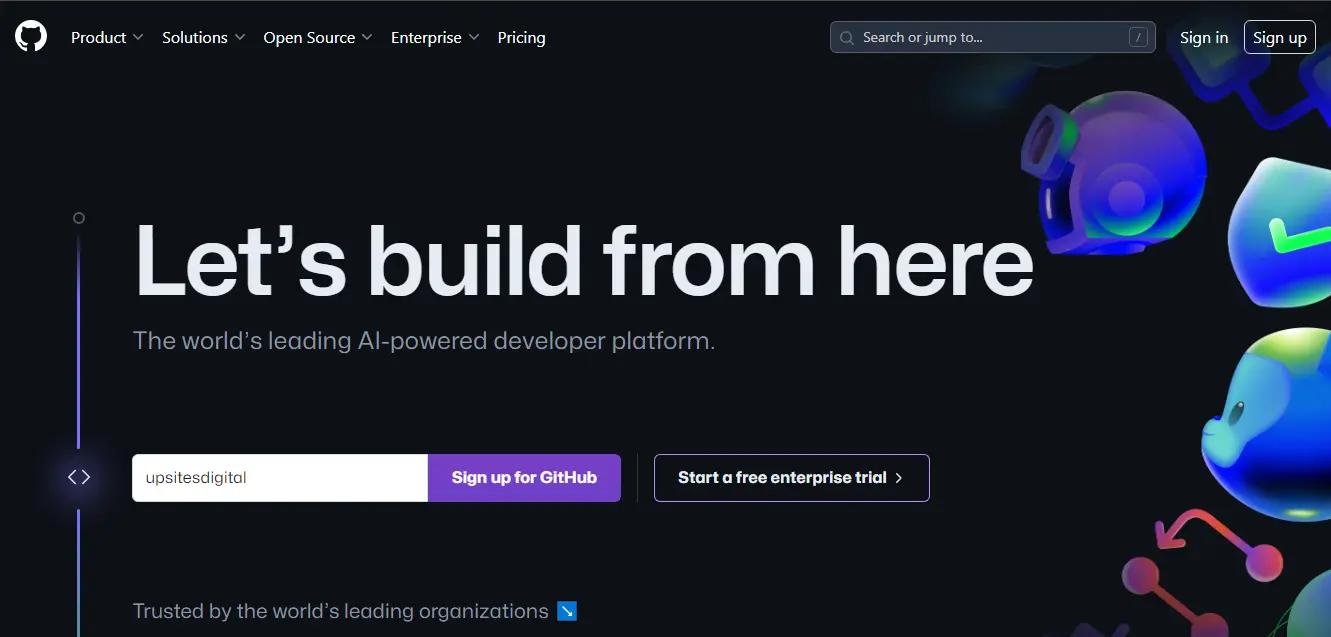
Sites like GitHub have millions of public pages indexed on Google.
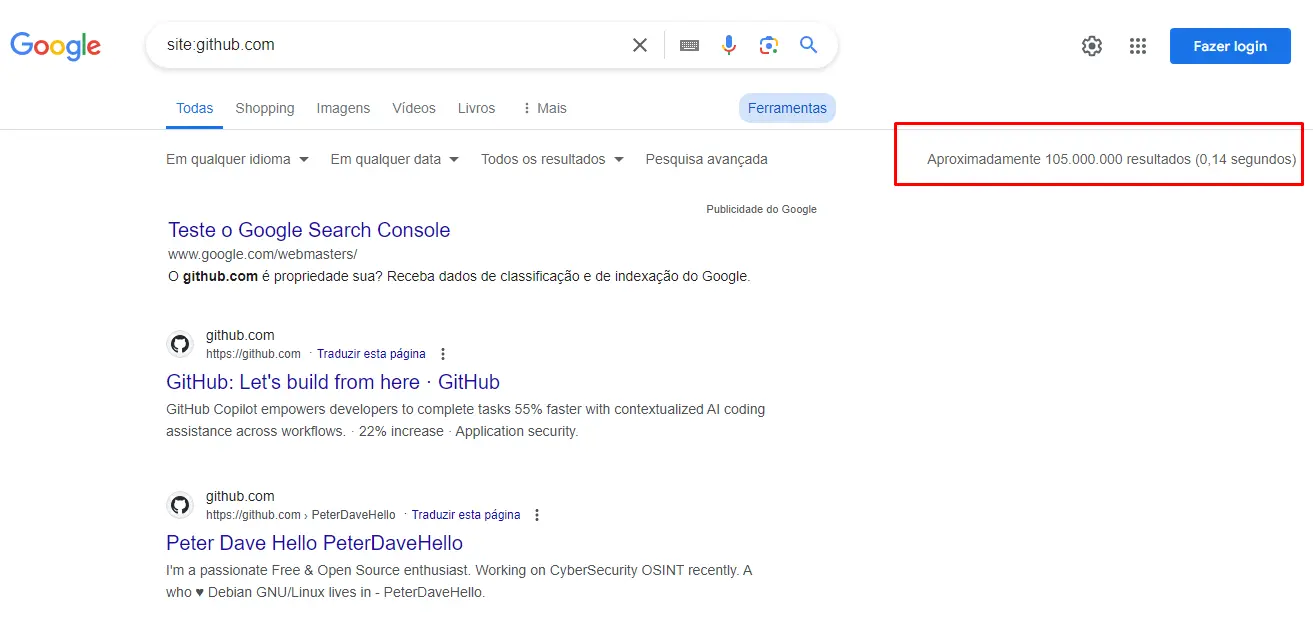
Most traditional SEO approaches will not work as well on a site like this.
Many SEO best practices need to be adapted to a multi-page business site.
How is SEO Enterprise Different from “Normal” SEO?
Scaleability
The biggest difference between SEO for corporate sites and “normal” websites is the scale.
Optimizing a few pages on a small site is one thing, but when you deal with a website that has thousands of pages, it is necessary to scale all SEO actions.
Internal Link Structure
For example, the internal link is an important SEO practice.
On a small site, linking some pages can make a remarkable difference in ratings.

But on a massive website like Amazon, you need to scale significantly the structure of internal links, and it can include creating scripts that automatically link across different areas of the site.
In any case, it is unlikely that you will be able to manually scale the internal links on an enterprise-level site.
Content Production for SEO Enterprise
Content production also needs to be escalated.
On an e-commerce site, this usually means writing unique content for each product page and category.
On content sites, this can include the assembly of a full editorial team to optimise each page.
If the site has a lot of user-generated content (UGC), content sizing will come in the form of moderation and community building.
Sometimes a corporate website may need 10x or up to 100x your content production. This type of scale sometimes means that the company needs to create an entire department focused on content marketing, setting up systems and software to ensure that they produce high-quality content regularly. One CMS headless enterprise it can simplify content management, making it easier for teams to adapt and share content on different platforms.
Ask for an SEO Consulting budget
SEO Consulting
Tools for SEO Enterprise
1. Semrush
- Features: Provides detailed domain analysis, keyword search, site audits, position tracking, and backlink analysis.
- Use for SEO Enterprise: Use the tool to create custom reports, perform technical audits on sites with thousands of pages and identify keyword opportunities and backlinks on a large scale.
2. Ahrefs
- Features: Backlink analysis, keyword search, site audits and position tracking.
- Use for SEO Enterprise: Ahrefs is excellent for monitoring the health of the backlink profile of a large site, finding high-competition keywords and analyzing competition at business level.
3. Screaming Frog SEO Spider
- Features: Website tracking, identification of technical errors, metadata analysis, redirecting audits.
- Use for SEO Enterprise: Ideal to perform detailed technical audits on large websites, identify tracking problems and structure, and optimise technical SEO.
4. Google Search Console
- Features: Search performance monitoring, indexing problems identification, click and print analysis, and feedback on site improvements.
- Use for SEO Enterprise: Use to monitor the indexation of thousands of pages, identify tracking errors, and receive alerts about critical issues that may affect website visibility.
5. BrightEdge
- Features: SEO platform with performance analysis, keyword search, site audits and automatic recommendations.
- Use for SEO Enterprise: BrightEdge is excellent for companies that need actionable insights and automation to maintain continuous large-scale optimisation.
6. Searchmetrics (conductor)
- Features: Market analysis, keyword research, technical audits, and performance monitoring.
- Use for SEO Enterprise: Provides deep data and insights to help the company master competitive markets, as well as detailed analysis for continuous optimisation.
Ask for an SEO Consulting budget
SEO Consulting
SEO Enterprise strategies
1. Automating Tasks
- Use automation features for repetitive tasks such as site audits, reporting and position monitoring.
- Tools like BrightEdge and Searchmetrics offer advanced automation that can save time and resources.
2. Continuous Monitoring
- Implement a continuous monitoring system to quickly identify and correct any technical or content issues.
- Use Google Search Console together with other tools to receive alerts and maintain the health of the site.
- For companies that also monitor the presence of generative mechanisms, AIScore can function as a complementary reading, combining domain technical checks with a Quote Rate observed in an AI response sample.
3. Large Scale Data Analysis
- Tools like Semrush and Ahrefs allow large data volumes analysis to identify trends, keyword opportunities and competition strategies.
- Use this data to continuously adjust your content strategies and technical SEO, including keyword rank monitoring for continuous performance insights.
4. Team Collaboration
- Integrate SEO tools with project management platforms such as Asana or Trello to improve collaboration between marketing, development and content teams.
- Tools like Screaming Frog can generate detailed reports that can be shared and worked by different teams.
5. Mass Content Optimization
- Use keyword search and content analysis features to optimise large volumes of product pages, categories, and articles.
- Tools like Semrush and Ahrefs help identify specific keywords and create scalable content strategies.
6. Detailed Technical Audits
- Perform frequent technical audits to identify and correct problems that may affect website traceability and indexing.
- Tools like Screaming Frog and Google Search Console are essential to identify technical problems on large websites.
Team Approval
Making changes to a business website often requires the approval of various teams and departments. This means that to implement an SEO change, it is necessary to get the support of SEO developers, designers and stakeholders, which can be a long and complex process.
Practical Example
Imagine you're a marketing agency working with an SEO Enterprise client. You realize that a specific set of pages has several H1 tags. As you know, it is recommended to have only one H1 tag per page for on-page optimisation.
You send an email to a developer who works on the site: “John, I noticed that your category pages have several H1 tags. Can you adjust that for me? Thank you.”
Sometimes the developer can make this correction quickly. However, this change often requires approval from various stakeholders in different departments: development, design and SEO. In addition, many corporate sites use a custom “headless CMS enterprise”, which means that a “simple” change can affect other parts of the site.
And that's just to change an H1. Imagine if you want to implement a script for internal linking or change the structure of the site to make it more SEO-friendly. This usually takes weeks or months of meetings, and yet there is no guarantee that your suggestion will be implemented.
Lessons Learned
Enterprise SEO does not just involve expanding SEO or optimizing many pages. In order for your SEO recommendations to be actually implemented, it is generally necessary to get the membership of different departments and team-specific members. When you get this, your recommendations are implemented more quickly and with less friction.
Secret to Getting Adherence
The key to getting membership for SEO changes is to make clear the benefit for each person involved. For example, if you want to level the architecture of a site to make it more SEO-friendly, you can present the recommendation in a way that shows the benefits for developers:
“Hey, João, I know you agree that we should restructure the architecture to improve the site. In addition to the benefits of SEO, this will also reduce site page count by about 10%, which should decrease server load and facilitate website management.”
Obviously, you'll probably need more arguments to completely convince the team. But when it comes to implementing business SEO recommendations, that's the general approach you should take.
Ask for an SEO Consulting budget
SEO Consulting
Duplicate and Swollen Pages
Business sites often face technical SEO challenges, such as duplicate content and excess pages, known as “page swelling”.
Duplicate Content
Duplicate content can arise when a CMS automatically generates product or category pages with the same text. In addition, it can also occur when there are several pages with very similar content. This problem is common in business sites due to the large amount of content generated by different departments.
Page Swelling
Another critical problem in SEO Enterprise is page swelling, which occurs when the site has many pages that should not be there. This may include:
- Old product pages
- Business announcements no longer relevant
- Accidentally indexed search results pages
bloating pages can harm the ranking of pages you really want them to rank.
This is because it consumes the site's Crawl Budget, affecting the indexing of new pages.
Why is Swelling of Pages Common on Business Sites?
Business sites tend to be large, which facilitates the presence of many low-quality pages that can go unnoticed.
In addition, with several teams and departments contributing to the content, it is often not considered the impact that this has on the swelling of pages.
Often, there is no specific person or team responsible for monitoring page swelling. This may fall on the development team or SEO professional, but it is rare to have someone dedicated exclusively to this task.
How to Manage Page Swelling in SEO Enterprise
- Regular Audits: Perform regular audits to identify and remove unnecessary pages.
- Content Governance: Establish clear policies on content creation and maintenance to avoid duplication.
- Advanced SEO Tools: Use tools like Semrush, Ahrefs and Screaming Frog to monitor and manage duplicate content and page swelling.
- Google Search Console: This tool is essential to manage page swelling. In the Tracking section, you can see indexing errors and tracking problems, as well as receiving recommendations on how to fix them.
Keyword Search in SEO Enterprise
Business sites, due to their high domain authority, can segment highly competitive keywords.
However, it is also important to target long-tail keywords to maximize range.
Unique Backlink Opportunities
Corporate sites can use the same set of link building strategies as any site, but have some unique opportunities that many smaller websites do not have.
Mark Names Not Linked
One of the most effective strategies for business sites is to capitalize on mentions of unlinked brands. Unlinked brand mentions occur when another site mentions a brand without including a link to it.
A popular and effective link building strategy is to contact the people who mentioned your brand without adding a link and asking them to do so. As these people have already mentioned your brand, it is much more likely that they will add the link. After all, they mentioned their brand for a reason, so it's not hard to convince them to add a quick link.
While smaller websites can receive 5 to 10 brand mentions per month, a large-branded business site may receive more than 500 unbound mentions every month. Each of these mentions is a potential backlink, providing a great opportunity to strengthen the site's backlink profile and improve your domain authority.
How to Enjoy Maximum Brand Names Not Linked
- Continuous Monitoring: Use tools like Ahrefs, Semrush or Google Alerts to monitor brand mentions. This helps to identify unlinked mentions quickly.
- Strategic Outreach: Develop a personalised and educated outreach approach. Explain the benefit of adding the link to both the author and readers.
- Automation of the Process: Tools like BuzzStream or Pitchbox can help automate and manage the outreach process, saving time and effort.
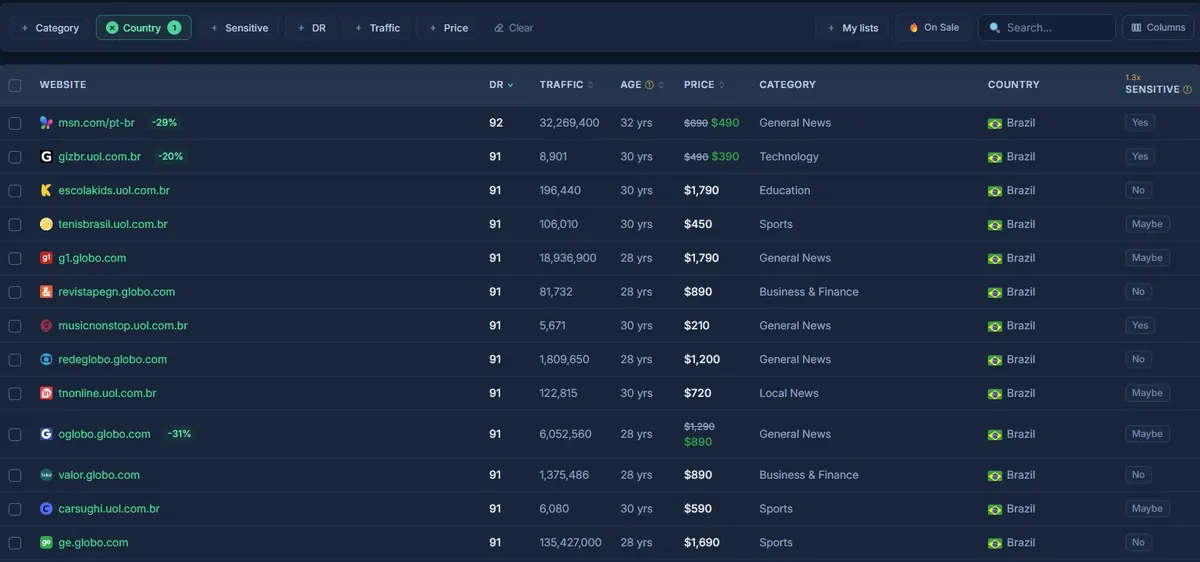
In projects that also require active acquisition of links in scale, the BlaaS can complement the outreach with a catalogue of filterable publishers by country, category, DR, traffic and price.
Ask for an SEO Consulting budget
SEO Consulting
How to Outsource Your Enterprise SEO Strategy
Outsourcing your company's SEO can be an effective way to leverage expertise. Follow these steps to ensure a successful partnership:
Evaluate Your Needs
Evaluate your current SEO capabilities and identify areas that need support. Business SEO differs from traditional SEO in terms of scale, tools, team acceptance and unique challenges.
Define Your Goals
Enlighten your SEO goals and take advantage of the strengths of your site, as a high domain authority, to target competitive keywords.
Choose the Right Partner
Search SEO consulting company with experience in business SEO, strategic processes, advanced tools and cultural alignment. Request case studies and references.
Establish Communication Protocols
Define clear communication channels and reporting cadences. Ensure that your partner understands the organizational structure of your company.
Set Work Scope
Develop a detailed design plan with deliverables, schedules and responsibilities. Consider unique opportunities for businesses.
Establish Standards and References
Determine current performance standards and set benchmarks to measure progress and ROI.
Join with Internal Teams
Ensure perfect collaboration between the agency and its internal teams to break silos.
Define Expectations and KPIs
Define success with specific and measurable KPIs linked to your SEO goals.
Think Long Term
View engagement as a continuous partnership with space for growth and evolution.
Monitor, Optimize and Scale
Perform regular reviews, optimise based on learning and scale successful initiatives.
Outsourcing business SEO requires finding a partner who understands the unique challenges and opportunities of large-scale websites. Setting clear expectations, keeping communication open and continuously optimizing, you can achieve your business SEO goals.
For advanced and customised SEO Enterprise strategies, see WebSyd, expert in SEO consulting for big companies. WebSyd provides complete support to ensure that your website achieves the best results in search engines, regardless of the size or complexity of your project.
SEO Consulting
FREQUENTLY ASKED QUESTIONS
What is SEO Enterprise?
SEO Enterprise is the practice of optimizing large enterprise websites to improve your visibility in search engines. Unlike traditional SEO, SEO Enterprise involves managing a large volume of pages and implementing large-scale strategies, often requiring specific tools and approaches to deal with the complexity and scale of the site.
What are the benefits of SEO Enterprise?
The benefits of SEO Enterprise include increased visibility in search engines, increased organic traffic, and improved domain authority. In addition, a good SEO Enterprise strategy can help the company to position itself as leader in its industry, attract more customers and consequently increase sales and return on investment (ROI).
How does SEO Enterprise differ from traditional SEO?
The main difference between SEO Enterprise and traditional SEO is the scale. While traditional SEO focuses on optimizing a limited number of pages, SEO Enterprise handles thousands or even millions of pages. This requires automated processes, advanced tools and efficient coordination between multiple teams within the company.
What are the main SEO Enterprise strategies?
Major SEO Enterprise strategies include site technical optimisation, large-scale content creation and management, link building, and use of advanced tools for monitoring and analysis. In addition, it is crucial to get the approval of several internal teams and ensure that all changes are implemented in a coordinated manner.
How to manage duplicate content in SEO Enterprise?
To manage duplicate content in SEO Enterprise, it is important to perform regular site audits to identify and correct problems. Tools like Google Search Console, Semrush and Ahrefs can be used to monitor content and ensure that each page has unique and relevant content, thus avoiding penalties on search engines.
Which tools are essential for SEO Enterprise?
Essential tools for SEO Enterprise include Google Search Console, Semrush, Ahrefs, Screaming Frog and BrightEdge. These tools help perform technical audits, monitor keywords, analyze backlinks, and automate various SEO tasks, allowing efficient management of large volumes of data.

Caio Nogueira is a SEO, GEO, link building and Digital PR expert and co-founder of WebSyd, website creation agency and SEO consulting founded in 2016. It acts with organic search strategies, digital authority construction and brand optimisation for search engines and artificial intelligence platforms. Throughout his trajectory, he participated in more than 1000 projects involving SEO, website development, content marketing and authority acquisition through backlinks and Digital PR. At WebSyd, it participates in the planning of strategies to increase organic visibility, lead generation and presence of companies on Google and AI-based search engines. As an author, it publishes content on SEO, GEO, website creation, link building and digital authority, sharing analyses, strategies and practical experiences related to organic growth of companies. Its contents and contributions have also been published in companies and vehicles of technology and marketing such as Wix, HostGator, Duda, Neil Patel, Locaweb and E-Commerce Brasil.
View all posts


 Estimate the cost

