
What's a nofollow link?
Summary (TL;DR)
This text explains the concept of nofollow links and their importance to SEO. Although they do not pass PageRank and do not directly affect the search engine classification, nofollow links still have value.
They help avoid Google penalties for negative SEO practices and maintain site integrity. The text teaches how to identify and create nofollow links, highlighting when using them, such as in unreliable comments or websites.
In addition, it mentions the relevance of nofollow links for brand construction and traffic, even if they do not directly influence the ranking of the site.
Quick answer: nofollow link is a link with rel=”nofold”, which tells Google that the site does not endorse the destination. Since 2019 Google has treated the attribute as a hint, and there are more specific options: rel=”sponsored” for paid or affiliate links and rel=“ugc” for comments and forums.
If you're going create site, or if you already have one ready, you probably have already done research on SEO techniques and may have come across content about nofollow link.
As much as there's a chance that you've heard of nofollow link, there are few people who really know what it's about and what it's for.
Links are still very important for SEO, but not all types of links are the same. In the case of nofollow links, they do not have a direct impact on your site optimisation, but also does not mean that they are useless.
In a nutshell, this is a link that points from one site to another, but with the attribute rel = “nofollow”. This HTML attribute indicates to search engines that you do not want to endorse the link or transfer authority to the destination page.
For many years, this meant that no “link juice” (or Pagerank) was passed from one site to another. Since 2019, however, Google has treated nofollow as a hint (hint) for classification and since March 2020 also for tracking and indexation: in most cases the link does not transfer authority, but the seeker may decide to consider it.
A normal user will not understand that it is a link without follow-up. Links continue to work normally for those who click; for searchers, the attribute indicates that the destination page should not be treated as an endorsement of your website.
Want to know more about link in follow? Continue reading and check it out!
How do I check if a link is nofollow?
The easiest way to check if a link is nofollow is to view the HTML code of a web page and search for the HTML tag. If you can find the attribute “rel =” nofollow ” between the opening <a> and closing </a>, then it means that the link is not followed.
Here are the steps to check any link using Google Chrome.
- Open the web page with links
- Right click anywhere on the page and select INSPECTOR or select VISUALIZE> DEVELOPMENT > INSPECTION ELEMENTS from the top menu.
- Click the SELECTION ELEMENT icon and highlight a link to view HTML Code.
How to link in follow
You can link in the follow by adding the attribute rel = “nofollow” between the element opening and closing tag. If you are writing a blog post, you can view the HTML code of a page, find the link and add the attribute.
To make changes throughout the site, i.e. add the nofollow attribute to all links found in the comments, you will need the help of a web developer.
What is the role of nofollow links in SEO?
You might be wondering why a webmaster should worry about nofollow links?
The answer is simple: in general, nofollow links do not link juice or PageRank and therefore tend not to directly help a site to have a higher rating on search engine results.
If you own an online business (or beginner in web programming), you probably have no knowledge, at least not advanced, of HTML. Therefore, it is worth making clear that link juice is the value and authority transmitted from one page to another.
In order for you to understand the best question of nofollow and SEO links, let's explain how the concept of links came about.
The concept of links
The founders of Google (Larry Page and Sergey Brin) created a system (this is Google's initial algorithm) to classify websites based on their importance. They assumed that important websites probably have more backlinks than other less important sites.
The links were perceived as a “vote of trust” from one site to another. This concept is still one of the most important SEO classification factors.
Over the years, Google has realized that this model could be easily manipulated by Black Hat SEO techniques, which are techniques viewed negatively by the search engine.
People can build hundreds of links by publishing content in articles, forums, ads and having a higher rating on Google. These links were not trusted votes, but were artificially created for the sole purpose of increasing the link count.
To solve this problem, they did the following three things:
- First, they changed their algorithms to value links differently;
- Secondly, they started punishing sites that had many outgoing links;
- Third, they introduced the attribute ‘nofollow’.
In addition, they also instructed webmasters to add the ‘nofollow’ attribute to all the output links they do not trust. A great example of this is the links in comments, which are nofollow by default on all major platforms and CMS (Content Management System, or Content Management System, in Portuguese).
Another example is links on social networks such as Facebook, Twitter, Pinterest and LinkedIn, which are also nofollow links.
But, after all, are nofollow links useless to SEO?
If nofollow links generally don't pass PageRank, does that mean they're useless?
Google says that “they usually don’t follow nofold links, ” leaving a door open to assume that sometimes they follow them. However, even if nofollow links do not work as trusted votes, they are still useful for SEO.
For example, if you publish an article in Forbes, for example, the links will be nofollow, but it is still an important link to have. That's because it can not only potentially direct traffic to your website, but it's also good for the brand.
“Market messages” and people talking about a brand is a factor Google takes into account, so nofollow links from reliable sources have a value.
When you can have nofollow link
As a webmaster or SEO professional, you are responsible for the overall SEO health of your website. This means that you should make sure that it does not violate any of Google's guidelines and the way you handle input or output links is part of this.
For example, paid or sponsored links need to be marked with rel=”sponsored” (or rel=“nofollow”). Selling links that pass authority, without this marking, violates Google's spam policies. Also, having many outgoing links on a website or blog page is not normal and Google can penalize you for that.
In general, you should create links only to websites on which you trust. If you have to link to a website and are not 100% sure about its quality and authority, you may not have the results you expect.
Next, check out two examples of when you can have a nofollow link.
Example 1: You are writing an article about SEO and want to create a link to a related study. The link doesn't need to be nofollow because you know it's from a reliable source.
Example 2: you are writing an article about SEO and add a link to a download site (for your users to download an application or Chrome extension). Since you do not trust the site 100% (download sites are unreliable), to be safe, you can create a nofollow link.
Finally, links in comments, forums or other user-generated areas should receive the attribute rel=”ugc” (or nofollow).
Nofollow, sponsored and ugc: which to use?
Since 2019, Google has recognized two more specific attributes besides nofollow: rel=”sponsored”, for paid, sponsored or affiliate links, and rel=”ugc” (user-generated content), for links to user-generated content such as comments and forum posts. Nofollow remains valid for other cases where you do not want to associate your site with the destination page, and attributes can be combined (e.g. rel=”ugc nofold”).
Last words
The nofollow attribute was created so that a webmaster can tell the search engines that it does not endorse specific links. Today it works as a tip: in most cases, nofollow links do not link juice or PageRank to the destination site. For paid links, use rel=”sponsored”; for content generated by users, rel=“ugc”.
However, this does not make any nofollow link of input useless to SEO. Links from high-authority websites can indirectly help with SEO.
As webmaster, you should not only worry about the input links, but also need to ensure that all outgoing links to sites on which you do not trust have the nofollow attribute.
Do you like the contents? We hope so and that from now on it is clearer to you what a nofollow link is and what it's for!
In the prospecting of publishers, the type of link and editorial rules need to be confirmed before publication. O BlaaS help in initial selection by category, country, DR, traffic and price; validation of the link attribute must be done on a case-by-case basis.
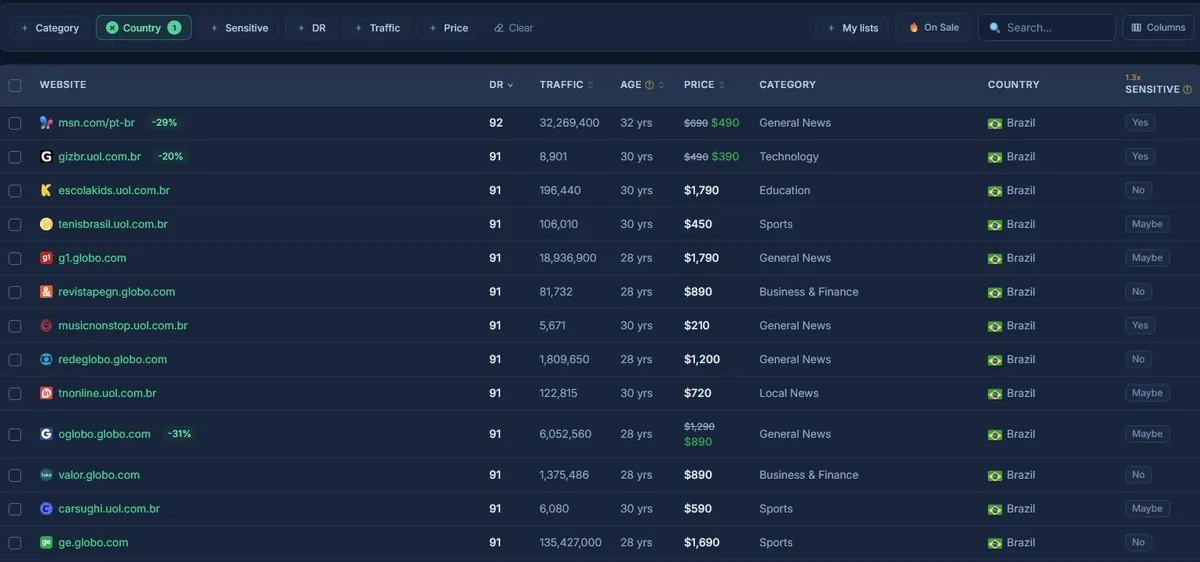
Now if you decided to invest in good backlinks, ask us for a quote right now by clicking on the button below!
FREQUENTLY ASKED QUESTIONS
What is a nofollow link and how does it work?
A nofollow link is a type of link that contains the rel=”nofold” attribute in HTML. This attribute instructs search engines not to follow the link, i.e. do not pass “link juice” or PageRank to the destination page. This means that the link does not contribute directly to the SEO of the target site.
How can I check if a link is nofollow?
To check if a link is nofollow, view the HTML code of the page and look for the attribute rel=”nofollow” inside the tag . . In Google Chrome, you can do this by right clicking on the page by selecting “Inspect” and looking for the specific link in the HTML code displayed.
Are nofollow links completely useless to SEO?
No, nofollow links are not useless for SEO. Although they do not pass PageRank, they can direct traffic to your site and help build the brand. Nofollow links from high authority sites can increase brand visibility and recognition, which may indirectly benefit SEO.
When should I use nofollow links?
You should use nofollow links when you do not fully trust the quality or authority of the site to which you are creating the link. Examples include links in comments, links in user-generated areas and links to download sites or less reliable sources. This helps protect your site from possible Google penalties for negative SEO practices.

Caio Nogueira is a SEO, GEO, link building and Digital PR expert and co-founder of WebSyd, website creation agency and SEO consulting founded in 2016. It acts with organic search strategies, digital authority construction and brand optimisation for search engines and artificial intelligence platforms. Throughout his trajectory, he participated in more than 1000 projects involving SEO, website development, content marketing and authority acquisition through backlinks and Digital PR. At WebSyd, it participates in the planning of strategies to increase organic visibility, lead generation and presence of companies on Google and AI-based search engines. As an author, it publishes content on SEO, GEO, website creation, link building and digital authority, sharing analyses, strategies and practical experiences related to organic growth of companies. Its contents and contributions have also been published in companies and vehicles of technology and marketing such as Wix, HostGator, Duda, Neil Patel, Locaweb and E-Commerce Brasil.
View all posts


 Estimate the cost

