
8 technical decisions in the development of websites that impact SEO
Summary (TL;DR)
Technical decisions made during the development of a website directly influence your visibility on Google.
Structure, performance, security and organization of pages are factors that determine the success of SEO.
To understand how to apply these optimizations in practice, check out the details throughout the content.

There are several technical decisions in the development of websites that impact on SEO, often still in the initial phase of the project. Structure, performance, page architecture and user experience are factors that determine whether or not a site will have organic visibility. For companies seeking qualified traffic without relying only on paid ads, thinking about SEO since development is fundamental.
When these decisions are made correctly, the site is already born prepared to be tracked, indexed and well positioned in search engines. Check out some of the main technical choices that directly influence the performance of a website on Google. These choices are part of the creation of professional websites.
1. Responsivity
Responsivity is the ability of a site to automatically adapt to different screen sizeslike smartphones, tablets and desktops. Instead of creating separate versions for each device, the responsive web design adjusts layout, images and navigation elements to ensure a good experience in any access format.
This factor became decisive for SEO especially after Google implemented the mobile-first indexing, process in which the mobile version of the site became considered the main for indexing and ranking. This means that if the experience on the mobile phone is bad, positioning can be directly affected.
Non-responsive sites tend to present low usability on mobile devices, which increases the rejection rate and can harm the ranking in the results pages.
2. Loading speed
The loading speed is one of the most important technical factors for SEO and user experience. The faster a site opens, the more likely the visitor will remain on the page and interact with the content. On the other hand, slow pages make users leave the site before they even view the content.
According to Google's own surveys, 53% of visitors leave a mobile page if it takes more than three seconds to load. In addition, many users expect pages to load in less than three seconds, making speed an essential quality criterion.
For that reason, experts recommend that pages load in up to two seconds, whenever possible. This involves image optimisation, cache usage, file compression and choosing a good hosting infrastructure. Speed not only improves user experience, but is also considered a direct ranking factor on Google.
3. URL structure and page hierarchy
Another important technical point is the structure of URLs and hierarchical organization of pages. The URL is the address of each page within the site, while the hierarchy defines how these pages are organized into categories and subcategories.
Clear and friendly URLs help both users and search engines to understand the content of the page. Instead of confusing addresses with numbers or codes, it is ideal to use descriptive terms that represent the subject of the page.
Example of friendly URLs on an accounting site:
- sitecontabilidade.com.br
- sitecontabilidade.com.br/servicos
- sitecontabilidade.com.br/servicos/abertura-de-empresa
- sitecontabilidade.com.br/servicos/planejamento-tributario
In addition, the hierarchy of pages should also be logical and organized. Example of hierarchy for an accounting site:
- Home
- About the office
- Services
- Opening of an undertaking
- Tax planning
- Accounting for MEI
- Blog
- Taxes
- Financial management
- Contact
This one. structure facilitates tracking by search engines, improves user navigation and helps Google better understand the context and relevance of each page within the site.
4. JavaScript Usage
JavaScript is widely used in modern website development to create dynamic and interactive interfaces. . Popular frameworks such as React, Angular and Vue allow you to build complex and fast applications, but improper use of these technologies can impact SEO. When a site only depends on customer-side rendering (Client-Side Rendering, CSR), the content may not be fully available when GoogleBot accesses the page.
That's because Google robot needs to run scripts to understand the content, which does not always occur completely or immediately. In some cases, pages may take longer to be indexed or even have parts of the content ignored. Therefore, many projects use Server-Side Rendering (SSR) or hybrid techniques, where the main content is already rendered on the server before reaching the browser, facilitating tracking and indexing by search engines.
5. Heading Tags
The Heading Tags are the structural titles used to organize the content of a page. They follow a logical hierarchy, starting with H1, which represents the main theme of the page, followed by H2, H3, H4 and so on, which organize subtopics and sections of the content. This structure helps search engines understand the context and importance of each part of the text.
Do technical and SEO point of view, each page should have only one H1, representing the central subject. H2 organize the main topics and H3 deepen subthemes within these topics. This organization improves user reading and facilitates tracking by search algorithms.
Example of header structure:
H1: How to start a company in Brazil
H2: Required documents
H3: Registration at the Commercial Board
H3: Registration in the Federal Revenue
H2: Choice of the tax regime
H3: National Simple
H3: Assumed Profit
6. Canonical Tags
As canonical tags are used to indicate the search engines which is the main version from a page when there are similar or duplicate URLs. This feature is important to avoid duplicate content problems, a situation in which multiple pages have very similar or identical contents, confusing search engines.
The tag implementation rel=”canonical” informs Google which URL should be considered the original and receive ranking authority. Without this indication, Google can divide the relevance between multiple pages or even choose the wrong version for indexing. In more severe cases, duplicate pages may lose positioning or have impaired performance in search results.
7. Sitemap XML and Robots.txt file
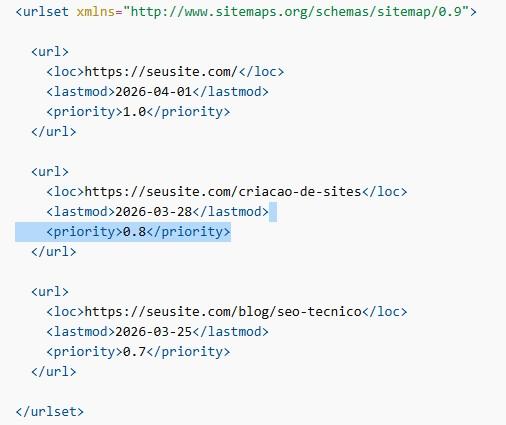
The XML sitemap is a file that lists all important pages of a website and facilitates the work of search mechanisms when tracking and indexing the content. It works as a map that guides Google robots about which pages exist on the site and which ones are more relevant. In many cases, content management systems automatically generate this file.
The Robots.txt file serves to guide robots on which areas of the site should be tracked or not. . It can block administrative pages, internal files or contents that do not need to appear in search results. Together, sitemap and robots help optimise tracking, ensuring that search engines prioritize pages that really matter to SEO.
8. Schema Markup
The Schema Markup is a form of structured data added to the site code to help search engines better understand the content of a page. These markings inform Google of the type of information present, such as product, article, event, revenue, evaluation or company, making interpretation of content more accurate.
When implemented correctly, Schema can generate Rich Results, enriched results that display extra elements on the search page such as reviews, prices, images or event dates. These results tend to attract more user attention and increase CTR (click rate), improving the site's organic performance.
How do these technical decisions impact SEO?
Technical decisions taken during the development of a performance-oriented website directly influence their ability to appear in search results. . Even if the content is good, structural problems can prevent Google from correctly tracking, understanding or indexing pages. Therefore, every technical detail can affect visibility, traffic and conversions.
Consider some common impacts when these decisions are not well planned:
- Damaged ranking: poorly structured or slow pages tend to lose positions in Google results;
- Difficulty tracking: sitemap problems, robots.txt or URL structure may prevent GoogleBot from finding important pages;
- Incomplete index: content rendered only via JavaScript may not be interpreted correctly by search engines;
- Bad mobile experience: non-responsive websites generate low usability and can be penalized in rankings mobile-first;
- Increased rejection rate: slow or confusing pages make the user quickly leave the site;
- Loss of authority between pages: no canonical tags can divide relevance between duplicate URLs;
- Low click rate (CTR): lack of structured data prevents the site from appearing with rich snippets in search results;
- Content misinterpreted by search engines: incorrect use of header tags may hinder the understanding of the content structure;
- Crawl budget waste: robots can spend time tracking pages that are little relevant instead of prioritizing strategic pages;
- Lower organic traffic potential: accumulated technical errors reduce site visibility and limit traffic growth.
Guide to technical optimisation in site development: techniques in website development
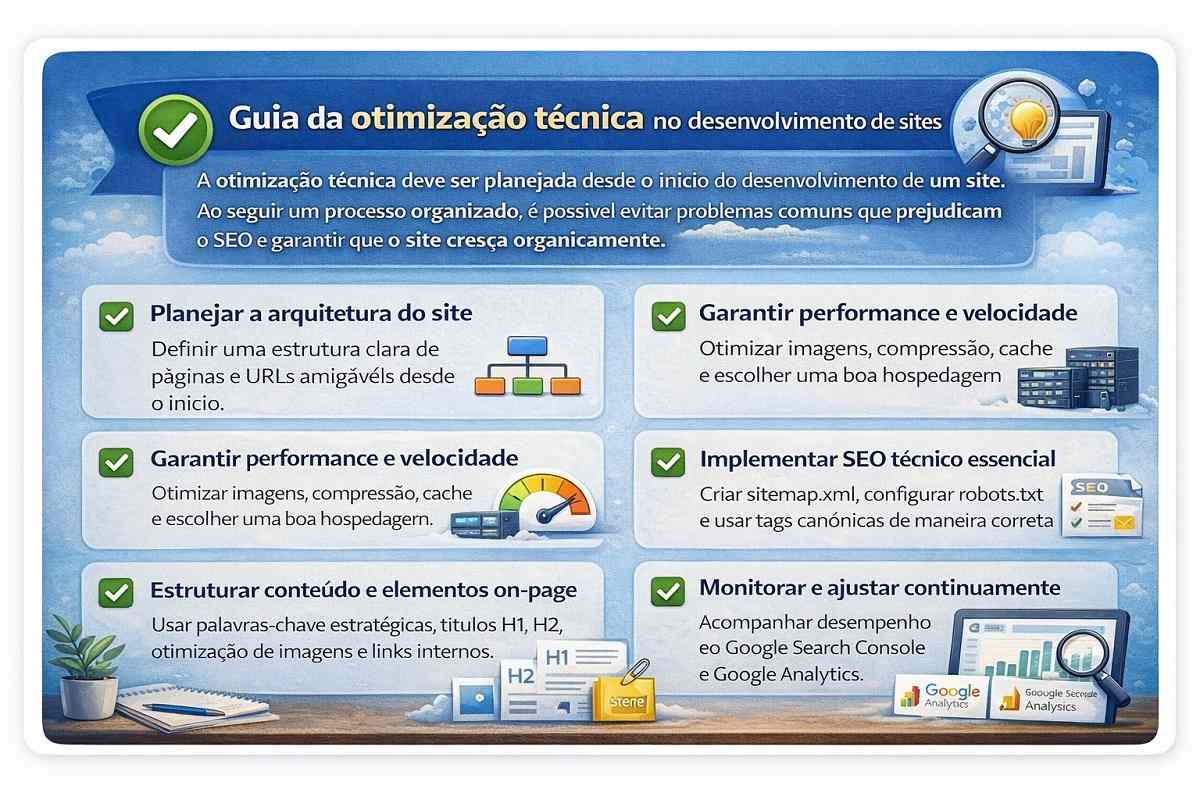
Technical optimisation should be planned from the start of a website development. This ensures that the structure is prepared for tracking, indexing and good performance in search engines. By following an organized process, it is possible to avoid common problems that harm SEO and ensure that the site is designed to grow organically.
1. Planning the site architecture
The first step is set the architecture of the site, organizing pages, categories and subcategories logically. A good architecture facilitates user navigation and helps search engines understand how content is related. This planning also involves defining friendly URLs and a clear hierarchy between main and secondary pages.
2. Ensure performance and speed
The loading speed shall be a technical priority during development. This includes image optimisation, file compression, cache usage and choice of a good hosting infrastructure. A fast site improves user experience, reduces rejection rate and contributes directly to better search results positions.
3. Implement essential technical SEO
At this stage, they are applied key settings for search engines to track and index the site correctly. . This includes creating XML sitemap, setting up the robot.txt file, implementing canonical tags and correct structure of header tags. These elements help Google to better understand the content and organization of the site.
4. Structure content and on-page elements
After the technical base, it's important correctly structure the contents of pages. . This involves defining strategic keywords, organizing titles with H1, H2 and H3, optimizing images and working internal linkage. This organization improves readability for the user and facilitates interpretation of content by search engines.
5. Monitor and adjust continuously
Technical SEO does not end when the site is launched. Momnitorize performance, tracking errors and user behavior is essential to keep the site competitive. Tools like Google Search Console and Google Analytics help identify necessary improvements and track organic traffic growth.
In addition to Search Console and Analytics, websites that also want to follow preparation for generative search can use the WebSyd AIScore as a complementary diagnosis of technical signs and citations observed in AI responses.
SEO starts in the structure of the site
Technical decisions made during development have a direct impact on the organic performance of a website. When the structure is planned correctly from the start, the project gains solid foundation to grow in search engines and attract qualified traffic.
Also read about how to do the site development focused on SEO since the beginning of the project.
If you want to invest in creation of professional websites prepared for SEO, a WebSyd offers specialised consulting and development of websites optimised for performance, visibility and real results. Talk to our experts and find out how to turn your website into a strategic asset for your business.
You want a website that manages contacts? Get a quote.

FREQUENTLY ASKED QUESTIONS
Does technical SEO replace quality content?
Nope. Technical SEO and strategic content work together. The technical part ensures that the site can be tracked, indexed and understood by search engines, while the content responds to user doubts and generates relevance. A website may have great technical structure, but without relevant content it will hardly be good positioning on Google.
Can a site lose positions on Google due to technical problems?
Yeah. Problems such as slow pages, tracking errors, broken links or duplicate content may impair organic performance. Google algorithms constantly evaluate the technical quality of the site and user experience. When failures are identified, positioning can be impacted.
Is it possible to fix technical SEO problems after the site is already ready?
Yes, many problems can be fixed after the launch of the site. However, making adjustments later is usually more laborious and in some cases requires important structural changes. Therefore, the ideal is to consider technical SEO from the development phase.
What's the difference between technical SEO and content SEO?
Technical SEO is related to site infrastructure, such as speed, security, URL structure, indexing and tracking. Content SEO involves keyword research, production of relevant texts and organization of pages to respond to user search intentions.
Does a small site also need technical SEO?
Yeah. Even small or institutional sites need a suitable technical structure for search engines to be able to track and index their pages correctly. In addition, a good technical basis facilitates future strategies for organic content and growth.
How often is it necessary to review technical SEO?
The ideal is to review periodically, especially after site updates or changes in structure. Regular technical audits help identify problems that may arise over time, such as broken pages, incorrect redirections or indexing failures.
Are free tools enough to monitor technical SEO?
Free tools like Google Search Console, PageSpeed Insights and Google Analytics already offer valuable information on performance and tracking. However, more advanced tools can bring deeper analysis and facilitate complete technical audits.
Yeah. Many technical factors that impact SEO also directly influence user experience, such as loading speed, intuitive navigation and mobile compatibility. A well optimised website technically tends to offer a more enjoyable and efficient experience.

Caio Nogueira is a SEO, GEO, link building and Digital PR expert and co-founder of WebSyd, website creation agency and SEO consulting founded in 2016. It acts with organic search strategies, digital authority construction and brand optimisation for search engines and artificial intelligence platforms. Throughout his trajectory, he participated in more than 1000 projects involving SEO, website development, content marketing and authority acquisition through backlinks and Digital PR. At WebSyd, it participates in the planning of strategies to increase organic visibility, lead generation and presence of companies on Google and AI-based search engines. As an author, it publishes content on SEO, GEO, website creation, link building and digital authority, sharing analyses, strategies and practical experiences related to organic growth of companies. Its contents and contributions have also been published in companies and vehicles of technology and marketing such as Wix, HostGator, Duda, Neil Patel, Locaweb and E-Commerce Brasil.
View all posts


 Estimate the cost

