
The 5 Best ERPS to Boost your company’s efficiency and competitiveness
Summary (TL;DR)
Our text addresses the importance of Business Resource Planning (ERP) systems for growth and operational efficiency of companies.
ERP is an integrated tool that centralizes business data and processes, facilitating the management of essential functions such as finance, human resources, production, among others.
By providing a holistic view of operations, ERP allows for more strategic decision-making and more efficient communication between departments.
The text also highlights the importance of carefully choosing an ERP, considering aspects such as data security, improvements in decision-making, process visibility, business scalability and operational efficiency optimisation.
The five best ERPs on the market are presented, each with specific characteristics that meet different business needs, from retail industries.
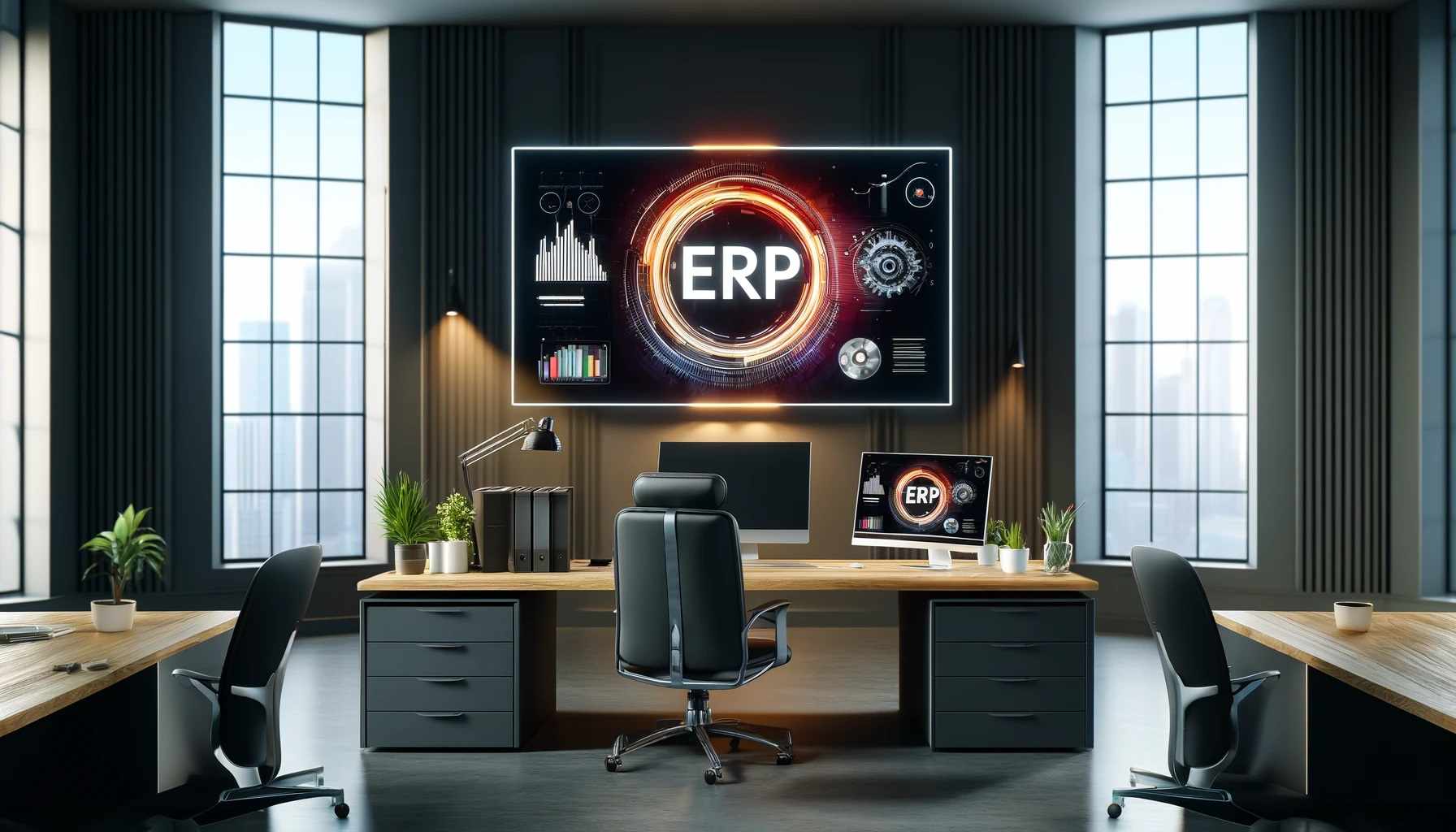
ERP is the system that brings together finance, stock, purchases, sales, production and HR in one place. Below are five known ERPs in Brazil, with the company profile of each one, and criteria to choose from.
Below, you provide the main ERP solutions in the market, which offer various features to boost your productivity and profitability: from a more efficient stock to accounting automation, covering all sectors of a company.
Don't stay behind, because ERPs are no longer the difference in managing a company. They're the basics. Find out now the best ERPs and take your company to the next maturity level:
What does ERP stand for? What's it for?
An ERP, or Enterprise Resource Planning, is a system designed to integrate and centralize business data and processes into a single platform.
It allows a company to manage and automate various functions such as finance, accounting, human resources, supply chain, production, sales and more.
Through the integration of different departments and processes, an ERP provides a holistic view of business operations, facilitating strategic decision-making and improving operational efficiency. It is a powerful tool designed to integrate and centralize data from all sectors of your organization.
Imagine having human, financial, marketing, logistics and legal resources connected and with up-to-date data in real time.
With an ERP system, this vision becomes reality. It functions as the central brain of your company, receiving, storing and distributing data as needed, which facilitates informed decision-making and speeds up processes at all levels.
In this way, ERP not only increases operational efficiency, but also promotes more fluid communication between different departments, allowing your company to adapt quickly to market changes and stand out from competition.
If the company depends on loose spreadsheets and rework between sectors, it is worth evaluating an ERP.
What are the advantages of using an ERP?

The advantages of using an ERP are diverse and have a high impact on the success and operational efficiency of a company. Check out some of the main benefits:
Advanced Data Security: With the use of an ERP, company data is stored securely in the cloud, protected by various layers of security. This significantly reduces the risks of data loss due to human errors, software or hardware failures, and cyber attacks.
Improvement in Decision-making: The agility in data collection provided by the ERP allows for a more informed and accurate decision-making. With access to a reliable and real-time database, managers can make strategic decisions more effectively based on accurate and up-to-date information.
Greater Process Visibility and Control: By integrating data from the entire production process in real time, the manager gains complete visibility of the company's operations. Thus, it is possible to quickly identify failures, non-compliance with deadlines, failure to achieve goals and other problems, facilitating the implementation of solutions and continuous improvement of processes.
Business scalability: With a better understanding of the business itself and more efficient decision making, operational costs and risks can be reduced. This facilitates business expansion and scalability for new levels, such as hiring new employees, skills training and even opening up new units or expanding to new markets.
Optimization of Operational Efficiency: By integrating and automating processes across the company, an ERP optimizes operational efficiency as a whole. This results in a reduction of costs, an improvement in employee productivity and a better use of the company's resources, positively impacting financial returns such as better sales conversion rates and elimination of logistics gaps.
In short, the use of an ERP not only improves the safety and efficiency of business processes, but also enables the company to make more strategic decisions and expand its growth horizons in a sustainable way.
The 5 Best Market ERPs Available
Explore the five best ERPs available on the market today and find out how these powerful solutions can transform your company's management and performance:
1. Nomus
The Nomus ERP Industrial is a solution developed by production engineers for industries of all sizes and sectors. It's a great cost-benefit, according to customer interviews, and its features address all the departments of a factory.
Engineering, production and purchases, financial, stock control, romance etc., all become integrated and the control can be made via cloud or offline. The system has a friendly and intuitive interface, reducing the adaptation time and also offering training that facilitates the use by employees of your factory at different levels.
2. Oracle Fusion Cloud ERP
The Oracle Fusion Cloud ERP runs in the cloud, receives periodic updates and includes artificial intelligence features. It's mostly used by medium and large companies with complex financial operations.
3. Linx
Recognized as a retail reference and developed by one of the largest technology companies in Latin America, Linx offers an integrated solution that unites several stores into a single network. By centralizing all information in a single system, Linx simplifies decision-making and improves business performance indices, allowing for more efficient and strategic management.
4. SAP
Recognized globally, SAP is a German technology designed to meet the various demands, regardless of size or sector of the company. Like Nomus, SAP allows the integration of all business processes into a single cloud platform.
With comprehensive features such as accounting closure, cost analysis, financial management, CRM, cash flow, HR and more, SAP offers a complete solution to boost efficiency and organizational performance.
5. TOTVS Protheus
The Protheus system provides data security by storing them in cloud, with regular updates, and also enables high mobility, being accessible on mobile devices.
For the team, this means consulting and updating data outside the office. Protheus is from TOTVS, a Brazilian company, and serves several segments.
How to choose the best ERP for my company?
Start with the needs of the company. Industries, for example, need production control, and many generic systems do not respond well to this part.
The usability of the system is another key point to consider. An intuitive and modern ERP facilitates deployment and reduces team resistance by using the tool in all sectors of your company. Therefore, it is also essential to check the quality of support and whether the people who serve you and your team are able to speak in your language.
Finally, request a demonstration of the running ERP if the supplier submits this option. It is a way of understanding whether the system is intuitive, as well as if it delivers what your company needs in terms of functionality.
Some systems are super specialised in certain sectors of the market. With the demonstration, you check if the software was developed thinking about your company Or if they're going down a completely different path. It is also appropriate to ask for a roadmap to check if the development in progress really relates to your company.
Integration of ERP with your website: why is it important?
Integrate ERP with site avoids entering the same data twice and leaves stock, price and consistent orders between store and management.
By connecting the business management system with the company's website, inventory information, prices and availability of products can be updated in real time, providing customers with an accurate and up-to-date view of the products and services offered.
In addition, integration allows efficient automation of sales and customer service processes, simplifying order management, payments and shipments, which results in a more agile and satisfying experience for the customer.
Along with the fact that integrating ERP and website facilitates data analysis and monitoring of business performance. With all data centralized in a single system, managers can easily access crucial information about sales, inventory, customers and finances, allowing for more informed and strategic decision making.
In practice, integration depends on the website platform and the ERP having an API or a ready connector. In online stores, the most common points are stock, price, orders and issue of invoices. We explain the gains in why integrate e-commerce into an ERP system. . If the store is yet to be created, please confirm first that the chosen platform has integration with the company's ERP. See how it works online store development WebSyd.
Which ERP to choose?
For industry, Nomus specializes in the sector; for retail with various stores, Linx; for medium and large companies, SAP, Oracle and TOTVS Protheus. Ask for demonstration of at least two and compare cost of deployment, support in Portuguese and integration with the site.
FREQUENTLY ASKED QUESTIONS
What's an ERP and what's it for?
ERP (Enterprise Resource Planning) is a software that integrates all processes and systems of a company into a single platform. Its main function is to centralize information and automate business functions such as finance, accounting, human resources, supply chain, production and sales, facilitating holistic management of operations and improving operational efficiency.
What are the main advantages of implementing an ERP in a company?
The implementation of an ERP brings several advantages, such as centralization and data protection, which minimize the risks of loss or theft. In addition, real-time data acquisition improves decision making, while integration and monitoring of all business processes increase transparency and allow proactive corrections. ERP also adapts to company growth and automates tasks, saving time and costs while increasing productivity.
How to choose the right ERP for my company?
Choosing the right ERP involves understanding your company's specific requirements and industry, checking if the system is intuitive and easy to use, ensuring that the system can grow and adapt with your company, and investigating the technical support and training opportunities available. It is also recommended to test the system before purchase through demonstrations or proofs of concept to ensure that it meets your expectations.
Cloud or local ERP: which is the best option?
The choice between a cloud or local ERP depends on the company's specific needs. A cloud ERP provides flexibility, scalability and less need for IT infrastructure maintenance, ideal for companies that value remote accessibility and have initial investment limitations. A local ERP, on the other hand, provides full control over data and allows deeper customizations, suitable for companies that need extreme customisation or have strict requirements for data compliance.

Lucas Pelisari has specialised in SEO and content at WebSyd for more than 6 years, working on the creation and optimisation of digital strategies focused on lead generation and organic growth. With experience in website development projects, SEO on-page and link building, he works directly on structuring content and pages aimed at positioning on Google and acquiring qualified traffic. Throughout his work, he has participated in projects for companies such as Kommo, Aldanth, Physical Care, In4, Design.com, Adaptive, Clipto and Yesim, as well as several other clients attended by WebSyd. Its contents address topics such as creating professional sites, SEO, page structure, performance, user experience and digital growth strategies, always with a practical approach based on real market scenarios.
View all posts
 Estimate the cost

